Tegucigalpa, Honduras -- The Honduran Constitution is just 28-years-old, but according to many Honduran citizens, it's already out of date. The current version of the national charter was composed under the close watch of the ruthless military dictator Policarpo Paz Garcia, who -- backed by the U.S. military and CIA -- conducted a bloody reign of terror against the Honduran people. In 1982, as the national charter was being written, government-sponsored, paramilitary units were roaming the country to suppress all forms of political "dissidence."
Under Garcia, the paramilitary squads were responsible for the torture, kidnapping, and assassination of hundreds of teachers, union leaders, and progressive activists. Experts say the extreme political repression precluded the construction of a participatory constitution - and that problem doesn't seem to have gone away.
"We don't have a democratic process in this country. We have a military process ... We have a very powerful oligarchy that is ruling the country with the army," says internationally renowned human rights expert Dr. Juan Almendares, during an interview. Almendares - who has directed research programs at Harvard and the University of Pennsylvania, and won awards from Oxfam and the Barbara Chester Foundation - also runs a free clinic in the Honduran capital.
Honduras, says Almendares, is now poised on the brink of the first meaningful constitutional reforms in this troubled country's history. Across the land, thousands of Honduran citizens are signing their names to petitions demanding a Constitutional Assembly - and a series of massive, nation-wide demonstrations are planned for June 28, including a peaceful march on the national Congress building in the capital of Tegucigalpa, to present the petitions and demand a national referendum on the issue.
The date of June 28, says Almendares, was chosen because it will mark the one-year anniversary of the military-backed coup that toppled democratically-elected president Manuel Zelaya. Zelaya, who currently lives in exile in the Dominican Republic, had attempted to hold a similar, nonbinding referendum on changing the Constitution the same morning he was ousted.
"The Honduran people want to change the essence of the Constitution, and they've wanted this for a long time," says Almendares, who is also a central figure in the powerful but pacifist National Front of the Popular Resistance (FNRP), which arose in response to the military-backed coup, and the martial law and repression that followed. "We want a state separated from the church. We want freedom of the people. We want people's power," Almendares says.
But as the movement for a more participatory constitution gains momentum in Honduras, the Resistance's leadership is suffering a mysterious wave of assassinations. Many International human rights analysts now believe that that the politically-motivated death squads which plagued Honduras in the 1980s have made a comeback.
"The situation of repression - violations of political and civil rights - is very bad," says Grahame Russell, co-director of the U.S.-based Rights Action, which maintains a team of international observers in Honduras. "The [Lobo] regime [has] implemented a policy of state repression - including the activation of paramilitary death squad groups, to threaten, intimidate, terrorize and kill member of the pro-democracy, anti-coup movement."
"We are living in a state of terror," agrees Dr. Juan Almendares. "There is no security in the country. . . We are in a terrible economic, moral and political crisis."
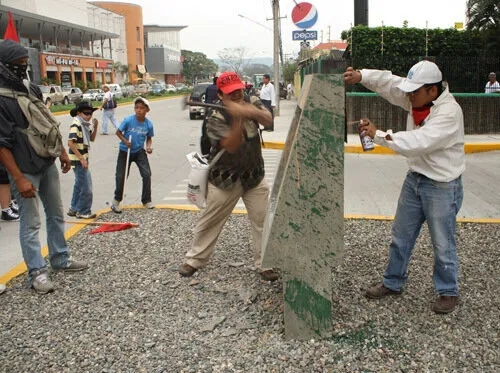
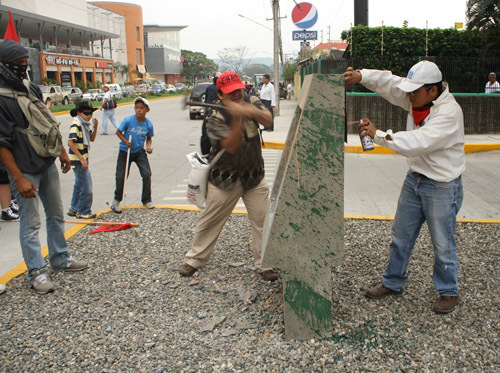 A demonstrator hammers away at a plaque honoring "Congressman-for-life" and coup-installed "interim president" Roberto Micheletti in San Pedro Sula, on February 27, 2010.
Casualties of the Crisis
According to human rights groups in Honduras, there have been 48 documented assassinations of Resistance members since the putsch last summer, with 15 coming since the inauguration of much-disputed President Porfirio "Pepe" Lobo, on January 28. Fifty-one percent of the Honduran electorate boycotted the presidential elections that thrust Lobo into power, and regional heavyweights like Brazil and Argentina still refuse to recognize his administration as legitimate, in part because of the militarized elections, as well as the human rights abuses that have occurred under his watch.
Those abuses have become so flagrant and troubling that even some in Washington have taken notice. Congresswoman Jan Schakowsky (D-IL) recently journeyed to Honduras on a fact-finding trip:
"I met with numerous men, women and children - as well as with activist groups - who had suffered serious unconscionable abuses," Representative Schakowsky wrote in an e-mail.
"I met with the father of Isis Obed Murillo, who was killed by the military at the airport on July 5th," Schakowsky wrote. "I met with the parents of activists who had fled the country after being harassed by officials. I heard many stories from the people there about arbitrary detentions and about the erosion of security for vulnerable communities."
Schakowsky was so concerned by what she'd seen in Honduras that in March she sent a letter, co-signed by several other high-ranking Representatives, to the U.S. State Department, urging Secretary of State Clinton to take action. But so far, the State Department remains on friendly terms with Lobo. President Obama even went so far as to congratulate Lobo - a wealthy rancher turned politician - for "restoring democratic and constitutional order in Honduras" during a recent phone conversation.
None of this sits well with Representative Schakowsky.
"I was - and still am - very concerned by persistent reports of serious human rights violations in Honduras. There are still allegations that activists and opposition leaders are being targeted for harassment and abuse."
According to Dr. Almendares, the best way to end that cycle of abuse is to allow the people to vote on the issue of a Constitutional Assembly. "We want to have true democracy. It can not be democracy with torture, when the military and those violate human rights have impunity. We don't want that. That's not democracy. That's a false democracy."
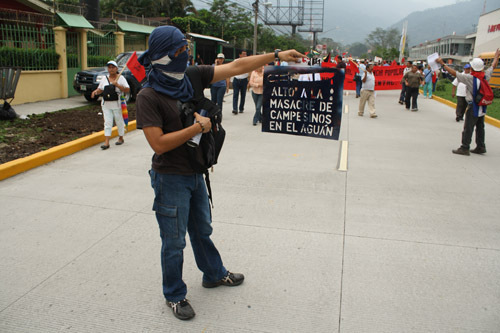 During a march on February 27, 2010 in San Pedro Sula, a youthful, pro-democracy demonstrator -- masked due to fear of government reprisal -- holds a stencil which reads: "Stop the massacre of the peasants in Aguan."
Journalists Targeted
It isn't just "activists and opposition leaders" who are being killed mysteriously. Seven journalists were gunned-down in Honduras in six weeks during March and April, prompting international watchdog groups to label Honduras the most dangerous country in the world for journalists. So far, the Honduran authorities have made little effort to investigate these killings.
"We need to get more information on these crimes," says Carlos Lauria, America's Program Senior Coordinator for The Committee to Protect Journalists (CPJ), in a cell-phone interview. Lauria said CPJ was already planning to send in a team of investigators to look into the journalist killings, since state and local police have so far seemed powerless. "The state is almost absent. There hasn't been any progress made in any of these cases. It's clear that they need to investigate these threats and prosecute those responsible, but they have not been able to. And that is worrisome," Lauria says.
But Honduras Secretary of Security, Oscar Alvarez, denies that the journalists were killed for professional reasons, instead citing "random violence."
According to Alvarez, "the things that happened to them [happened] when they were not doing journalism. It was not related to their work."
Secretary Alvarez - who was a former officer in the Honduran military, and studied at Texas A&M, Ft. Benning, and the Special Forces School at Fort Bragg - said that for the year 2009, there were 117 kidnappings and 6,000 murders in this impoverished textile and coffee exporter.
"We're hoping to do better next year," Alvarez said. But most experts are predicting those numbers to get worse, not better, in 2010.
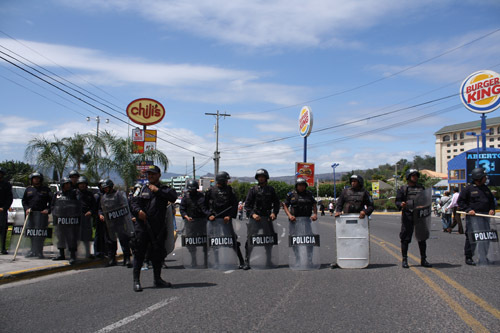 Honduran police officers barricade the street to block off a peaceful, pro-democracy protest march in the capital of Tegucigalpa, on February 25, 2010.
Death Squads Rise Again?
Despite the high level of street crime in Honduras, Carlos Lauria of CPJ, does not believe the seven journalists were killed at random.
"How can [the Honduran authorities] say it was random violence when they are not investigating and have nothing on any of these cases? That's just irresponsible. Freedom of expression is a Constitutional right. They have the obligation as a state to provide safety guarantees for all Honduran journalists to go to work without fear of reprisal."
Grahame Russell, of Rights Action, is equally critical of the authorities excuses.
"That the Honduran regime speaks so derisively and cynically about grave human rights violations - including assassinations, illegal detentions, torture - simply demonstrates the degree of impunity with which this regime operates."
Secretary of Security Alvarez admits that death squads were once a political tool in Honduras, but he says those days are over. "I can guarantee you that from our side of the government, we don't promote it, we don't have it, we won't do it."
Alvarez also questions the professionalism of the seven dead journalists.
"Only one of them was certified with the association of journalists in Honduras," he says. "The law says that you have to certify yourself with the association of reporters of Honduras. You have requirements. Go to school. Go to university. And get a degree in journalism . . . Just walking around with a recorder, or having a TV program isn't enough."
But Lauria, of CPJ, strongly disagrees.
"Hondurans should be able to exercise journalism whether they hold a journalism degree or not. A press licensing regime compromises freedom of expression by allowing a limited group to determine who can exercise this universal right and who can't."
Lauria also points out that in 1985, the Costa Rica based Inter-American Court of Human Rights ruled that laws requiring the mandatory licensing of journalists violate the American Convention on Human Rights.
Lauria, who has spent almost a decade investigating violence against the press in Latin America, says he believes a pattern has emerged in Honduras.
"There seem to be hired hit men involved. The way some of these murders were conducted - journalists driving and a car or van pulled alongside. Gunmen firing from a vehicle. [This] seems to be the work of professional[s]."
State Fails to Provide Security
Secretary Alvarez acknowledges that the Honduran police force is overwhelmed by crime - as well as crippled internally by corruption and a lack of funds; Lobo's government declared bankruptcy in February.
"We have very low levels of education [among policemen]. We need training . . . We have very poor investigations for crime scenes and all that." Minimum wage in Honduras is about five U.S. dollars per day - but according to Alvarez, many police officers don't even make that much.
But CPJ's Lauria believes the problems run deeper than just incompetence and corruption. He cites the case of murdered journalist Nahum Palacios as proof that at least one of the journalists was assassinated for political reasons. Palacios - who was killed in drive-by fashion on March 14 - had been covering a recent stand-off over land rights between peasants and soldiers in the Aguan region near the Caribbean coast. "[Palacios] was someone who was critical of the interim government, and was harassed and intimidated by military officers. The inter-American Commission of Human Rights suggested that the state provide precautionary measures," Lauria says. "But the state failed to provide precautionary measures, and he was killed."
According to Congresswoman Schakowsky, the death of these journalists could have grave implications for the political future of Honduras.
"Not only are there serious human rights violations going on in Honduras, but the intimidation of the media also poses a threat to the country's long-term stability," writes Schakowsky. "A free press is an absolutely critical component of democratic order and it must be restored to protect the rights and humanity of the Honduran people."
U.S. Complicit in Ongoing Human Rights Abuses?
The U.S. is the largest trading partner for Honduras, and remittances from both legal and illegal immigrants residing in the U.S. are a mainstay of the Honduran economy. But Honduras also has great strategic value for U.S. foreign policy in the region.
"For over fifty years, Honduras has been the United States' most secure puppet in Central America - used to launch invasions of Guatemala in 1954 and Nicaragua during the 1980s," says University of Santa Cruz History Professor Dr. Dana Frank, who last visited Honduras in March. "The U.S. Air Force base at Palmerola has enormous strategic importance for U.S. domination of Latin America." Frank says the importance of maintaining regional control has led the Obama administration to back, "the repressive ongoing military occupation of Honduras."
And that occupation has brought severe economic consequences.
"The wealthy elites in Honduras . . . consolidated, or re-consolidated their interests and power with the coup and the ensuing repression, undermining of democracy and the rule of law," says Rights Action Coordinator Russell. "They carried out the coup as a preemptive strike against a government that was beginning to design and implement much needed, pro-poor policies."
Mark Weisbrot, Co-Director of the Washington-based Center for Economic and Policy Research (CEPR), agrees that economic motives played a big role in the coup and subsequent oppression. But, like Dr. Frank, he also believes the airbase at Palmerola to be of vital importance to the Obama administration.
"They saw some risk of losing [their] biggest base in the region," Weisbrot says. "They saw that there was a significant chance that if Zelaya and the movements that were backing him were to succeed in getting a Constituent Assembly and a new constitution [that] might prohibit a foreign military [presence]. So to them it's not even worth taking that that chance. They don't care that much about democracy or human rights - the military base is much more important. . . . The White House did everything possible to help the coup succeed without providing direct support, which wasn't politically feasible."
Weisbrot firmly believes that the U.S.'s role in Honduras is contributing directly to the human rights violations and oppression taking place there.
[The Obama administration] stopped the Organization of American States from taking stronger action after the coup. . . . They've tried to prevent [the Lobo administration] from paying any political cost, either internationally or domestically, for killing people. In fact, I think, in some sense, this administration's legacy in Central America is similar to Regan's, in that they're bringing death-squad governments back."
But Representative Schakowsky, who is also a member of the Human Rights Commission in Congress, says she'll continue to push for a change in U.S. policy.
"I think that as a country we can play a critical role in shining a bright light on serious abuses such as these," writes Schakowsky, who would like the State Department to "make it clear to the government in Honduras that there will be consequences for further disregard of fundamental human rights."
Power to the People
Despite the close economic and military ties between the two nations, many Hondurans don't feel they need to look to Obama or Secretary Clinton to solve their political problems. Dr. Almendares says there is a concrete relation between improving democracy and resolving civil rights abuses.
"This oligarchy wants only money for themselves. They don't want to share anything. They don't care anything about injustice or poverty. They don't contribute to the development of the country," says Almendares, who adds that the current Constitution, "keeps all the power in the hands of the wealthy," and that many of those ruling financial elites are also potent political players.
"The people don't want these kinds of representatives in the Congress," says Almendares. "They want indigenous people. They want women [and] intellectuals [and] workers, they want honest business people in Congress. Not these parasites."
In fact, Honduras has had a total of four different constitutions - but the previous incarnations of the national charter were all authored behind closed doors, or by assemblies that had been hand-picked by ruling juntas.
"All of the [previous Constitutional] Assemblies were arrangements between the ruling political parties, that favored the oligarchy's interests," says Gilda Batista, founder of Refuge without Limits (ASL), a human rights research center in Tegucigalpa. "For the first time, the people of Honduras are requesting the Assembly; now it's the [our] turn to make a fair request."
Surprisingly, the controversial Lobo administration has professed support for holding a Constitutional Assembly - despite the fact that former president Zelaya was kidnapped by soldiers and flown out of the country in his pajamas last year for trying the same thing.
"The president said that we have a democracy and people can express themselves," says Secretary Alvarez, who also served as Security Chief from 2002-2005. "And I think if there's enough popular support, signatures and momentum then [Congress] will consider it."
But many observers are concerned about President Lobo's motives in backing the referendum - especially since he also backed the coup against the former president.
"We in the Resistance are worried about Mr. Lobo's professed support for the Constituent Assembly because he has betrayed the social movements in the past," said ASL founder Batista. "Back in the 70's and 80's Lobo was a leftist and later he switched ideologies . . . He is not a person [we] can trust."
"Why is changing the Constitution going to make a difference?"
Honduras Security Secretary Alvarez says he's skeptical of the Resistance movement's claim that a Constitutional Assembly would result in substantive political changes. "They would like to believe that changing the Constitution is a panacea. Why is changing the Constitution going to make the difference? We have freedom for everybody. We have elections every four years. What else [do they want]?"
Yet even some experts in the international human rights community believe that a Constitutional Referendum might be a good way forward. "It is viable. It is peaceful; it is public; it is democratic; it is participatory," says Rights Action Coordinator Russell. "Whether it improves human rights and environmental issues is in the hands of the powers that be, who don't want this widespread empowerment, who don't want serious reforms." Russell also says he expects, "a constant level of state repression and terrorization, before, during and after [the referendum]... to try and minimize the popular participation."
Even without active opposition from the Lobo administration, the Resistance faces an uphill battle. Under Honduran law, in order to demand a plebiscite, the Resistance will need to provide signed petitions from at least six percent of the Honduran electorate, or about 250,000 voters. But that's just the first step - during the actual referendum, at least 51 percent of the Honduran electorate must "yes" vote in favor of the Assembly - something that has never happened before in any ballot vote in the country's history.
But the Resistance Front - which is comprised of a broad base of Honduran society, including teachers, students, environmental organizations, labor unions, and indigenous groups - isn't backing down.
"We'll get it done," says human rights investigator Batista. "We have to. The future of our nation depends on it."
Dr. Almendares, too, believes his country's future is at stake.
"We don't want our people to leave for the U.S. We want them to stay here. But there simply are no possibilities for them here." Almendares also cites the U.S. founding fathers as an inspiration for the current push for constitutional freedom and equality in Honduras.
"So many of our heroes - and also your heroes - have dreamt of having a true democracy," he says. "That is what we're struggling for."