Climate Week 2009, as celebrated in New York at the UN, failed to produce a much needed breakthrough in negotiations leading up to COP15 in Copenhagen this December where the successor to the Kyoto Protocols will be finalized. The meeting of world leaders in New York did not result in any significant forward movement on international agreements to reduce greenhouse gas (GHG) emissions which are driving global warming. President Obama continues to proclaim the urgency of addressing anthropogenic climate change while offering no specific goals, targets, or policies to reduce carbon emissions. His administration is sending signals that there will be no consensus agreement in Copenhagen, placing the blame on the US Congress which has yet to pass any legislation to regulate GHG emissions. In light of the new United Nations Climate Change Science Compendium Report 2009 (UNEP) 2009, it is imperative that a consensus treaty be reached in Copenhagen.
The UNEP report confirms what many of the world's leading climate scientists have been saying with ever increasing urgency; climate shift mechanisms are accelerating at a far faster rate than anticipated just two years ago. We are witnessing the rapid deterioration of the earth's biosphere and a global temperature increase of 6.3 degrees this century is now likely, unless aggressive action is taken immediately. The consequences for life on this planet will be devastating. A maximum rise of 2 degrees is generally accepted as the limit before catastrophic climate change is certain.
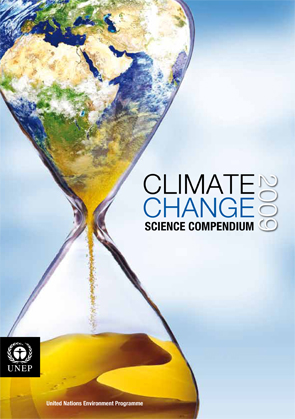
The scientific evidence is incontrovertible; the life support systems which have created a stable global biosphere now signal a cascading collapse, caused by GHGs and other human activity. The sixth great extinction is gathering momentum and it would seem human political systems are incapable of action which could prevent the worst case scenarios from happening.
The UNEP 2009 report indicates that climate tipping points, which will result in irreversible accelerating changes to the planetary ecosystem, have already been been reached and possibly surpassed.
The range of 1.4 to 4.3 degrees Celsius in the committed warming
overlaps and surpasses the currently perceived threshold range of 1-3
degrees Celsius for dangerous anthropogenic interference with many of
the climate-tipping elements such as the summer Arctic sea ice, Himalayan
glaciers, and the Greenland Ice Sheet.
Researchers suggest that 0.6 degrees Celsius of the warming we committed
to before 2005 has been realized so far. Most of the rest of the
1.6 degrees Celsius total we have committed to will develop in the next
50 years and on through the 21st century. The accompanying sea-level
rise can continue for more than several centuries. Lastly, even the most
aggressive CO2 mitigation steps as envisioned now can only limit further
additions to the committed warming, but not reduce the already committed
GHGs warming of 2.4 degrees Celsius (Ramanathan and Feng, 2008).
Continuing carbon dioxide emissions in the future means further irreversible effects on the planet, with attendant long legacies for choices made by contemporary
society (Ramanathan and Feng 2008).
We have already committed our civilization to considerable deficits in how Earth
Systems respond. These dangers pose substantial challenges to humanity
and nature, with a magnitude that is directly linked to the management
practices we choose to retreat from further tipping points and irreversible
changes from GHG emissions (Lenton et al. 2008, Solomon et al. 2009).
COP15 may very well be the last chance for the world to reach a consensus on measures to reduce GHG emissions and avoid climate chaos for the next millennium. Bill McKibben whose organization 350.org is advocating for the reduction of CO2 concentration levels in the Earth's atmosphere to a "safe level" of 350 Parts Per million (PPM) from present levels of 390PPM, said " The political system is not producing at the moment a result which has anything to do with what the science is telling us."
One of the world's foremost climate scientists James Hansen (who first sounded the alarm on climate change 20+ years ago) said, "Those who lead us have no excuse -- they are elected to guide, to protect the public and its best interests. Only in the past few years did the science crystallize, revealing the urgency. Our planet is in peril. If we do not change course, we'll hand our children a situation that is out of their control. One ecological collapse will lead to another, in amplifying feedbacks."
It is abundantly clear that the world's leaders must take action to reduce anthropogenic climate change while there remains some chance of averting all out ecolypse. The time for preventive measures has passed, it is now time for emergency action.
Follow Jerry Cope on Twitter: www.twitter.com/jercope
Bill McKibben: Organizing The Biggest Day Of Action The World Has Ever Seen
There are big climate actions organized for almost every city on earth on October 24th. If we can build this wave, we have a chance of making real, not token, change in the Senate, at Copenhagen, and beyond.
Mohamed Nasheed: Climate Change Requires a Real Movement
For the Maldives, climate change is no vague or distant irritation but a clear and present danger to our survival.
Betsy Taylor: On Climate Change: It's Not Time to Throw In the Towel
We must protect ourselves against the dark vision of rising seas and temperatures, but not by numbly going through the motions with our actions and alerts. The times call for more risk-taking.
Want to reply to a comment? Hint: Click "Reply" at the bottom of the comment; after being approved your comment will appear directly underneath the comment you replied to
According to this monumental report,....
(Deniers take note. There is a lot of denial you must do!)
"The science has become more irrevocable than ever: Climate change
is happening. The evidence is all around us. And unless we act, we will
see catastrophic consequences including rising sea-levels, droughts and
famine, and the loss of up to a third of the world’s plant and animal species."
http://www.unep.org/compendium2009/PDF/compendium2009.pdf
Deniers can read the kiddy version of the report!
"The scientific evidence is incontrovertible." Really? As mentioned by Andrew Revkin in the New York Times, and supported by satellite measurements, the earth's temperature has not increased over the past ten years. This stable temperature environment has occurred despite an increase in "human activities." Also, measurements of sea levels indicate a slight slowing in the very gradual long term trend in sea levels. The slowing of sea level rise implies that the oceans have stopped warming. Further, the Antarctic's sea ice extent is above the long term trend line, and the Antarctic contains most of the planet's ice. The Vostok Station near the south pole, has a website with the daily weather conditions. It is not uncommon for temperatures there to be in the -70 to -90 degree F range.
It appears from the most obvious scientific measurements: temperature, mean sea levels, dates that rivers freeze, and so on, that no unusual, rapidly accelerating climate change is occurring, despite the steady increase in man-made CO2 releases. No unusual melting, no sea level surge, no rise in temperatures.
It appears that the basic AGW idea, that increased CO2 leads to increased temperature, is simply not true, or hasn't been for the last ten years.
Actually even if deniers begin with the year 1998 and the hottest year on record by far until then, world temperatures have not been stable. Not even if you plot a straight line comparing 1999 to 2008, which were both La Nina years. And if you calculate the trend for the entire data set, it's clear warming has not stopped. But why would deniers want to start from the year 1998? . Because it was one of the hottest years on record and significantly hotter than the preceeding year. So, to them, it masks the warming since then. Of course, it is totally arbitrary to begin with the year 1998. If one started with the year 1995, 1996, or 1997 would would see significant warming in the last decade.
According to the UK's Hadley Center's Climate Research Unit
:
"Thirteen of the fourteen warmest years in the [temperature anomaly time] series have now occurred in the past fourteen years (1995-2008). The only year in the last fourteen not among the warmest fourteen is 1996 (replaced in the warm list by 1990). The period 2001-2008 (0.43°C above 1961-90 mean) is 0.19°C warmer than the 1991-2000 decade (0.24°C above 1961-90 mean)."
NASA GISS Global Annual Mean Surface Temperature Change data shows that 2001 was warmer than 1999-2000, that 2002 was warmer than 2001, that 2005 was warmer than 1998-2004, and that 2007 tied 1998? Heck even 2008 was warmer than 1999-2000.
Yes, the scientific evdence is incontroverable...
A NASA satellite has revealed more accurately than ever that polar ice in Antarctica and Greenland is melting from glaciers and ice sheets far faster than scientists had previously thought, a discovery that one UC Berkeley climate expert calls "ominous and distressing."
http://www.sfgate.com/cgi-bin/article.cgi?f=/c/a/2009/09/24/MNMM19R00D.DTL#ixzz0SjfJFDQH
"The world’s ocean surface temperature was the warmest for any August on record, and the warmest on record averaged for any June-August (Northern Hemisphere summer/Southern Hemisphere winter) season according to NOAA’s National Climatic Data Center in Asheville, N.C. The preliminary analysis is based on records dating back to 1880."
According to the National Snow and Ice Data Center (NSIDC), Arctic sea ice covered an average of 2.42 million square miles during August. This is 18.4 percent below the 1979-2000 average extent, and is generally consistent with a decline of August sea ice extent since 1979.
http://www.noaanews.noaa.gov/stories2009/20090916_globalstats.html
"UK Met Office: Catastrophic climate change, 13-18°F over most of U.S. and 27°F in the Arctic, could happen in 50 years, but “we do have time to stop it if we cut greenhouse gas emissions soon."
http://climateprogress.org/2009/09/28/uk-met-office-catastrophic-climate-change-could-happen-with-50-years/
Our love affair with the automobile has brought about remarkable new ways to sharply reduce the need for fossil fuel. Regardless of belief about climate change, almost everyone can agree on the economic benefits that make it important to move beyond oil, coal and I would add, nuclear power, as fast as possible.
Revolutionary new technology will make possible electric cars that need no recharge - as well as hybrid engines that might need to be fueled with only one gallon of water for each thousand miles of driving.
There are little known breakthroughs that promise to lead to cars and truck that need no fossil fuel or recharge. Later, more advanced versions can become power plants when parked, wirelessly selling electricity to the local utility. Such cars can pay for themselves over time. They also can replace coal burning plants.
The science is new, and will understandably be greeted with widespread disbelief and skepticism. However, independent laboratory validation of one extraordinary breakthrough has taken place at Rowan University. It produced more heat than can be explained by existing textbook knowledge, clearly suggesting a new source of energy is involved. The experiments can and should be repeated, without delay, at National laboratories and other universities.
The Rowan experiments began the process of proving that new technology can allow one barrel of water to replace 200 barrels of oil!
For additional information, see the article: 4 Steps to Revive the Auto industry and the Economy on the website: http://www.aesopinstitute.org
See Wade Norris's Profile
this is an urgent issue
thanks for posting
“The new green left (environmentalist) propaganda reminds me of the old red left (communist) propaganda. The dirty word is now carbon rather than capitalism. The game is simply to intrude and control everything. How much will the carbon tax be for each of us to breathe?”
It's way too late, the only hope is a vegan world. Let's hope it happens within the next couple of yrs.
The deniers are just like AGW, inevitable.
I am glad the deniers are not on the page. They all seem to flock to the same articles as if queued.
"The UNEP report confirms what many of the world's leading climate scientists have been saying with ever increasing urgency; climate shift mechanisms are accelerating at a far faster rate than anticipated just two years ago. We are witnessing the rapid deterioration of the earth's biosphere and a global temperature increase of 6.3 degrees this century is now likely, unless aggressive action is taken immediately."
We are witnessing the rapid acceleration of long range predictions of climate disaster, far faster than two years ago. Unless aggressive action is taken immediately, next year will see even more rapid acceleration of long range predictions of climate disaster.
Back in the real world, no such rapid acceleration is being detected in historical climate measurements.
Did you read the report becasue I sort of doubt it?
"The science has become more irrevocable than ever: Climate change
is happening. The evidence is all around us. And unless we act, we will
see catastrophic consequences including rising sea-levels, droughts and
famine, and the loss of up to a third of the world’s plant and animal species."
"The Arctic, with implications for the globe, is emerging as an area of major
concern. There is growing evidence that the ice there is melting far faster
than had been previously supposed. Mountains glaciers also appear to be
retreating faster. Scientists now suggest that the Arctic could be virtually
ice free in September of 2037 and that a nearly ice-free September by
2028 is well within the realms of possibility. Recent findings also show
that significant warming extends well beyond the Antarctic Peninsula to
cover most of West Antarctica, an area of warming much larger than
previously reported."
"Rising levels of aridity are also concentrating scientific minds. New
research indicates that by the end of the 21st century the Mediterranean
region will also experience much more severe increases in aridity
than previously estimated rendering the entire region, but particularly
the southern Mediterranean, even more vulnerable to water stress and
desertification."
http://www.unep.org/compendium2009/PDF/compendium2009.pdf
You must be logged in to comment. Log in or connect with