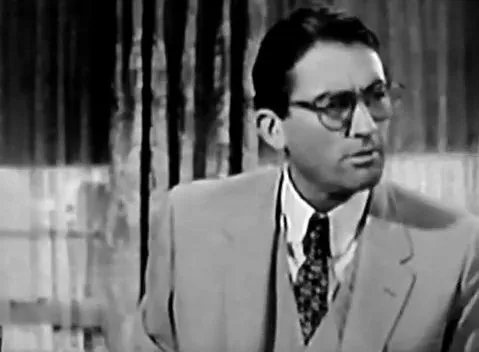
I never thought I'd see the day when the lawyer who argued Brown v. Topeka Board of Education before the Supreme Court and went on to be the first African-American to sit on that Court would have his career reduced to that most dreaded of all contemporary labels: "activist."
I never thought I'd see the day when you can legally carry concealed weapons into airports and bars.
I never thought I'd see the day when allegedly smart adults would tell me that America's poor were so powerful that, given the chance to own real estate, they bought so many houses they couldn't afford that they tanked the economy of almost every country in the world.
But then I never thought I'd see the day when "To Kill A Mockingbird" --- a novel that has inspired readers for half a century --- would be derided as a book about "the limitations of liberalism" (by Malcolm Gladwell, no less, in The New Yorker, of all places) and "a sugar-coated myth of Alabama's past" with a hero who's "a repository of cracker-barrel epigrams" (by Allen Barra, in the Wall Street Journal)
But as we approach July 11th --- the 50th anniversary of the publication of "To Kill a Mockingbird" (to buy the paperback from Amazon, click here; shamefully, there is no Kindle edition) --- it's probably not surprising that we're seeing one of America's best-loved books criticized for its "politics."
And it's definitely no surprise that the downgrading is done by men.
"To Kill a Mockingbird" is a woman's book.
Written by a woman, Harper Lee, but more, written by a woman who dared to see herself as her region's Jane Austen. Told by a six-year-old girl. With a hero who's not, in any traditional sense, manly. With a message of kindness and empathy generally associated with female values:
And one more female value, once common in the heroes of Western movies, but less and less common by the time Harper Lee wrote her novel --- a willingness to do the right thing, regardless of the consequences. Readers often forget, but this is the foundation of the character of Atticus Finch: He takes on the legal defense of an African-American, knowing he can't prevail in court.
"I wanted you to see what real courage is, instead of getting the idea that courage is a man with a gun in his hand," he tells his children. "It's when you know you're licked before you begin but you begin anyway and you see it through no matter what. You rarely win, but sometimes you do."
I'm not one for stereotyping, but how many men do you know who step up to confront unpleasantness and conflict? Here's Atticus: "Best way to clear the air is to have it all out in the open."
Atticus Finch is --- let's just say it --- a feminized man who appeared a decade before America started hearing about feminism. No wonder he appeals to English teachers, who tend to be idealists. And no wonder the film is a "family" favorite --- mother choose it in the hope it will make their kids kinder. (To buy the DVD from Amazon, click here.)
In the long clock of history, we stopped killing each other over resources only a moment ago. Since then, we make progress, we take a step backward --- civilization is a recent, fragile concept. But I take it as an unvarnished Good Thing that readers have persistently loved "To Kill a Mockingbird" for as long as it's been in print. I think it's just great that Mary Murphy has written a book about Harper Lee's book: "Scout, Atticus & Boo: A Celebration of 50 Years of 'To Kill a Mockingbird.'" (To buy the book of "Scout, Atticus & Boo," click here. To buy the Kindle edition, click here.)
And it pleases me no end that, in a year when men denigrate Thurgood Marshall and get off on carrying guns in public and blame the poor for every failing of men in expensive suits, that some of the most passionate defenders of a book you'd think needs no defense are male. Like, for instance:
[Cross-posted from HeadButler.com ]
John Farr: For Father's Day, Dads in Film
As we salute fathers far and wide this Sunday, why not pop in some first-rate DVD titles that examine the distinct challenges of fatherhood, and how various dads rise to the occasion or, for a host of reasons, fall short.
Nathan Gardels: Avatar vs. Confucius and China's Alternative to Liberal Democracy
Before we dismiss the deep civilizational influence of ancient Confucian ways in the name of popular China's embrace of Avatar, we might listen to a more considered voice.
Oprah on To Kill a Mockingbird's 50th anniversary
Free Washington area events: 'To Kill a Mockingbird,' outdoor concerts and more
What is generally missing in discussions like this is noting the imbalanced presentation of white people as heroes and Black people as backdrop or inept or victims. The book perpetuates racism in the more subtle ways of its paternalism than the blatancy of lynchings as in Strange Fruit. But it is racism nonetheless. Children of color are very uncomfortable with this book when it is taught. Our finding is that it is usually taught by caucasian teachers who have little sensitivity to the issue of racism and how the book affects children of color. The book is never taught in context of other books that portray people of color as positive role models or as primary actors with strong voices with successful outcomes.
For children of color the experience of this book is often devastating, destroying their positive self image, particularly when they are a small minority in a sea of white faces. In this setting they feel viewed as ‘less than.’ This is not the way to effect equity in education for all.
Wait until water becomes scarce.
Then you will see man's humanity in all it's glory.
The Devil's Alternative by Frederick Forsyth
The Figure in the Shadows by John Bellairs
The Grapes of Wrath by John Steinbeck
The Great Gilly Hopkins by Katherine Paterson
The Handmaid's Tale by Margaret Atwood
The Headless Cupid by Zilpha Snyder
The Learning Tree by Gordon Parks
The Living Bible by William C. Bower
The Merchant of Venice by William Shakespeare
The New Teenage Body Book by Kathy McCoy and Charles Wibbelsman
The Pigman by Paul Zindel
The Seduction of Peter S. by Lawrence Sanders
The Shining by Stephen King
The Witches by Roald Dahl
The Witches of Worm by Zilpha Snyder
Then Again, Maybe I Won't by Judy Blume
To Kill A Mockingbird by Harper Lee
Twelfth Night by William Shakespeare
Webster's Ninth New Collegiate Dictionary by the Merriam-Webster Editorial Staff
Witches, Pumpkins, and Grinning Ghosts: The Story of the Halloween Symbols by Edna Barth
James and the Giant Peach by Roald Dahl
Lady Chatterley's Lover by D.H. Lawrence
Leaves of Grass by Walt Whitman
Little Red Riding Hood by Jacob and Wilhelm Grimm
Lord of the Flies by William Golding
Love is One of the Choices by Norma Klein
Lysistrata by Aristophanes
More Scary Stories in the Dark by Alvin Schwartz
My Brother Sam Is Dead by James Lincoln Collier and Christopher Collier
My House by Nikki Giovanni
My Friend Flicka by Mary O'Hara
Night Chills by Dean Koontz
Of Mice and Men by John Steinbeck
On My Honor by Marion Dane Bauer
One Day in The Life of Ivan Denisovich by Alexander Solzhenitsyn
One Flew Over The Cuckoo's Nest by Ken Kesey
One Hundred Years of Solitude by Gabriel Garcia Marquez
Ordinary People by Judith Guest
Our Bodies, Ourselves by Boston Women's Health Collective
Prince of Tides by Pat Conroy
Revolting Rhymes by Roald Dahl
Scary Stories 3: More Tales to Chill Your Bones by Alvin Schwartz
Scary Stories in the Dark by Alvin Schwartz
Separate Peace by John Knowles
Silas Marner by George Eliot
Slaughterhouse-Five by Kurt Vonnegut, Jr.
Tarzan of the Apes by Edgar Rice Burroughs
The Adventures of Huckleberry Finn by Mark Twain
The Adventures of Tom Sawyer by Mark Twain
The Bastard by John Jakes
The Catcher in the Rye by J.D. Salinger
The Chocolate War by Robert Cormier
The Color Purple by Alice Walker
A Clockwork Orange by Anthony Burgess
A Wrinkle in Time by Madeleine L'Engle
Annie on My Mind by Nancy Garden
As I Lay Dying by William Faulkner
Blubber by Judy Blume
Brave New World by Aldous Huxley
Bridge to Terabithia by Katherine Paterson
Canterbury Tales by Chaucer
Carrie by Stephen King
Catch-22 by Joseph Heller
Christine by Stephen King
Confessions by Jean-Jacques Rousseau
Cujo by Stephen King
Curses, Hexes, and Spells by Daniel Cohen
Daddy's Roommate by Michael Willhoite
Day No Pigs Would Die by Robert Peck
Death of a Salesman by Arthur Miller
Decameron by Boccaccio
East of Eden by John Steinbeck
Fallen Angels by Walter Myers
Fanny Hill (Memoirs of a Woman of Pleasure) by John Cleland
Flowers For Algernon by Daniel Keyes
Forever by Judy Blume
Grendel by John Champlin Gardner
Halloween ABC by Eve Merriam
Harry Potter and the Sorcerer's Stone by J.K. Rowling
Harry Potter and the Chamber of Secrets by J.K. Rowling
Harry Potter and the Prizoner of Azkaban by J.K. Rowling
Harry Potter and the Goblet of Fire by J.K. Rowling
Have to Go by Robert Munsch
Heather Has Two Mommies by Leslea Newman
How to Eat Fried Worms by Thomas Rockwell
Huckleberry Finn by Mark Twain
I Know Why the Caged Bird Sings by Maya Angelou
Impressions edited by Jack Booth
In the Night Kitchen by Maurice Sendak
It's Okay if You Don't Love Me by Norma Klein
8:35 PM CST
Thank you very much for these great memories...and there are at least a couple dozen here I haven't read but will add to my must read least...in fact, I'm copying the entire list for re-reads...!!...
Fanned.
J.B.
7/6/10
The book could get banned. Too much in favor of the underdog. Actual justice? Cannot have that!
(However, when a man or even a movie role that exposes sensitivity, humanity, nurturing qualities; this is not "feminizing." This is humanizing. Please stop genderizing certain human qualities.)
Seriously, what should have been a thoughtful opinion piece became a literary info-mercial, overloaded with product placement.
"To be or not to be" (To purchase more ontological dramas from Amazon, click here).