
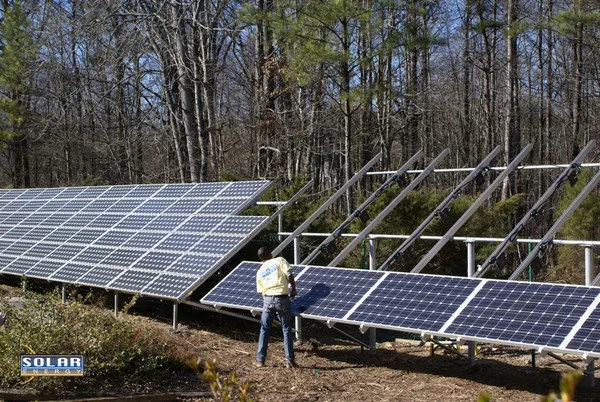
Last year, Bill Gates noted in an interview with Alan Murray of the Wall Street Journal that technologies like solar photovoltaics and LED lights were "cute" but could never deal with the bigger issue of climate change and powering the developing world.
And, this week, writer Marc Gunther wrote in his post that "Germany, once the world's leading market for solar power, is pulling back its subsidies. Q Cells, once the world's largest solar company, just went bankrupt.' This isn't happy news."
So, I am writing to point out three things:
1.The solar industry is growing and is significant, but is not going to solve all the ills of carbon;
2.Mistakes are a blessing; and
3.Theory is theory, not a solution
1. Solar Growth: First, let me make note that I, and others, have just spent the last decade in solar creating the solar services industry which, according to the 2011 National Solar Jobs Census published by the Solar Foundation, grew 6.8 percent between 2010 and 2011.
Plus, the solar industry installed $90 billion of equipment last year. That's double the amount of equipment that was installed for the new coal industry.
And, GTM research and Solar Energy Industries Association (SEIA), issued a report that the showed that U.S. installed 1,855 MW (or 1.86 GW) of solar in 2011 and is expected to install a full gigawatt more than that in 2012: 2.8 GW.
GTM Research and SEIA estimate the U.S. solar market's total value surpassed $8.4 billion in 2011.
So, solar is winning and growing. But, no one is saying it is the only solution -- just a compelling piece of the puzzle.
In fact, there is no silver bullet. We must find efficiencies and new solutions in solving the carbon issue in several areas: transport, agriculture, energy, forestry, industry, buildings and waste.
However, when we think about carbon, most of us tend to think of two areas: transportation and electricity. While Bill Gates might label solar and LED lighting as "cute," the numbers seem to suggest otherwise. Both are billion-dollar industries and together with hundreds of other solutions will help reach the $5+ trillion in new investments necessary to make an impact by 2020.
Remember, we did not get to this point with one major offender, and we will not solve our ills with one major solution.
Gates, however, suggested that we spend more money developing a new generation of energy technologies instead of investing in incremental improvements of today's energy technologies. He said this at WIRED's third annual conference, Disruptive by Design.
"Can we, by increasing efficiency [technologies], deal with our climate problem?" Gates asked. "The answer there is basically no, because the climate problem requires more than 90% reduction of CO2 emitted, and no amount of efficiency improvement is enough."
Again, I disagree with Gates as, in this case, "perfect is the enemy of good." In solving our CO2 problem, we actually have all of the cost-effective technology need to meet our 2020 goals and more to meet future goals. More R&D is always a good thing, but to suggest the current suite of technologies is not ready is just criminal. Gates certainly didn't wait for the perfect solutions to Windows before he deployed his beta versions on the world. We are a more productive society because he didn't wait
2. Mistakes Matter
As noted, Marc Gunther believes that Germany pulling back its subsidies, and Q Cells bankruptcy "isn't happy news."
I could not disagree more. While I do not wish for things like the Internet bubble, we now have a robust Internet economy. Did it come at a heavy cost at the end of the 90s and early 2000s? Yes.
But, pioneers are the brave people who take the risk.
Germany, through its aggressive subsidies did contribute to a solar bubble. But, Germany made the seed investment for the world.
The US market is now growing exponentially after Germany paid for all of the "scaling" costs. In my own analysis of more than 1,200 electric utilities, we have reached grid parity for more than 200 utilities in 20 states representing 20% of all electricity becoming solar. More states are coming by 2016.
Grid parity means solar is now a cost-effective alternative for electricity consumers who hate paying their electric bill to the local utility company. It is getting cheaper to install a new megawatt of solar and in 2011, U.S. solar energy Installations soared by 109% in 2011 to 1,855 Megawatts according to SEIA. We are at a point where the companies that cannot manufacture cost competitively, like Q Cells, must go by the wayside.
There is a new generation of solar deployment coming that is a roadmap of profitability. It is one with no subsidies and profitable companies.
3.Theory is theory
Finally, while Gates is an entrepreneur, he never ran an energy company. And, while Gunther writes about energy, he has never run a company.
I respect both of them. But each is espousing his own beliefs. Certainly each is well researched, but it is still theory.
However, we are at a tipping point. The place where the theorists who blazed the awareness trail, must give way to the brave entrepreneurs who are willing to risk it all to drive us ahead with real solutions and real businesses.
So, I thank those who have really brought climate change and energy to the forefront of awareness including Al Gore, Bill Gates, and all the writers like Marc Gunther.
And, I thank the Q Cells of the world and Germany for putting a stake in the ground to blaze the trail.
But, now, with time running out, and much learning behind us, we must implement with speed -- and implement wisely.
Electricity production using solar technology is proven. Now we need to deploy it as fast as we can to build the next economy. There are thousands of other proven technologies to be implemented in other sectors as well to make an impact and make the next economy. For example, the shipping industry could save $50 billion per year on fuel and reduce carbon and other pollutants by 30 percent using existing technologies.
And, while we attempt incremental improvements, let's also spend more money developing a new generation of energy technologies. It is not either/or, it is both.
We will continue to implement thousands of proven ways to reduce carbon and improve energy efficiency. And, we will continue to make mistakes.
Let's leverage what is proven, and learn from our mistakes as we go. It is in fact, the only way forward.
In the meantime, I do admit I am not qualified to run a software company.