"It does me no injury for my neighbour to say there are 20 gods or no god. It neither picks my pocket, nor breaks my leg."
--Thomas Jefferson, Notes on Virginia
Take a moment to imagine Thomas Jefferson contemplating the hysterical posturing of Rev. Terry Jones. What might the author of the Virginia Statute for Religious Freedom make of the would-be burner of a book cherished by one-fifth of the world's people as the most sacred manifestation of God on earth? He might well have asked how the republic had come to such a pass.
And how did it happen? How did the comic-opera pastor of a tiny Southern congregation come to dominate the media for the better part of a week, eclipsing countless expressions of outrage from religious and secular groups around the country? How did our ninth annual day of solemn remembrance become an occasion for naked intolerance? How could fear, anger, and hatred so discolor a time set aside for the celebration of values worth dying for?
There's no doubting the importance of cynically crafty posturing by major figures on the far right or the grandstanding of penny-ante demagogues. But none of that would have any traction at all if it weren't for culture-wide ignorance of and insensitivity to the religious "other."
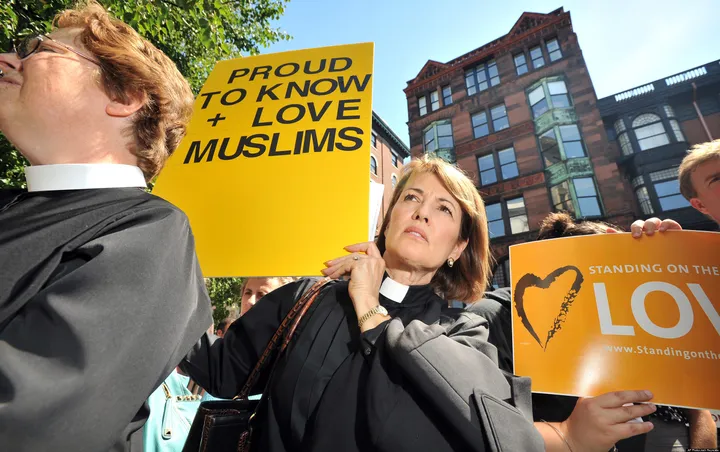
We've heard a great deal from pollsters and pundits regarding Americans' concerns about Islam and their overwhelming opposition to the Park51 project (unsurprising, given the torrent of misleading invective about the "Ground-Zero Mosque"). But we've heard much less about polling data suggesting that 63 percent of us have very little knowledge of Islam -- or none at all.
Today's ugly Islamophobia painfully recalls the bigotries of earlier times. Now, as then, "culture wars" are energized less by what is known about the other than by what is not known or not understood. And, for those who care about lifting up the values that have meant the most to America's social, political, and ethical maturation, that's the place to put the lever.
When a society is divided by race, gender, class, politics, or religion, the path to harmony always leads through encounter, dialogue, and engagement. Too often, our most deeply held prejudices are simply unexamined, because we've never met, really talked to, or worked with anyone from "that group." Actually meeting the other almost always lightens the burden of misconception, and the next steps can begin to build productive relationships.
So where do we start?
For the past 20-some years I've been on a fool's errand, or so I've often been told. I've been active in the global movement for interreligious understanding and cooperation for the common good. Those who disparage the effort usually come from one of two very different starting points:
- Religions differ in their basic premises; only one can be true. Therefore, interreligious engagement can only imperil the faith of the true believer.
Yet the interreligious movement flourishes despite the naysayers. Those who have struggled to empower it know that religions, deep down, have much more in common than divides them, and that most of these religions are more inclined to convergence than conflict. The bridge-builders also understand that together, the religions of the world have a great deal of energy and inspirational power to offer to a world facing a daunting array of critical global challenges.
Skeptical? Then consider that in 1960, virtually no city on Earth had a serious interreligious program. By 2000, most did. Something significant had changed. What's more, by the early 21st century, most of those local efforts had created rich programs of outreach, community-building, and interreligious cooperation.
On a larger scale, organizations like the International Association for Religious Freedom, the World Conference of Religions for Peace, the Council for a Parliament of the World's Religions, and the United Religions Initiative now bring their own unique perspectives and years of experience to overcoming our cultural blindness to one another. And groups like the Islamic Society of North America and the Council for American-Islamic Relations are hard at work countering pernicious stereotypes and encouraging American Muslims to reach out to people of other faiths and to non-believers as well, to build new models for dialogue and engagement.
Those who are concerned about the current storm of religious intemperance are probably heartened by the calls for tolerance that we've heard from the president and from religious and secular groups around the country. But for those closest to the ongoing interreligious movement, tolerance just won't suffice. If I merely tolerate you, I may be willing to accept your presence in the social order, but I'm less likely to relate to you in genuinely constructive ways. Real intercultural harmony demands exposure, as well as respect, mutuality, and, ultimately, engagement -- the shared commitment to building a better world. Tolerance is only the starting gate.
Today, at home and abroad, religious extremists (who are to be found in every major tradition) are playing the odds, hoping to emerge victorious from a zero-sum game of their own making. In the process they have learned to manipulate the less-informed among their own co-religionists and in the despised group. But in an age on which the radical fact of religious plurality has descended, when the great majority of the world's urban centers are home to adherents of countless different faith traditions, interreligious existence is a starkly non-zero-sum proposition. We either all win together or we all lose.
It may seem daunting during times like these, but culture-wide interreligious engagement is not only possible, but highly probable. And like so many of life's most surprisingly rewarding dimensions, it all begins with the willingness to learn. I'm reminded of my friend Steve in Telluride, who responded to Rev. Jones' incendiary proposition with mountaintop clarity. Instead of "Burn-a-Quran Day," he urged, in a letter to National Public Radio, that we make it "Buy-a-Quran Day." How ironically transformative it would be if for every sacred book desecrated many more were opened and read for the first time, and for every holy site defaced countless more were visited by people of other faiths.
I believe that Jefferson, who owned a copy of the Quran, would have nodded and, perhaps, smiled.