The Buddhist concept of reincarnation, while both mysterious and enchanting, is hard for most Westerners to grasp.
A new film -- from Israel -- is out to change that. The film features the Dalai Lama.
Unmistaken Child follows the search for a reincarnated Tibetan master. It opened in New York June 3 at the Film Forum.
Unmistaken Child follows the four-year search for the reincarnation of Lama Konchog, a world-renowned Tibetan master who passed away in 2001 at age 84.

Unmistaken Child: searching for a reincarnated Tibetan master.
The Dalai Lama charges the deceased monk's devoted disciple, Tenzin Zopa, to search for his master's reincarnation. Tenzin had been in service to the Dalai Lama for 21 years - since the age of seven.
The difficulty was that the child might be found anywhere in the world. Further, the child had to be found within four years -- before it becomes too difficult to separate him from his parents.
Tenzin sets off on foot, mule and even helicopter, through breathtaking landscapes and remote traditional villages.
He listens to stories about children with special characteristics, performs rituals, and rarely-seen tests designed to determine the likelihood of reincarnation.

The Dalai Lama makes the final decision: which boy?
He eventually presents his chosen one to the Dalai Lama, who will make the final decision.
Stunningly shot, Unmistaken Child is a beguiling, surprising, touching and even humorous experience.
Observing rather than explaining ancient tradition, the film inspires as many questions as it answers. It is a fascinating insider's perspective that captures the beauty in wild nature and elaborate Buddhist rites and rituals.
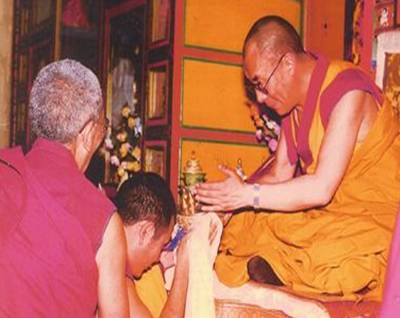
The Dalai Lama must ultimately approve the real reincarnation.
Tenzin speaks in good English about his tearfulness following the death of the Buddhist monk he followed, Geshe-La, and the challenge of searching for his reincarnation.
Tenzin expresses doubt: "I am not Buddha." He is concerned that as a mortal man, he may not be able to recognize Geshe-La's reincarnation.
He travels from Nepal to the south of India, and then back to Nepal in his search.
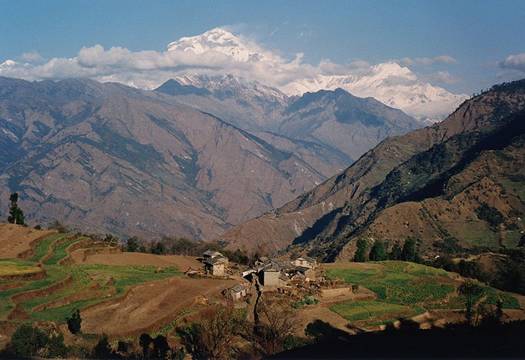
Tezin's search for his master's reincarnation takes him through Nepal.
Tenzin discusses in the film how he had never thought for himself, but only followed his master. He admits to being completely lost once his master had died.
I was able to interview its scriptwriter and filmmaker, Nati Baratz. As an Israeli filming a Tibetan film, Nati Baratz is both a thought leaders and global citizen. I asked him about the Israeli-Tibetan connection.
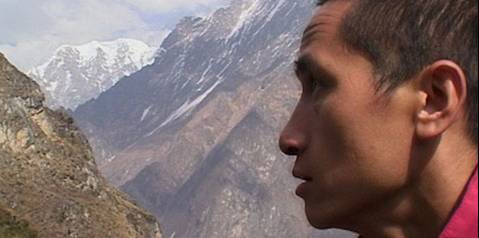
The film follows Tenzin's quest to find the boy who was his master.
"As an Israeli, seeing the calm, non-violence Tibetan nature and struggle for independence, I was forced to redefine my innermost beliefs about happiness and conflict," Nati told me.
"I felt that the peaceful Tibetan struggle for independence must succeed to the benefit of the whole world, not to mention the middle east."
The film is in English, Tibetan, Nepalese, and Hindi with English subtitles.
Our 2024 Coverage Needs You
It's Another Trump-Biden Showdown — And We Need Your Help
The Future Of Democracy Is At Stake
Our 2024 Coverage Needs You
Your Loyalty Means The World To Us
As Americans head to the polls in 2024, the very future of our country is at stake. At HuffPost, we believe that a free press is critical to creating well-informed voters. That's why our journalism is free for everyone, even though other newsrooms retreat behind expensive paywalls.
Our journalists will continue to cover the twists and turns during this historic presidential election. With your help, we'll bring you hard-hitting investigations, well-researched analysis and timely takes you can't find elsewhere. Reporting in this current political climate is a responsibility we do not take lightly, and we thank you for your support.
Contribute as little as $2 to keep our news free for all.
Can't afford to donate? Support HuffPost by creating a free account and log in while you read.
The 2024 election is heating up, and women's rights, health care, voting rights, and the very future of democracy are all at stake. Donald Trump will face Joe Biden in the most consequential vote of our time. And HuffPost will be there, covering every twist and turn. America's future hangs in the balance. Would you consider contributing to support our journalism and keep it free for all during this critical season?
HuffPost believes news should be accessible to everyone, regardless of their ability to pay for it. We rely on readers like you to help fund our work. Any contribution you can make — even as little as $2 — goes directly toward supporting the impactful journalism that we will continue to produce this year. Thank you for being part of our story.
Can't afford to donate? Support HuffPost by creating a free account and log in while you read.
It's official: Donald Trump will face Joe Biden this fall in the presidential election. As we face the most consequential presidential election of our time, HuffPost is committed to bringing you up-to-date, accurate news about the 2024 race. While other outlets have retreated behind paywalls, you can trust our news will stay free.
But we can't do it without your help. Reader funding is one of the key ways we support our newsroom. Would you consider making a donation to help fund our news during this critical time? Your contributions are vital to supporting a free press.
Contribute as little as $2 to keep our journalism free and accessible to all.
Can't afford to donate? Support HuffPost by creating a free account and log in while you read.
As Americans head to the polls in 2024, the very future of our country is at stake. At HuffPost, we believe that a free press is critical to creating well-informed voters. That's why our journalism is free for everyone, even though other newsrooms retreat behind expensive paywalls.
Our journalists will continue to cover the twists and turns during this historic presidential election. With your help, we'll bring you hard-hitting investigations, well-researched analysis and timely takes you can't find elsewhere. Reporting in this current political climate is a responsibility we do not take lightly, and we thank you for your support.
Contribute as little as $2 to keep our news free for all.
Can't afford to donate? Support HuffPost by creating a free account and log in while you read.
Dear HuffPost Reader
Thank you for your past contribution to HuffPost. We are sincerely grateful for readers like you who help us ensure that we can keep our journalism free for everyone.
The stakes are high this year, and our 2024 coverage could use continued support. Would you consider becoming a regular HuffPost contributor?
Dear HuffPost Reader
Thank you for your past contribution to HuffPost. We are sincerely grateful for readers like you who help us ensure that we can keep our journalism free for everyone.
The stakes are high this year, and our 2024 coverage could use continued support. If circumstances have changed since you last contributed, we hope you'll consider contributing to HuffPost once more.
Already contributed? Log in to hide these messages.