It is probably the most overrated painting in the history of art -- the Mona Lisa by Leonardo da Vinci.
This murky portrait, hanging behind protective glass at the Louvre, draws thousands of visitors a day. It has inspired volumes of essays, research, speculation, a film and at least one song. (Thank you, Nat King Cole.) And scientists are now saying they have cracked the mystery of the painting technique -- sfumato -- which consists of thin layers of paint and glaze, reappplied dozens of times.
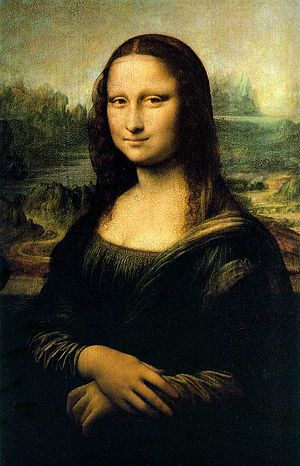
The scientists say they used a noninvasive technique (X-ray fluorescence spectroscopy) to study the layers and their chemical composition. That's interesting as far as technology goes, but do we really care? Why, in fact, do we care at all about this dreary portrait?
She has been identified as Lisa Gherardini, the wife of a Florentine merchant, Francesco del Giocondo. (In fact, the French and Italian names for her are La Joconde and La Gioconda; whence came our English "Mona Lisa"?) The woman is plain, with a long nose, tired eyes shifting to the side and that annoyingly wan smile. Her arms are placidly crossed over her voluminous dark garment in a matronly manner, and a dark landscape (a Leonardo trademark) rises behind her.
It's estimated that Leonardo spent four years working on it (and the signs of his sitter's fatigue are surely there!). Some serious researchers have suggested that the portrait may actually be the artist's portrait of himself, transposed as a female. What cultural chaos, if that were ever proven! Da Vinci in drag.
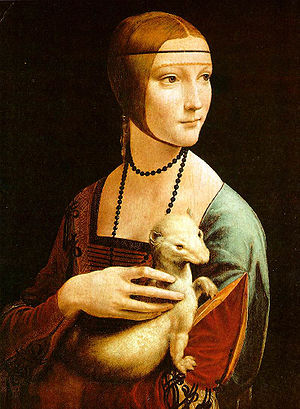
Meanwhile, we are left with this mad mystique. When did it all begin? Is it possible that Lisa, or her husband, hired a public relations firm? Hardly. Did an owner of the painting deliberately publicize it before putting it up for sale? Maybe. Was its notoriety enhanced after the work was stolen? Definitely. And why is another, finer portrait by Leonardo -- The Lady With an Ermine -- overlooked and overshadowed by Lisa?
That portrait, painted about fifteen years earlier, is a luminous study of Cecilia Gallerani, the mistress of Lodovico Sforza, who was Duke of Milan and Leonardo's patron. Cecilia is sixteen years old; she gently cradles an ermine (also identified as a ferret), a symbol of purity. She is wearing a gorgeous dress, her hair is exquisitely arranged, and there is no distracting landscape behind her. The colors are fresh and sparkling, and her sideways pose, with a three-quarter profile, was a dynamic innovation in portraiture.
In a way, I'm glad Cecilia does not have Lisa's fame. It would spoil her to be turned into a world-renowned symbol, a public icon. And besides, I can calculate who my true soulmates are: the art aficionados who prefer Cecilia to Lisa!