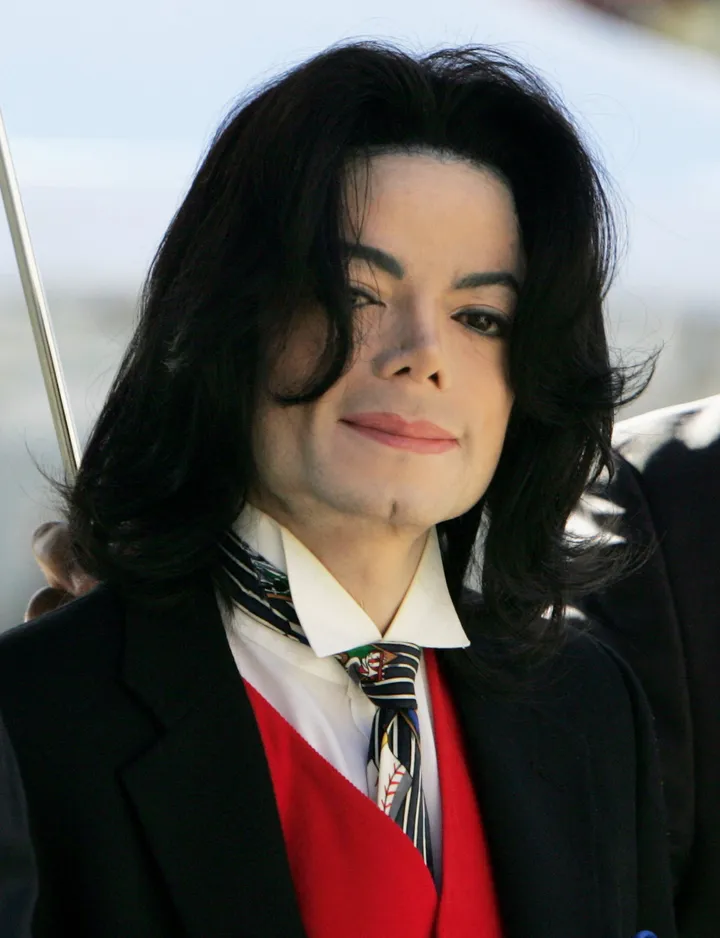
We have heard the point made over and over these past few weeks: It is not Michael Jackson currently on trial; it is Dr. Conrad Murray. But, of course, we know the reality. This is the "Michael Jackson Death Trial." He is, as he always was, the main event, the tantalizing spectacle. It is Michael Jackson who is under the microscope as we pry, one more time, through his home, his medical records, his body. And while the public at large is much more sympathetic now that Jackson has passed, he remains the subject of endless scrutiny and judgment.
Does any of it matter now that the man himself can't feel the abuse? Should the average person even care whether a "celebrity" like Jackson is treated with callousness or disregard? Projects like Voices, whose "Words and Violence" series highlights the disturbing trajectory of our social discourse, says yes. Words matter. No matter the target. Words, as we have witnessed with the recent attention on youth bullying and suicides, can lead to devastatingly tragic ends.
They can also be used to inspire and heal.
Michael Jackson knew this. In 1988, he befriended AIDS victim Ryan White, a young boy forced out of his school in Kokomo, Indiana because of relentless verbal assaults and threats of violence. Jackson, White said, made him feel normal. "[Michael] didn't care what race you were, what color you were, what was your handicap, what was your disease," recalled Ryan White's mother, Jeanne. "[He] just loved all children."
White is one of thousands of "outsiders" to whom Jackson reached out, befriended and treated with kindness. He identified with them. He understood their pain and loneliness. He felt empathy for their struggle to live in a world that refused to accept them for who they were, whether because of illness, physical appearance, race, sexual orientation or some other reason.
Even as a young boy, Jackson possessed this sensitivity. Listen to the song, "Ben." There is genuine pain and compassion in Jackson's delivery ("They don't see you as I do/ I wish they would try to"). The song can be seen as one of the first artistic statements Jackson made on behalf of the marginalized and misunderstood. Many more would follow.
Jackson's outsider role may have begun in childhood (as there was never a time Jackson felt "normal" and never a time he was perceived as such). Yet the intensity and hostility caused by his difference grew over time. In his 1996 essay, "The Celebrity Freak: Michael Jackson's Grotesque Glory," David Yuan argued that Michael Jackson was the defining "freak" of our time. No other public figure in the world evoked the same level of ridicule, scrutiny and hyper-interrogation. As early as 1985, Jackson was being labeled "Wacko Jacko" by the tabloids, a term he despised (as recently as this year, some mainstream news organizations continued to refer to him as "Jacko"). In the press, he was frequently described as "bizarre," "weird," and "eccentric." Indeed, there was very little he said or did from the mid-1980s forward that wasn't described in these terms by the media.
Jackson was mocked incessantly for his skin disorder, vitiligo, which most people didn't believe was real until it was confirmed definitively in his autopsy. He was mocked for his love of animals; for his love of children; for his love of the planet. He was mocked for his marriages, for his three kids, for his Neverland home. He was mocked for his sexuality, his voice, his childlike behavior. Even reviews of his music couldn't resist filling up the majority of the space with pseudo-psychoanalysis and ad hominem assaults. Can there be any doubt that this treatment by the media and culture at large was abusive?
Certainly the victim of these dehumanizing attacks felt that way. Listen to the lyrics of his songs. In "Tabloid Junkie" he describes the mass media as "parasites" sucking the life out of him, while drugging/distracting the general public with a steady dose of sensationalism. In "Stranger in Moscow" he is an artist in exile, used up and spit out by his native country. "I was wanderin' in the rain," he sings from the lonely role of vagabond, "Mask of life/ Feeling insane."
In "Scream" he is so weary of being bullied, he pleads, "Oh brother, please have mercy 'cause I just can't take it." The song, however, also serves as a vehicle of strength and resolve ("Kickin' me down/ I got to get up"). Michael and sister Janet deliver a fierce counterblow to a system they rightfully see as corrupt and unjust. "You're sellin' out souls," Janet sings in one verse, "but I care about mine." It is a defiant song about standing up to cruelty, even when the pain and indignation is so deep it can only be expressed in a guttural scream.
In numerous songs, Jackson uses his music as a rallying call for others who have been mistreated. In "They Don't Care About Us," he witnesses for the disenfranchised and demeaned. "Tell me what has become of my rights," he sings, "Am I invisible because you ignore me?" "Little Susie" draws attention to the plight of the neglected and abandoned, telling the story of a young girl whose gifts go unnoticed until she is found dead at the bottom of the stairs in her home ("Lift her with care," Jackson sings, "Oh, the blood in her hair"); "Earth Song" offers an epic lamentation on behalf of the planet and its most vulnerable inhabitants (represented by the choir's passionate shouts, "What about us!"). Through such songs (as well as through his life and persona), Jackson became a sort of global representative of the "Other."
The mass media, however, never held much regard for Jackson's other-ness, just as they held little regard for the "others" he spoke of in his songs. Rather, they found a narrative that was simple and profitable -- Jackson as eccentric "freak" -- and stuck with it for nearly three decades, gradually upping the stakes.
Perhaps Jackson's most compelling response to the public perception of him that resulted comes in his trio of late Gothic songs: "Ghosts," "Is It Scary," and "Threatened." It is here that Jackson holds a mirror up to the society that scorns him and asks it to look at its own grotesque reflection. "Is it scary for you!" he demands. The songs, and their accompanying visual representations, are not only keenly self-aware, they demonstrate a shrewd understanding of the toxic forces that surround and haunt him.
In the short film, Ghosts, the Mayor of Normal Valley (a conservative figure of authority inspired, in part, by Santa Barbara District Attorney, Tom Sneddon) taunts Jackson's character: "Freaky boy! Freak! Circus freak." Interestingly, it is Jackson himself (disguised as the Mayor) that delivers these words, and one can feel the way they have been internalized. They are slurs intended to mark, marginalize and humiliate (which was ultimately the purpose of the witch hunts of 1993 and 2005). For the Mayor, Jackson's presence in the community is intolerable. It is not that Jackson has done any harm; it is simply that he is different and that difference is threatening.
In such artistic expressions, Jackson clearly recognizes what is being done to him. He is being defined by outside forces. He is a phantom they have constructed in their own minds. As he sings in "Is It Scary," "If you wanna see/ Eccentric oddities I'll be grotesque before your eyes." He will be grotesque, in other words, because that is what the public "wants to see." It is how they have been conditioned to see. Later in the song, he anticipates his audience's reactions, asking: "Am I amusing you/ Or just confusing you/ Am I the beast you visualized?" Has he become something less than human? Why is this? Is it his physical appearance? His ambiguous identity? His unusual life story? There is no question Michael Jackson was different. The question is why this difference incited such fervent disparagement and abuse.
One of the remarkable qualities of Jackson's life and work, however, is that he refuses to compromise his "difference." He never becomes "normal," as the term is represented by, say, the Mayor of Normal Valley. He doesn't conform to expectations. Rather, he is true to himself and flaunts his unique, multi-faceted identity, to the frustration of those who would like him to fit in more predictable boxes. His differences, as Susan Fast notes, were "impenetrable, uncontainable, and they created enormous anxiety. Please be black, Michael, or white, or gay or straight, father or mother, father to children, not a child yourself, so we at least know how to direct our liberal (in)tolerance. And try not to confuse all the codes simultaneously."
Even over two years after his tragic passing, it seems, many people don't know what to make of Michael Jackson. He is reduced, therefore, to easy labels like "drug addict." A picture of his lifeless body is callously plastered on news sites. It is cruel, abusive behavior masquerading as "normal." Perhaps this is why Jackson chose the medium of the Gothic to fight back. It was a way to turn the tables, to symbolically represent the world as it often felt to him: monstrous and grotesque. His "horror stories" certainly weren't intended merely to entertain.
"Freaks are called freaks," observed author James Baldwin, "and are treated as they are treated -- in the main, abominably -- because they are human beings who cause to echo, deep within us, our most profound terrors and desires." In Jackson's case those "terrors and desires" were manifold, including race, sexuality, money and power. Yet as much as Jackson became the symbolic magnet onto which many of these cultural anxieties were projected, he was also an actual person trying to live his life. Toward the end of "Is It Scary" he explains, "I'm just not what you seek of me," before revealing to the compassionate listener: "But if you came to see/ The truth, the purity/ It's here inside a lonely heart/ So let the performance start!"
Ironically, it is in the "performance" of his art that we find "the truth, the purity." This is where he exorcizes his demons, where his anguish is transfused into creative energy. This is where the walls come down and the mask comes off. To the outside world, he may be a spectacle, a caricature, a freak; but here, finally, inside his music, he bares his soul. He is a human being.
The question is: What do we see?
This article is cross-posted at Voices: Education Project as part of the "Words and Violence" curriculum.
Joseph Vogel is the author Man in the Music: The Creative Life and Work of Michael Jackson, released worldwide November 1, 2011.