
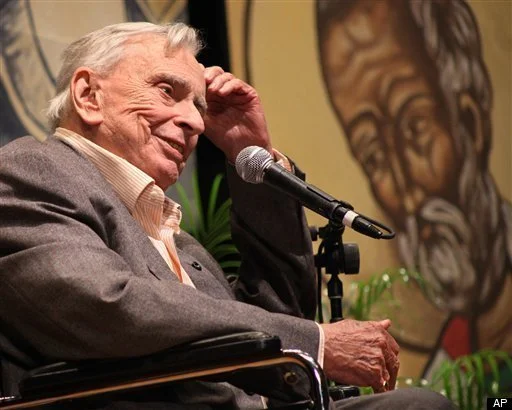
In Russian, the phrase 'gore vidal' means "he has seen grief." As Gore Vidal is wheeled towards me across an empty London hotel lobby, it seems for the first time like an apt translation. In the eight years since I saw him last, he has lost his partner of fifty years, most of his friends, most of his enemies, and the use of his legs. The man I met then - bristling with his own brilliance, scattering witticisms around like confetti - has withered. His skin is like parchment, but the famous cheekbones are still sharp beneath the crags. "It is so cold in here," he says, by way of introduction. "So fucking cold."
Gore Vidal is not only grieving for his own dead circle and his own fading life, but for his country. At 83, he has lived through one third of the lifespan of the United States. If anyone incarnates the American century that has ended, it is him. He was America's greatest essayist, one of its best-selling novelists, and the wit at every party. He holidayed with the Kennedys, cruised for men with Tennessee Williams, was urged to run for Congress by Eleanor Roosevelt, co-wrote some of the most iconic Hollywood films, damned US foreign policy from within, sued Truman Capote, got felated by Jack Kerouac, watched his cousin Al Gore get elected President and still lose the White House, and - finally, bizarrely - befriended and championed the Oklahoma bomber, Timothy McVeigh.
Yet now, he says, it is clear the American experiment has been "a failure." It was all for nothing. Soon the country will be ranked "somewhere between Brazil and Argentina, where it belongs." The Empire will collapse militarily in Afghanistan; the nation will collapse internally when Obama is broken "by the madhouse" and the Chinese call in the country's debts. A ruined United States will then be "the Yellow Man's Burden," and "they'll have us running the coolie cars, or whatever it is they have in the way of transport."
A Scotch is fetched for him as he is wheeled into the corner of the bar.
I was like everyone else when Obama was elected - optimistic. Everything we had been saying about racial integration was vindicated, but he's incompetent. He will be defeated for re-election. It's a pity because he's the first intellectual president we've had in many years, but he can't hack it. He's not up to it. He's overwhelmed. And who wouldn't be? The United States is a madhouse. The country should be put away - and we're being told to go away. Nothing makes any sense.
The President "wants to be liked by everybody, and he thought all he had to do was talk reason. But remember - the Republican Party is not a political party. It's a mindset, like Hitler Youth. It's full of hatred. You're not going to get them aboard. Don't even try. The only way to handle them is to terrify them. He's too delicate for that."
When he compares Obama to his old friend Jack Kennedy, he shakes his head:
He's twice the intellectual that Jack was, but Jack knew the great world. Remember he spent a long time in the navy, losing ships. This kid [Obama] has never heard a gun fired in anger. He's absolutely bowled over by generals, who tell him lies and he believes them. He hasn't done anything. If you were faced with great problems in chemistry - to find the perfect gas, to gas a population - you won't know for a long time whether it works. You have to go by what people tell you. He's like that. He's not ready for prime time and he's getting a lot of prime time on his plate at once.
Is there any hope? "Every sign I see is doom. But then people say" - he adopts a whiny, nasal voice - "'Oh Mr Vidal, you're so negative, can't you say something nice about America? It's a wonderful country, everybody wants to live here.' Oh yes? When was the last time you saw a Norwegian with a green card who wanted to come here because of the health service? I'll pay you if you can find one."
But there is, he says with sudden perkiness, some "good news. Afghanistan will be terminal for the American empire, yes. Which is a happy way of looking at it. We'll be out of the empire game, rapidly. But it's too late for the country and the constitution." He raises his drink, and smiles ironically. "To a better republic," he says, and drinks in one long gulp.
I. The Death of America
The current spasming death of America was foretold at its birth, Vidal says, and it can only be understood by whirling back there. It has been his mission to explain the past to the "United States of Amnesia," through his novels and essays. When he speaks, he sweeps over two millennia of history - from Caesar to Obama - as if he was there, forever spraying one-liners from the back row. Today, he was stopped time in Philadelphia, at the birth of the republic. "Benjamin Franklin saw all this coming," he says. "I quote him because most Americans don't even know who he was now. You'll have to explain to your readers." Franklin was a polymathic writer, scientist and soldier who became one of the founding fathers of the United States.
In Philadelphia in 1781, when the constitution was being put together, he was an observer. He didn't want to have any part of it, and as he was leaving the Constitution Hall in Philadelphia a couple of old ladies said, 'Ah, Mr Franklin, what is going to happen?' He told them: 'Well, you're going to get a Republic, if you can keep it. But every constitution of this sort has failed since the beginning of time due to the corruption of the people.'
So the American people are corrupt? Americans weren't good enough for America? "Precisely. They were only good enough to be a restive colonial power - or the dregs of one."
Vidal's politics began here - almost. He was born at the United States Military Academy in West Point to a wealthy family at the apex of American power. His grandfather was Thomas Pryor Gore, the Senator for Oklahoma. He was blind, so from the age of five, little Gore was reading letters and books for big Gore and guiding him discreetly through Washington D.C. parties. The Senator was a populist, fighting to rally the people against the concentrated power of Wall Street and Big Finance. He represented the cotton farmers who emerged battered from the Civil War, only to be destroyed by Wall Street financiers playing roulette with the global cotton price. Yet there was always a strange contradiction to his life: "My grandfather couldn't stand his constituents," Vidal says. "And they loved him for it. Figure that one out."
He was a populist with no faith in the populace - precisely what his grandson has turned into. Gore Vidal shares the populist belief that the people are being shafted by the rich - but he thinks the population is too cretinous and drugged by television and fast food to figure it out.
It is always to be hoped that the people will mysteriously be educated, somehow. Well, that's the link. But the people don't know anything. As soon as we became an empire, we stopped teaching geography in the schools, so nobody would know where anything is. It's not the people's fault - they have been perverted them into imperial ways of thinking so that they would be docile workers and loyal consumers. That was the dream and it has come true.
As a child, Vidal loved spending time with his Senator-grandfather, not least because it meant he could escape for a time from his alcoholic mother Nina. When I raise the topic, he adopts the whiny nasal voice of a mock-interviewer again and says: "'Oh Mr. Vidal, your poor mother can't have been as awful as you say [in your memoirs].' She was a lot worse. I don't go after other people's mothers, but my own was quite enough to attack."
She was constantly drunk, and when she wasn't savaging him or threatening suicide, she would tell her son the full details of her life in an obsessive angry blather. When he was ten, "she told me that rage made her orgasmic. I didn't think to ask her if sex did the same." When he appeared on the cover of Time magazine years later, she wrote a long letter to the magazine denouncing him. The magazine headlined it: "A Mother's Love." Vidal seems to have inherited his bitter wit from her. Asked why she didn't marry for a fourth time, she said: "My first husband had three balls, my second two, my third one. Even I know enough not to press my luck." Does he think of her often? "No." He gives me an icy stare. After all these years, can he feel any compassion for her? "No." The ice becomes a glacier.
Does he think, at least, that she shaped his personality? His old friend Kenneth Tynan, the theatre critic, wrote in his diaries: "What superb and seamless armour he wears, as befits one for whom life is a permanent battle for (social and intellectual) supremacy. ... Gore could never surrender (i.e. expose) himself to anyone." Could his mother's cruelty explain his life-long sweeping dismissal of everything around him - the constant goring by Gore? As soon as I ask this, I realize how Vidal has changed since I last saw him. Then, he would have responded with a witty put-down, or reasserted his supremacy with an obscure classical reference, quoted in the original Greek. Now he looks a little hurt - his eyes flicker sadly - and he says: "Well, it's the last thing I'd like to think about." Then he is silent. I suddenly feel rude, and cruel.
His grandfather became increasingly furious that Franklin Roosevelt was - he believed - dragging the United States into an unnecessary war against Germany and Japan. He was opposed to all foreign wars, which he believed were drummed up by Big Business to serve their interests. "He thought that no foreign war was worth the life of any American," Vidal says, with a smile of pride. But this - combined with his opposition to the New Deal - meant he was voted out of office. As a little act of revenge, Vidal says he has never visited Oklahoma.
He joined the army at the age of seventeen, glad to escape his mother. He spent the war posted in Italy and, for three years, Alaska. He is not surprised that this "frozen hell" has produced Sarah Palin, "the latest idol in America's long cult of stupidity." Alaska was, he says, "The place where all the crooks in America went to hide. And they produced her."
He says he realizes now that he was part of an army sent to build a global Empire by "America's Augustus, Roosevelt." The old America was replaced by a military octopus with a metal arm on every continent, and the old constitution was replaced by a "National Security State. I wouldn't have enlisted if I knew where it was going to lead," he says. "But there it was, and we ended [the war as] an empire and slammed the door behind us. Then we fucked it up."
He left the army with no money. "My father and grandfather, as self-made men, were not going to make any other man. I knew that," he says. So he sat down and wrote a novel about the war called Williwaw. At the age of twenty, he was suddenly a hard-boiled realist best-seller. He was lauded as a tough young soldier, and his grandfather talked of setting him up with a Congressional seat - but Vidal wanted to write another, bolder novel, based on the only person he had ever loved. It pulled any hope of a political career down behind him - but made him a defining figure in American life.
II. An Interrupted Love Story
When Vidal was fourteen, a boy called Jimmy Trimble moved into Vidal's dorm at his Washington boarding school. He was a blond, built jock; Vidal was a bookish intellectual. "His sweat smelled of honey, like that of Alexander the Great," he wrote years later in his memoir, 'Palimpsest.' They fell in lust and perhaps in love, and had sex in the forest at the edge of the school grounds. "It was the first human happiness I had ever encountered," Vidal wrote. He saw Trimble as his other half, the person who finally made him complete. Then Trimble was, at the age of nineteen, blown up by a hand grenade on the beaches of Iwo Jima.
For years, thoughts of Trimble still made Vidal tremble. I think they still do: his eyes turn distant and a little watery when we talk about him. So he wrote a novel - The City and The Pillar - imagining what would have happened if they had met again after the war. It's a dark, bitter book: the sex is a failure, and one kills the other. But in 1950s America, to show two all-American boys - manly, self-assured - having sex was wildly bold. He was subject to a blackout in the "respectable" press and any hope of elected office died, but the book became a best-seller.
Vidal resolved that he would never again find what he had lost with Jimmy: "It would be greedy to expect a repetition. I was aware of my once-perfect luck, and left it at that." He says he had sex with more than a thousand "anonymous youths" by the age of 25. He never saw them twice; he never pretended there was any affection there. He was what they labeled "trade" - he did nothing (deliberately, at least) to please them. He was pleasured; that was all. "When I got too old, I paid for it gladly." After the death of Trimble, he seems to have emotionally cauterised himself. Even his closest friends have said there is an isolation at the core of his character. He once said: "I have known so many people, but it seems I have known nobody at all."
Strangely, though, Vidal has always resisted the idea that he is a "gay" champion. "I never said I was gay, because I don't think anyone is." He says he finds "these restrictions tiresome. In the centuries of Rome's great military and political success, there was no differentiation between same-sexers and other-sexers; there was also a lot of crossing back and forth. Of the first twelve Roman emperors, only one was exclusively heterosexual." The US today is, for all the fussing, full of sodomy, he says.
Did you see [Colonel] Gaddafi [at the UN] complaining that American soldiers have been sodomizing Arab boys? I thought, well that's been the case since the very beginning of the republic. They blamed the sodomy on those great forests out there which they said made them horny. There was nothing else to do but bugger boys, they said.
So homosexuality and heterosexuality are fictions? "Yes, of course." He adopts a camp faggy voice and adds: "But it makes a lot of girls happy." Why do so many people believe it to be true about themselves if it's false? "They believe in Jesus, and that's a much bigger fiction, with more money spent on it. Prettier clothes too."
When he was 25, Vidal met a younger man called Howard Austen, and they settled down together, on one condition - they agreed to never have sex, nor be romantic in any way. He and Austen were together for fifty years. He died last year, in a hospital in the Hollywood Hills. "He had lung cancer and he wouldn't stop smoking and then it went to his brain and he had brain cancer. That's... that's what happened," he says. Once, in an essay, he quoted the critic Edmund Wilson, who said of his dead wife: "After she was dead, I loved her." Can he say that of Howard? He affects not to hear. "Now I'm a gimp. I can't walk. I need hospitals. You know I have a knee made out of titanium." He taps his knee. "So you see, I need hospitals." And he looks away, a little absently, as if thinking of something else.
III. Isolation
By his mid-twenties, Vidal was a best-selling author, and rich. He rented a property in Guatemala - far from his mother - and settled down to write his next novel. But in that small tropical central American country, he found he was going to have to dramatically reassess the country he had just fought for - and pull his grandfather's abandoned philosophy from the gutter of history.
Just before Vidal arrived, the poverty-wreathed Guatemalan people had elected a left-wing President called Jacobo Arbenz Guzmán. They wanted him to introduce a minimum wage and start taxing the US mega-corporation the United Fruit Company that dominated the country's only industry, banana-growing. The outraged United Fruit Company acted to preserve its profits - by getting Washington to topple Arbenz and install a dictator. The phrase 'banana republic' entered the language.
"I was astonished," Vidal says. "I had known vaguely about our numerous past interventions in Central America. But that was the past." He discovered that Senator Henry Cabot Lodge was leading the charge, and, "I didn't believe it. Lodge was a family friend; as a boy I had discussed poetry with him." He says he realized then he had been fighting "for an Empire, not a republic." His grandfather, he resolved, had been right all along: wars only serve elites.
He rapidly became the leading left-wing critic of American foreign policy. He warned against every war from Vietnam to Iraq, often with extraordinary prescience. At the height of George Bush's post-9/11 popularity, he said: "Mark my words - he will leave office the most unpopular President in history." His essays on this subject are often great flares of truth and anger. His horror at US foreign policy can be summarized in one little scene. In the 1980s, the Sistine Chapel was being restored, and some VIPs were invited to view it on an elevated platform. He spotted that old serial killer Henry Kissinger inspecting the section depicting Hell, and said: "Look, he's apartment hunting."
Vidal started preaching his grandfather's gospel of isolationism. "I am a patriot of the old republic that has slowly vanished during the expansionist years and disappeared completely in 1950 when the National Security State replaced it," he says. "I want us to go from a wartime economy to a peacetime economy, and restore the constitution. We should leave the world alone, before they make us."
The US is only menaced, he says, because it menaces others. "In geopolitics as in physics, there is no action without reaction." He stirs his Scotch and says: "There was no 9/11. I mean - our policies were such that we were going to have a lot of crazy people out there in the Arab world who were going to try to blow us up, because of crimes they feel we committed against them. Any fool could see it coming. And I'm sufficiently a fool to have seen it."
He sees his job as expressing "the unacceptable obvious," and says he is always ready to "turn the other fist." I tell him that while I agree with many of his criticisms of US foreign policy, it seems that to keep his isolationism pristine and pure, he has to go further than the truth. He has to imply every attack on the United States' power was provoked, and therefore justified - when some were not. He looks coldly at me. "Okay - name one." Pearl Harbor, I say. If the US can be an expansionist empire, so can other countries. The Japanese empire attacked the US, just as the US expansionists attacked Guatemala, Vietnam and others. It was unprovoked aggression.
His face tightens into a scowl. "Roosevelt saw to it that we got that war!" he snaps.
He taunted the Japanese so they would have to hit us, at Pearl Harbor, and they did. ... We have conveniently forgotten because we don't teach American history to anybody, but he sent an ultimatum to the Japanese telling them to get out of China, which they'd been trying to conquer for years. He was laying down the law to them, [saying they had to] surrender their rather proud nation's empire. And they said fuck you. And the next thing we knew the fleet was moving towards Pearl Harbor.
That's not how most historians read it - but I move on to an even more contested example. He says the Soviet Empire was "purely reactive" to American power, and only committed atrocities and invasions because the US "goaded them." Can that be true? Couldn't they be independently cruel, just as the US sometimes was? "They had a whole continent to play with, they didn't need any more space," he says, and changes the subject, rather oddly, to talk about the Dutch.
I try to pull him back. Yes, it's clearly the case that 9/11 was in part a blow-back response to US crimes in the Middle East, but he goes much further, and says the Bush administration was "probably" in on it. Where is the evidence for this huge claim?
It would certainly fit them to a tee, so you can't blame the rest of us for starting to think on slightly conspiratorial grounds. They did steal the great election of the year 2000 and they somehow fixed the Supreme Court of the United States, that sacred place and got them to go along with it, with the selection, not the election, the selection of George W Bush as president. He wasn't voted for, people didn't want him. And were somewhat mystified that he ended up with it.
But there was an earlier attack on America that he wants to discuss now - one he says was carried out by a "sane" and "noble" man.
IV. A Noble Boy
On April 19, 1995, a former US soldier called Timothy McVeigh planted a massive truck bomb outside a government building in Oklahoma City, at the heart of Vidal's grandfather's old constituency. Some 168 people died, including a kindergarten full of children. McVeigh wrote to Vidal, saying he had been motivated, in part, by studying his work. He said he believed the US Constitution had been usurped by a National Security State that had to be defeated by force. Vidal wrote back - and they became friends. He started mounting passionate defenses of the bomber in public. He says now he was not crazy, but "too sane for his place and time."
"He was a dedicated student of the American way, of the Constitution itself," he says.
You should read his writings - they're very good. Particularly on the Posse Comitatus Act of 1876, which forbids the Federal government ever to use its troops against the American people - but which they proceeded to do at Waco [at a compound used by a religious cult that was attacked by federal troops in 1993]. They killed more people than he managed to kill when he blew up that building in Oklahoma City. He was a noble boy.
Noble? The man who consorted with far right militia groups and blew up all those children? Vidal scowls again, and almost hisses:
He didn't kill them deliberately! But the American government killed all those people at Waco, men, women and children deliberately! It was his gesture against the government he loathed. You know, he swore to me he had no idea there were children there. He said - 'How would I know? I walked by the place once and I knew that there was some kind of dining room, families might be there, or they might not be there,' and he wasn't counting, he wasn't out for a big count. But he was trying to tell the government - look, you have done this arbitrarily, contrary to the Posse Comitatus Act, contrary to American law, you've killed American citizens. Remember he was an army boy, and he loved it, and he was longing to get back in the army and the army was longing to get him back, he was the best sharpshooter they'd seen in years. But it was not meant to be.
But he knew he would kill hundreds of innocent people: that was the point. Doesn't that show a callous disrespect for human life? "So did Patton, so did Eisenhower!" he says angrily.
Everybody's rather careless about it once you start getting involved in wars. He saw this as a war to preserve the Constitution! You know what he said? But you don't, so I'm going to tell you. The judge [at his trial] quite liked him, and he was intrigued by the fact that this rather talkative kid who wrote tons of pieces for the press had not defended himself. So he said - Mr McVeigh, could we hear more from you? [McVeigh] said, 'Well, your honour, I will base my case on Justice Brandeis, one of our most brilliant jurists, in his opinion in Olmstead. There, he writes that when government ceases to lead by example and actually provides a bad example, anything can happen. Government is the last teacher. Everything I did, I learned from my government.
When did this happen to Gore Vidal? When did he go from righteous - and right - opposition to atrocities carried out by his own government, to justifying any atrocity against it, no matter how extreme? When I ask him, his scowl turns to a sneer, and he says I am ignorant and clearly haven't read anything. I decide to try a different approach. I ask him - if there were more people like McVeigh, would that be a good thing? There is a crack in his hauteur, and he says: "It strikes me as a perfect nightmare. Of course I don't want more people like McVeigh. Since Americans refuse to think about anything, being incapable I suspect of thought, then they're not going to come to any conclusions except mistaken ones."
I don't understand. I try again and again to tug him back and get him to say whether this means he thinks McVeigh was wrong to plant the bomb. He won't. Finally, he jeers: "You are trying my patience," and defies me - with a long stare - to change the subject.
V. Pale Moonlight
Vidal is one of the last of his generation of American intellectuals standing (or, at least, sitting). I ask him about some of his rivals, who have died recently - John Updike, William Buckley, Norman Mailer - and he interrupts. "Updike was nothing. Buckley was nothing with a flair for publicity. Mailer was a flawed publicist, too, but at least there were signs every now and then of a working brain." Then he smiles to himself: "You know, he used the word 'existential' all the time, to the end of his life, and never even learned what it meant. I heard Iris Murdoch once at dinner explain to Norman what existential meant, philosophically. He was stunned."
There is a vulnerability to Vidal now that didn't exist eight years ago. Before, I felt like I was shouting questions up Mount Olympus: he conducted the interview from above and beyond me, impervious to anything I said. Now, when I laugh at his jokes, he looks pleased, and laughs too. When we argue, he looks genuinely thrown, and hurt, and angry. He seems keen to return to the calmer waters of his memories, and we paddle together in his Kennedy anecdotes. Jackie was really secretly in love with Bobby, he says. He used to call Jack the President-erect. Jack once had sex with an actress friend of his in a bath, and suddenly rammed her head underwater, so she would have a vaginal spasm, and he would have an orgasm. "She hates him still," he says. But when I ask him what he made of the late Teddy Kennedy as a person, he snaps: "Who cares what they were like as people? That's just show business."
He has had to abandon his second home in the high hills of Italy, and says he misses it. "Italy is such a civilized country. Unlike America." But is the gap so great? Is Silvio Berlusconi better than Barack Obama? He snaps again: "Who cares? This is showbiz you're worried about. I don't care who's on television telling jokes on the Late Show."
Vidal seems exhausted and alone, living out his days in the Hollywood Hills. After an amazingly full life - "I have tried everything but incest and folk-dancing", he says - he has no more books gestating. He has traveled to London to receive applause on stage for providing the recorded narration for the new production of Mother Courage at the National Theatre, but all his old London friends - Tynan, Tom Driberg, Princess Margaret - are dead. I ask what it's like to be here, and he says: "This isn't a country, it's an American aircraft carrier." He starts to talk about his old friends again. He is swimming with ghosts now - from Jimmy Trimble to Jack Kennedy to his drunken, scolding mother. As he declines, he announces that everything around him is declining - America, literacy, humanity itself.
In one essay, Vidal said the author William Dean Howells at 84 "lived far too long." He quoted a line Howells wrote to Henry James: "I am comparatively a dead cult with my statues cut down and the grass growing over me in pale moonlight." Does he feel this about himself? I stare at him and don't have the heart to ask. He tells me he is unafraid of death. "I'm the least primitive American you're going to meet, and you have to be pretty primitive to believe in hell. To me hell is the United States of today."
After two hours, his carer - a beautiful long-haired French boy who has been reading Celine in the corner of the hotel bar - indicates that our time is up. I tell Vidal I hope I will interview him in another eight years' time. "Another eight years? Oh, the monotony!" he exclaims, and begins to be wheeled away. The last thing I hear him say - as he vanishes across the marble lobby - is a curse to his carer: "It's still so fucking cold in here!"
You can follow Johann Hari on Twitter by going to http://twitter.com/johannhari101
He is a writer for the Independent. To read more of his articles, click here . You can email him at johann -at- johannhari.com
To read an archive of interviews by Johann Hari -- with everyone from Hugo Chavez to Salman Rushdie to Dolly Parton -- click here.
Gore Vidal is the narrator for Mother Courage, which is part of the Travelex £10 season at the National Theatre and continues in the repertoire until 8 December. For tickets go to www.nationaltheatre.org.uk/