
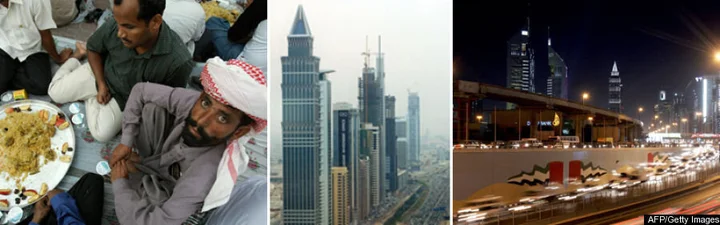
The wide, beneficent face of Sheikh Mohammed - the absolute ruler of Dubai - smiles down on his creation. His image is displayed on every other building, sandwiched between the more familiar corporate rictuses of Ronald McDonald and Colonel Saunders. He dominates the Manhattan-manqué skyline, beaming out from row after row of glass pyramids and hotels smelted into the shape of piles of golden coins. And there he stands on the tallest building in the world - a skinny spike, jabbing farther into the sky than any other human construction in history.
But something has flickered in Sheikh Mohammed's smile. This man has sold Dubai to the world as the city of One Thousand and One Arabian Lights, insulated from the dust-storms blasting across the Middle East. The ubiquitous cranes have paused on the sky-line, as if stuck in time. There are countless buildings half-finished, seemingly abandoned. In the swankiest new constructions - like the vast Atlantis hotel, a giant pink castle built in a thousand days on its own artificial island, where rainwater is leaking from the ceilings and the tiles are falling off the roof. This Neverland was built on the Never-Never. Suddenly it looks less like Manhattan in the sun, and more like Iceland in the desert.
Once the manic burst of building has stopped and the whirlwind has slowed, the secrets of Dubai are slowly seeping out. This is a city built from nothing in just a few wild decades on credit and ecocide, suppression and slavery. Dubai is a living metal metaphor for the neoliberal globalized world that may be crashing - at last - into the sands.
I An Adult Disneyland
Karen Andrews can't speak. Every time she starts to tell her story, she puts her head down and crumples. She is slim and angular and has the faded radiance of the once-rich, even though her clothes are as lined as her forehead now. I find her in the car park of one of Dubai's finest international hotels, where she is living, in her Range Rover. She has been sleeping here for months, thanks to the kindness of the Bangladeshi car park attendants who don't have the heart to move her on. This is not where she thought her Dubai dream would end.
Her story comes out in stutters, over four hours. At times, her old voice - witty and warm - breaks through. Karen came here from Canada when her boyfriend was offered a job in the senior division of a famous multinational. "When he said Dubai, I said - if you want me to wear black and quit booze, baby, you've got the wrong girl. But he asked me to give it a chance. And I loved him."
All her worries melted when she touched down in Dubai in 2005. "It was an adult Disneyland, where Sheikh Mohammed is the mouse," she says. "Life was fantastic. You had these amazing big apartments, you had a whole army of your own staff, you pay no taxes at all. It seemed like everyone was a CEO. We were partying the whole time."
Her husband Daniel bought two properties. "We were drunk on Dubai," she says. But for the first time in his life, he was beginning to mismanage their finances. "We're not talking huge sums, but he was getting confused. It was so unlike Daniel, I was surprised. We got into a little bit of debt." After a year, she found out why: Daniel was diagnosed with a brain tumour.
One doctor told him he had a year to live; another said it was benign and he'd be okay. But the debts were growing. "Before I came here, I didn't know anything about Dubai law. I assumed if all these big companies come here, it must be pretty like Canada's or any other liberal democracy's," she says. Nobody told her there is no concept of bankruptcy. If you get into debt and you can't pay, you go to prison.
"When we realized that, I sat Daniel down and told him: listen, we need to get out of here. He knew he was guaranteed a pay-off when he resigned, so we said - right, let's take the pay-off, clear the debt, and go." So Daniel resigned - but he was given a lower pay-off than his contract suggested. The debt remained. As soon as you quit your job in Dubai, your employer has to inform your bank. If you have any outstanding debts that aren't covered by your savings, then all your accounts are frozen, and you are forbidden to leave the country.
"Suddenly our cards stopped working. We had nothing. We were thrown out of our apartment." Karen can't speak about what happened next for a long time; she is shaking.
Daniel was arrested and taken away on the day of their eviction. It was six days before she could talk to him. "He told me he was put in a cell with another debtor, a Sri Lankan guy who was only 27, who said he couldn't face the shame of his family. Daniel woke up and the boy had swallowed razor-blades. He banged for help, but nobody came, and the boy died in front of him."
Karen managed to beg from her friends for a few weeks, "but it was so humiliating. I've never lived like this. I worked in the fashion industry. I had my own shops. I've never..." She peters out.
Daniel was sentenced to six months imprisonment at a trial he couldn't understand. It was in Arabic, and there was no translation. "Now I'm here illegally too," Karen says. "I've got no money, nothing. I have to last nine months until he's out, somehow." Looking away, almost paralyzed with embarrassment, she asks if I could buy her a meal.
She is not alone. All over the city, there are maxed-out expats sleeping secretly in the sand-dunes or the airport or in their cars. "The thing you have to understand about Dubai is - nothing is what it seems," Karen says at last. "Nothing. This isn't a city, it's a con-job. They lure you in telling you it's one thing - a modern kind of place - but beneath the surface it's a medieval dictatorship."
II Tumbleweed
Thirty years ago, almost all of contemporary Dubai was desert, inhabited only by cacti and tumbleweed and scorpions. But downtown there are traces of the town that once was, buried amidst the metal and glass. In the dusty fort of the Dubai Museum, a sanitized version of this story is told.
In the mid-eighteenth century, a small village was built here, in the lower Persian Gulf, where people would dive for pearls off the coast. It soon began to accumulate a cosmopolitan population washing up from Persia, the Indian subcontinent, and other Arab countries, all hoping to make their fortune. They named it after a local locust, the daba, who consumed everything before it. The town was soon seized by the gunships and cannons of the British Empire, who held it by the throat as late as 1971. As they scuttled away, Dubai decided to ally with the six surrounding states and make up the United Arab Emirates (UAE).
The British quit, exhausted, just as oil was being discovered, and the sheikhs who suddenly found themselves in charge faced a remarkable dilemma. They were largely illiterate nomads who spent their lives driving camels through the desert - yet now they had a vast pot of gold. What should they do with it?
Dubai only had a dribble of oil compared to neighboring Abu Dhabi - so Sheikh Maktoum decided to use the revenues to build something that would last. Israel used to boast it made the desert bloom; Sheikh Maktoum decided to make the desert boom. He resolved to build a city that would be a center of tourism and financial services, hoovering up cash and talent from across the globe. He invited the world to come tax-free - and they came in their millions, swamping the local population, who now make up just five percent of Dubai. A city seemed to fall from the sky in just three decades, whole and complete and swelling. They fast-forwarded from the eighteenth century to the twenty-first in one generation.
If you take the Big Bus Tour of Dubai - the red-top passport to a pre-processed experience of every major city on earth - you are fed the propaganda-vision of how this happened. "Dubai's motto is 'Open doors, open minds'," the guide tells you in clipped tones, before depositing the depleted hoardes of tourists at the souqs to buy camel tea-cosies. "Here you are free. To purchase fabrics," he adds. As you pass each new monumental building, he tells you: "The World Trade Centre was built by His Highness..."
But this is a lie. The sheikh did not build this city. No. It was built by slaves. They are building it now.
III Hidden in plain view
There are three very different Dubais, all swirling around each other. There are the expats, like Karen; there are the Emiratis, headed by Sheikh Mohammed; and then there is the foreign underclass who built the city, and are trapped here. They are hidden in plain view. You see them everywhere, in dirt-caked blue uniforms, being shouted at by their superiors, like a chain gang - but you are trained not to look. It is like a mantra: the Sheikh built the city. The Sheikh built the city. Workers? What workers?
Every evening, the hundreds of thousands of young men who build Dubai are bussed from their shining sites to a vast concrete wasteland an hour out of town, where they are quarantined away. Until a few years ago they were delivered back and forth on cattle trucks, but the expats complained this was unsightly, so now they are shunted on small metal buses that function like microwaves in the desert heat. You see them sweating like sponges being slowly wrung out.
Sonapur is a rubble-strewn patchwork of miles and miles of identical concrete buildings that look like multi-storey car-parks. Some 300,000 men live piled up here, in a place whose name in Hindi means 'City of Gold.' In the first camp I stop at - rivven with the smell of sewage and sweat - the men huddle around, eager to tell someone, anyone, what is happening to them.
Sahinal Monir, a slim 24 year-old from the deltas of Bangladesh. "To get you here, they tell you Dubai is heaven. Then you get here and realize it is hell," he says. Four years ago, an employment agent arrived in Sahinal's village in Southern Bangladesh. He told the men of the village that there was a place where they could earn 40,000 takka a month (£400) just for working nine-to-five on construction projects. It was a place where they would be given great accommodation and food, and treated well. All they had to do was pay an up-front fee of 220,000 takka (£2300) for the work visa - a fee they'd pay off in the first six months, easy. So Sahinal sold his family land, and took out a loan from the local lender, to head to this paradise.
As soon as he arrived at Dubai airport, his passport was taken from him by his construction company. He has not seen it since. He was told brusquely that from now on he would be working fourteen hour days in the desert-heat - where Western tourists are advised not to stay outside for even five minutes in summer, when it hits 55 degrees - for 500 durhams a month (£90), less than a quarter of the wage he was promised. If you don't like it, the company told him, go home. "But how can I go home? You have my passport, and I have no money for the ticket," he said. "Well, then you'd better get to work," they replied.
Sahinal was in a panic. His family back home - his son, daughter, wife and parents - were waiting for money, excited that their boy had finally made it. But he was going to have to work for more than two years just to pay for the cost of getting here - and all to earn less than he did in Bangladesh.
He shows me his room. It is a tiny poky concrete cell with triple-decker bunk-beds where he lives with eleven other men. All his belongings are piled onto his bunk: three shirts, a spare pair of trousers, and a cell-phone. The room stinks of shit because the toilets in the corner of the camp - holes in the ground - are backed up with excrement and clouds of black flies. There is no air conditioning or fans, so the heat is "unbearable. You cannot sleep. All you do is sweat and scratch all night." At the height of summer, people sleep on the floor, on the roof, anywhere where they can pray for a moment of breeze.
The water delivered to the camp in huge white containers isn't properly desalinated: it tastes of salt. "It makes us sick, but we have nothing else to drink," he says.
The work is "the worst in the world," he says. "You have to carry 50kg bricks and blocks of cement in the worst heat imaginable ... This heat - it is like nothing else. You sweat so much you can't pee, not for days or weeks. It's like all the liquid comes out through your skin and you stink. You become dizzy and sick but you aren't allowed to stop, except for an hour in the afternoon. You know if you drop anything or slip, you could die. If you take time off sick, your wages are docked, and you are trapped here even longer."
He is currently working on the 67th floor of a building, where he builds upwards, into the sky, into the heat. He doesn't know its name. In his four years here, he has never seen the Dubai of tourist-fame, except as he constructs it floor-by-floor.
Is he angry? He is quiet for a long time. "Here, nobody shows your anger. You can't. You get put in jail, then deported." Last year, some workers went on strike after they were not given their wages for four months. The Dubai police surrounded their camps with razor-wire and water-canons and blasted them out and back to work. The "ring-leaders" were imprisoned. I try a different question: does Sohinal regret coming? All the men look down, awkwardly. "How can we think about that? We are trapped. If we start to think about regrets..." He lets the sentence trail off. Eventually, another worker breaks the silence by adding: "I miss my country, my family and my land. We can grow food in Bangladesh. Here, nothing grows. Just oil and buildings."
Since the credit crunch, they say, the electricity has been cut off in dozens of the camps, and the men have not been paid for months. Their companies have disappeared with their passports and their pay. "We have been robbed of everything. Even if somehow we get back to Bangladesh, the loan sharks will demand we repay our loans immediately, and when we can't, we'll be sent to prison." This is all supposed to be illegal. Employers are supposed to pay on time, never take your passport, give you breaks in the heat - but I met nobody who said it happens. Not one.
Sahinal could well die out here. A British man who used to work on construction projects told me: "There's a huge number of suicides in the camps and on the construction sites, but they're not reported. They're described as 'accidents'." Even then, their families aren't free: they simply inherit the debts. A Human Rights Watch study found there is a "cover up of the true extent" of deaths from heat exhaustion, overwork and suicide, but the Indian consulate registered 971 deaths of their nationals in 2005 alone. After this figure was leaked, the consulates were told to stop counting.
At night, in the dusk, I sit in the camp with Sohinal and his friends as they scrape together what they have left to buy a cheap bottle of spirits. They down it in one ferocious gulp. "It helps you to feel numb", Sohinal says through a stinging throat. In the distance, the glistening Dubai skyline he built stares down, oblivious.
IV Mauled by the mall
I find myself stumbling in a daze from the camps into the sprawling marble malls that seem to stand on every street in Dubai. It is so hot there is no point building pavements; people gather in these cathedrals of consumerism to bask in the air conditioning. So within a ten minute taxi-ride, I have left Sohinal and I am standing in the middle of Harvey Nichols', being shown a £20,000 taffeta dress by a bored salesgirl. "As you can see, it is cut on the bias..." she says, and I stop writing.
Time doesn't seem to pass in the malls. Whole days merge into one with the same electric light, the same shined floors, the same brands I know from home, and even a few raised from the corporate dead: Woolworths, British Home Stores, Dunkin' Donuts. Here, Dubai is reduced to its component sounds: do-buy. In the most expensive malls I am almost alone, the shops empty and echoing. On the record, everybody tells me business is going fine. Off the record, they look panicky. There is a Hat Exhibition ahead of the Dubai races, selling elaborate headgear for £1000 a pop. "Last year, we were packed. Now look," a hat designer tells me. She swoops her arm over a vacant space.
Between the malls, there is nothing but the connecting tissue of tarmac. Every road has at least four lanes; Dubai feels like a motorway punctuated by shopping centres. You only walk anywhere if you are suicidal. The residents of Dubai flit from mall to mall by car or taxis.
How does it feel if this is your country, filled with foreigners? Unlike the expats and the slave-class, you can't just approach the native Emiratis to ask questions when you see them wandering around - the men in cool white robes, the women in sweltering black. If you try, the women look frightened, and the men look affronted, and tell you brusquely that Dubai is "fine". So I browse through the Emirati blog-scene and find some typical-sounding young Emiratis. We meet - where else? - in the mall.
Ahmed al-Atar is a handsome 23 year-old with a neat, trimmed beard, tailored white robes, and rectangular wire-glasses. He speaks perfect American-English, and quickly shows that he knows London, Los Angeles and Paris better than most Westerners. Sitting back in his chair in an identikit Starbucks, he announces: "This is the best place in the world to be young! The government pays for your education up to PhD level. You get given a free house when you get married. You get free healthcare, and if it's not good enough here, they pay for you to go abroad. You don't even have to pay for your phone calls. Almost everyone has a maid, a nanny, and a driver. And we never pay any taxes. Don't you wish you were Emirati?"
I try to raise potential objections to this Panglossian summary, but he leans forward and says: "Look - my grandfather woke up every day and he would have to fight to get to the well first to get water. When the wells ran dry, they had to have water delivered by camel. They were always hungry and thirsty and desperate for jobs. He limped all his life, because he there was no medical treatment available when he broke his leg. Now look at us!"
For Emiratis, this is a Santa Claus state, handing out goodies while it makes its money elsewhere: through renting out land to foreigners, soft taxes on them like business and airport charges, and the remaining dribble of oil. Most Emiratis, like Ahmed, work for the government, so they're cushioned from the credit crunch. "I haven't felt any effect at all, and nor have my friends," he says. "Your employment is secure. You will only be fired if you do something incredibly bad." The laws are currently being tightened, to make it even more impossible to sack an Emirati.
Sure, the flooding of expats can sometimes be "an eyesore," Ahmed says. "But we see the expats as the price we had to pay for this development. How else could we do it? Nobody wants to go back to the days of the desert, the days before everyone came. We went from being like an African country to having an average income per head of $120,000 a year. And we're supposed to complain?"
But do all young Emiratis see it this way? Can it really be so sunny in the political sands? In the sleek Emirates Tower Hotel, I meet Sultan al-Qassemi. He's a 31 year-old Emirati columnist for the Dubai press and private art collector, with a reputation for being a contrarian liberal, advocating gradual reform. He is wearing Western clothes - blue jeans and a Ralph Lauren shirt - and speaks incredibly fast, turning himself into a manic whirr of arguments.
"People here are turning into lazy, overweight babies!" he exclaims. "The nanny state has gone too far. We don't do anything for ourselves! Why don't any of us work for the private sector? Why can't a mother and father look after their own child?" And yet, when I try to bring up the system of slavery that built Dubai, he looks angry. "People should give us credit," he insists. "We are the most tolerant people in the world. Dubai is the only truly international city in the world. Everyone who comes here is treated with respect."
I pause, and think of the vast camps in Sonapur, just a few miles away. Does he even know they exist? He looks irritated. "You know, if there are thirty or forty cases [of worker abuse] a year, that sounds like a lot but when you think about how many people are here..." Thirty or forty? This abuse is endemic to the system, I say. We're talking about hundreds of thousands.
Sultan is furious. He splutters: "You don't think Mexicans are treated badly in New York City? And how long did it take Britain to treat people well? I could come to London and write about the homeless people on Oxford Street and make your city sound like a terrible place too! The workers here can leave any time they want! Any Indian can leave, any Asian can leave!"
But they can't, I point out. Their passports are taken away, and their wages are with-held. "Well, I feel bad if that happens, and anybody who does that should be punished. But their embassies should help them." They try. But why do you forbid the workers - with force - from going on strike against lousy employers? "Thank God we don't allow that!" he exclaims. "Strikes are inconvenient! They go on the street - we're not having that. We won't be like France. Imagine a country where they the workers can just stop whenever they want!" So what should the workers do when they are cheated and lied to? "Quit. Leave the country."
Sultan is seething now. "People in the West are always complaining about us," he says. Suddenly, he adopts a mock-whiny voice and says, in imitation of these critics: "Why don't you treat animals better? Why don't you have better shampoo advertising? Why don't you treat labourers better?" He becomes more heated, shifting in his seat, jabbing his finger at me. "I gave workers who worked for me safety goggles and special boots, and they didn't want to wear them! It slows them down! I had to send them home."
And then he smiles, coming up with what he sees as his killer argument. "When I see Western journalists criticise us - don't you realize you're shooting yourself in the foot? The Middle East will be far more dangerous if Dubai fails. Our export isn't oil, it's hope. Poor Egyptians or Libyans or Iranians grow up saying - I want to go to Dubai. We're very important to the region. We are showing how to be a modern Muslim country. We don't have any fundamentalists here. Europeans shouldn't gloat at our demise. You should be very worried.... Do you know what will happen if this model fails? Dubai will go down the Iranian path, the Islamist path."
Sultan sits back and says in a softer, conciliatory tone: "Listen. My mother used to go to the well and get a bucket of water every morning. On her wedding day, she was given an orange as a gift because she had never eaten one. Two of my brothers died when they were babies because the healthcare system hadn't developed yet. Don't judge us." He says it again, his eyes filled with intensity: "Don't judge us."
V The Dunkin' Donuts Dissidents
But there is another face to the Emirati minority - a small huddle of dissidents, trying to shake the Sheikhs out of abusive laws. Next to a Virgin Megastore and a Dunkin' Donuts, with James Blunt's 'You're Beautiful' blaring behind me, I meet the Dubai dictatorship's Public Enemy Number One. By way of introduction, Mohammed al-Mansoori says from within his white robes and sinewy face: "Westerners come here and see the malls and the tall buildings and they think that means we are free. But these businesses, these buildings - who are they for? This is a dictatorship. The royal family think they own the country, and the people are their servants. There is no freedom here."
We snuffle out the only Arabic restaurant in this mall, and he says everything you are banned - under threat of prison - from saying in Dubai. Mohammed tells me he was born in Dubai to a fisherman father who taught him one enduring lesson: Never follow the herd. Think for yourself. In the sudden surge of development, Mohammed trained as a lawyer. By the Noughties, he had climbed to the head of the Jurists' Association, an organization set up to press for Dubai's laws to be consistent with international human rights law.
And then - suddenly - Mohammed thwacked into the limits of Sheikh Mohammed's tolerance. Horrified by the "system of slavery" his country was being built on, he spoke out to Human Rights Watch and the BBC. "So I was hauled in by the secret police and told: shut up, or you will lose you job, and your children will be unemployable," he says. "But how could I be silent?"
He was stripped of his lawyer's license and his passport - becoming yet another person imprisoned in this country. "I have been blacklisted and so have my children. The newspapers are not allowed to write about me."
Why is the state so keen to defend this system of slavery? He offers a prosaic explanation. "Most companies are owned by the government, so they oppose human rights laws because it will reduce their profit margins. It's in their interests that the workers are slaves."
Last time there was a depression, there was a starbust of democracy in Dubai, seized by force from the sheikhs. In the 1930s, the city's merchants banded together against Sheikh Said bin Maktum al-Maktum - the absolute ruler of his day - and insisted they be given control over the state finances. It lasted only a few years, before the Sheikh - with the enthusiastic support of the British - snuffed them out.
And today? Sheikh Mohammed turned Dubai into Creditopolis, a city built entirely on debt. Dubai owes 107 percent of its entire GDP. It would be bust, if the neighbouring oil-soaked state of Abu Dhabi hadn't pulled out its chequebook. Mohammed says this will constrict freedom even further. "Now Abu Dhabi calls the tunes - and they are much more conservative and restrictive than even Dubai. Freedom here will diminish every day." Already, new media laws have been drafted forbidding the press to report on anything that could "damage" Dubai or "its economy".
Everybody here waves Islamism as the threat somewhere over the horizon, sure to swell if their advice is not followed. Today, every imam is appointed by the government, and every sermon is tightly controlled to keep it moderate. But Mohammed says anxiously: "We don't have Islamism here now, but I think that if you control people and give them no way to express anger, it could rise. People who are told to shut up all the time can just explode."
Later that day, against another identikit-corporate backdrop, I meet another dissident - Abdulkhaleq Abdullah, Professor of Political Science at Emirates University. His anger focuses not on political reform, but the erosion of Emirati identity. He is famous among the locals, a rare outspoken conductor for their anger. He says somberly: "There has been a rupture here. This is a totally different city to the one I was born in fifty years ago."
He looks around at the gleaming floors and Western tourists overloaded with carrier bags and says: "What we see now didn't occur in our wildest dreams. We never thought we could be such a success, a trend-setter, a model for other Arab countries. The people of Dubai are mighty proud of their city, and rightly so. And yet..." He shakes his head. "In our hearts, we fear we have built a modern city but we are losing it to all these expats."
Adbulkhaleq says every Emirati of his generation lives with a "psychological trauma." Their hearts are divided - "between pride on one side. And fear on the other."
VI Dubai Pride
There is one group in Dubai for whom the rhetoric of sudden freedom and liberation rings true - but it is the very group the government wanted to liberate least: gays.
Beneath a famous international hotel, I clamber down into possibly the only gay club on the Saudi Arabian peninsular. I find a United Nations of tank tops and bulging biceps, dancing to Kylie, dropping ecstasy, and partying like it's Soho. "Dubai is the best place in the Muslim world for gays!" a 25-year old Emirati with spiked hair says, his arms wrapped around his 31-year old "husband". "We are alive. We can meet. That is more than most Arab gays."
It is illegal to be gay in Dubai, and punishable by ten years in prison. But it circulates online which is the latest unofficial gay club, and men flock here, seemingly unafraid of the police. "They might bust the club, but they will just disperse us," one of them says. "The police have other things to do."
In every large city, gay people find a way to find each other - but Dubai has become the clearing-house for the region's gay people, a place where they can live in relative safety. Saleh, a lean Private in the Saudi Arabian army, has come here for the Coldplay concert, and tells me Dubai is "great" for gays: "In Saudi, it's hard to be straight when you're young. The women are shut away so everyone has gay sex. But they only want to have sex with boys - 15 to 21 year olds. I'm 27 so I'm too old now. I need to find real gays, so this is the best place. All Arab gays want to live in Dubai."
With that, Saleh dances off across the dance-floor, towards a Dutch guy with big biceps and a big smile.
VII The Lifestyle
All the guidebooks call Dubai a "melting pot", but as I trawled across the city, I found that every group here huddles together in its own little ethnic enclave - and becomes a caricature of itself. One night - in the heart of this homesick city, tired of the malls and the camps - I went to Double Decker, a hang-out for British expats. At the entrance there is a red telephone box, and London bus-stop signs. Its wooden interior looks like a cross between a colonial club-house in the Raj and a 1980s school disco. As I enter, a girl in a short skirt collapses out of the door onto her back. A guy wearing a pirate hat helps her to her feet, dropping his beer bottle.
Two sun-dried women in their sixties have been getting gently sozzled since midday. "You stay here for The Lifestyle," one of them says, telling me to take a seat and order some more drinks. All the expats talk about The Lifestyle, but when you ask what it is, they become vague. Ann Wark tries to summarize it: "Here, you go out every night. You'd never do that back home. You see people all the time. It's great. You have lots of free time. You have maids and staff so you don't have to do all that stuff. You party!"
They have been in Dubai for twenty years, and they are happy to explain how the city works. "You've got a hierarchy, haven't you?" Ann says. "It's the Emiratis at the top, then I'd say the British and other Westerners. Then I suppose it's the Filipinos, because they've got a bit more brains than the Indians. Then at the bottom you've got the Indians and all them lot." They admit, however, they have "never" spoken to an Emirati. Never? "No. They keep themselves to themselves."
Dubai has disappointed them. Jules Taylor tells me: "If you have an accident here it's a nightmare. There was a British woman we knew who ran over an Indian guy, and she was locked up for four days! If you have a tiny bit of alcohol on your breath they're all over you. These Indians throw themselves in front of cars, because then their family has to be given blood money - you know, compensation. But the police just blame us. That poor woman."
A 24 year-old British woman called Hannah Gamble takes a break from the dance-floor to talk to me. "I love the sun and the beach! It's great out here!" she says. Is there anything bad? "Oh yes!" she says. Ah: one of them has noticed, I think with relief. "The banks! It's like something from the prehistoric age. When you want to make a transfer you have to fax them. You can't do it online." Anything else wrong with Dubai? She thinks hard. "The traffic's not very good."
When I ask the British expats how they feel to not be in a democracy, their reaction is always the same. First, they look bemused. Then they look affronted. "It's the Arab way!" an Essex boy shouts at me in response, as he tries to put a pair of comedy antlers on his head while pouring some beer into the mouth of his friend, who is lying on his back on the floor, gurning.
Later, in a hotel bar, I start chatting to a dyspeptic expat American who works in the cosmetics industry and is desperate to get away from these people. She says: "All the people who couldn't succeed in their own countries end up here, and suddenly they're rich and promoted way above their abilities and bragging about how great they are. I've never met so many incompetent people in such senior positions anywhere in the world." She adds: "It's absolutely racist. I had Filipino girls working for me doing the same job as a European girl, and she's paid a quarter of the wages. The people who do the real work are paid next to nothing, while these incompetent managers pay themselves £40,000 a month."
With the exception of her, one theme unites every expat I speak to: their joy at having staff to do the work that would clog their lives up Back Home. Everyone, it seems, has a maid. The maids used to be predominantly Filipino, but with the credit crunch, Filipinos have been judged to be too expensive, so a nice Ethiopian servant-girl is the latest trendy acquisition.
It is an open secret that once you hire a maid, you have absolute power over her. You take her passport - everyone does; you decide when to pay her, and when - if ever - she can take a break; and you decide who she talks to. She speaks no Arabic. She cannot escape.
In a Burger King, a Filipino girl tells me it is "terrifying" for her to wander the malls in Dubai because Filipino maids or nannies always sneak away from the family they are with and beg her for help. "They say - 'Please, I am being held prisoner, they don't let me call home, they make me work every waking hour seven days a week.' At first I would say - my God, I will tell the consulate, where are you staying? But they never know their address, and the consulate isn't interested. I avoid them now. I keep thinking about a woman who told me she hadn't eaten any fruit in four years. They think I have power because I can walk around on my own, but I'm powerless."
The only hostel for women in Dubai is a filthy private villa on the brink of being repossessed. The corridor is grimy, the bathroom is full of cockroaches, and in every corner, there is an escaped maid who sits terrified. When they realise I am not the police come to seize them, they give me a tiny, faint smile of gratitude. Mela Matari, a 25 year-old Ethiopian woman with a drooping smile, tells me what happened to her - and thousands like her.
She was promised a Paradise in the sands by an agency, so she left her four year-old daughter at home and headed here to earn money. "I was put with an Australian family - four children - and Madam made me work from 6am to 1am every day, with no day off. They paid me half what they promised. I was exhausted and pleaded for a break, but they just shouted: 'You came here to work, not sleep!' They wouldn't give me my wages: they said they'd pay me at the end of the two years. One day I just couldn't go on, and Madam beat me. She beat me with her fists and kicked me. What could I do? I didn't know anybody here."
One day, after another beating, Mela ran out onto the streets, and asked - in broken English - how to find the Ethiopian consulate. After walking for two days, she found it, but they told her she had to get her passport back from Madam. "Well, how could I?" she asks. She has been in this hostel for six months, four frightened women to a room. She has spoken to her daughter twice. "I lost my country, I lost my daughter, I lost everything."
As she says this, I remember a stray sentence I heard back at Double Decker. I asked a British woman what the best thing about Dubai was. "Oh, the servant class!" she trilled. "You do nothing. They'll do anything!"
VIII The End of The World
The World is empty. It has been abandoned, its continents left unfinished. Through binoculars, I think I can glimpse Britain, its sceptred isle left barren in the salt-breeze.
Here, off the coast of Dubai, developers have been rebuilding the world. They have constructed artificial islands in the shape of all Planet Earth's land masses, and they plan to sell each continent off to be built on. There were rumors that the Beckhams would bid for Britain. But the people who work at the nearby coast say they haven't seen anybody there for months now. "The World is over," a South African suggests.
All over Dubai, crazy projects that were Under Construction are now Under Collapse. They were building an air-conditioned beach here, with cooling pipes running below the sand, so the super-rich didn't singe their toes on their way from towel to sea.
The projects completed just before the global economy crashed look empty and tattered. The Atlantis Hotel was launched last winter in a $20m fin-de-siecle party attended by Robert De Niro, Lyndsay Lohan, and Lily Allen. Sitting on its own fake island - shaped, of course, like a palm tree - it looks like an immense upturned tooth in a faintly decaying mouth. It is pink and turreted - the architecture of the Pharaohs, as reimagined by Zsa-Zsa Gabor. Its Grand Lobby is a monumental dome covered in glitterballs, held up by eight monumental concrete palm trees. It is unexpectedly raining, so water is leaking from the roof, and tiles are falling off.
A South African PR girl shows me around its most coveted rooms, explaining that this is "the greatest luxury offered in the world." We stroll past shops selling £24m diamond rings around a hotel themed on the lost and sunken continent of Atlantis. There are huge water tanks filled with sharks who poke around mock-abandoned castles and dumped submarines. The Neptune suite has three floors, and - I gasp as I see it - it looks out directly onto the vast shark tank. You lie on the bed, and the sharks stare in at you. In Dubai, you can sleep with the fishes, and survive - if you have the cash.
But even the luxury - reminiscent of a Bond villain's lair - is also being abandoned. I check myself in for a few nights to the classiest hotel in town, the Park Hyatt. It is the fashionista hotel where Elle MacPherson and Tommy Hilfiger stay, a gorgeous, understated palace. Apart from the servants, it feels empty. Whenever I eat, I am one of the only people in the restaurant. A staff member tells me in a whisper: "It used to be full here. Now there's hardly anyone." Rattling around, I feel like Jack Nicholson in The Shining, the last man in an abandoned, haunted home.
The most famous hotel in Dubai - the proud icon of the city - is the Burj al Arab hotel, sitting on the shore, shaped like a giant glass sail-boat. In the lobby, I start chatting to a couple from London. They have been coming to Dubai for ten years now, and they say they love it. "You never know what you'll find here," he says. "On our last trip, at the beginning of the holiday, our window looked out on the sea. By the end, they'd built an entire island there."
Doesn't the omnipresent slave class bother you? The woman replies: "That's what we come for! It's great, you can't do anything for yourself!" Her husband chimes in: "When you go to the toilet, they open the door, they turn on the tap - the only thing they don't do is take it out for you when you have a piss!" And they both fall about laughing.
IX Taking on the Desert
The very earth is trying to repel Dubai, to dry it up and blow it away. The new Tiger Woods Gold Course needs four million gallons of water to be pumped onto its grounds every day, or its grasses and sands simply shrivel and disappear on the winds. The city is washed over with dust-storms that fog up the skies and turn the skyline into a blur, and when the dust parts, sheer heat burns through. Anything that is not kept constantly and artificially wet or cold is cooked to a crisp.
This is the most water-stressed place on earth, according to the UN - yet it is littered with sprinklers, giant artificial ski-slopes frozen to create real snow, and tanks filled with dolphins. Dr Mohammed Raouf, the Environmental Director of the Gulf Research Centre, sits in his Dubai office and warns: "This is a desert area, and we are trying to defy its environment. It is very unwise. If you take on the desert, you will lose."
Sheikh Maktoum built his showcase city in a place with no useable water. None. There is no surface water, very little aquifer, and some of the lowest rainfall in the world. So Dubai drinks the sea. The Emirates' water is stripped of salt in vast desalination plants around the Gulf - making it the most expensive water on earth. It costs more than petrol to produce, and belches vast amounts of carbon dioxide into the atmosphere as it goes. It's the main reason why the residents of Dubai have the biggest average carbon footprint of any human being - more than double an American's.
If a depression bites deep, Dr Raouf bluntly says Dubai could run out of water. "At the moment, we have financial reserves that cover bringing so much water to the middle of the desert. But if we had lower revenues - if, say, the world shifts to another source of energy than oil..." he shakes his head. "We will have a very big problem. Water is the main source of life. It would be a catastrophe. Dubai only has enough water to last us a week. There's almost no storage. We don't know what will happen if our supplies falter. It would be hard to survive."
Is the Dubai government concerned about any of this? "There isn't much interest in these problems," he says sadly. In the looming century of water stress, Dubai seems uniquely vulnerable. How will the government react? I decided to look at how they have dealt with an environmental problem that already exists: the pollution of their beaches. One woman - an American, working at one of the big hotels - had written in a lot of online forums arguing that it was bad and getting worse, so I called her to arrange a meeting. "I can't talk to you," she said sternly. Not even if it's off the record? "I can't talk to you." But I don't have to disclose your name... "You're not listening. This phone is bugged. I can't talk to you," she snapped, and hung up.
The next day I turned up at her office. "If you reveal my identity, I'll be sent on the first plane out of this city," she said, before beginning to nervously pace the shore with me. "It started like this. We began to get complaints from people using the beach. The water looked and smelled odd, and they were starting to get sick after going into it. So I wrote to the Ministers of Health and Tourism and expected to hear back immediately - but there was nothing. Silence. I hand-delivered the letters. Still nothing."
The water quality got worse and worse. The guests started to spot raw sewage, condoms, and used sanitary towels floating in the sea. So the hotel ordered its own water analyses from a professional company. "They told us it was full of fecal matter 'too numerous to count.' I had to start telling guests not to go in the water, and since they'd come on a beach holiday, as you can imagine, they were pretty pissed off." She began to make angry posts on the expat discussion forums - and people began to figure out what was happening. Dubai had expanded so fast its sewage treatment facilities couldn't keep up. The sewage disposal trucks had to queue for three or four days at the treatment plants - so instead, they were simply drilling open the manholes and dumping the untreated sewage down them, so it flowed straight to the sea.
Suddenly, it was an open secret - and the Municipal Authorities finally acknowledged the problem. They said they would fine the truckers. But the water quality didn't improve: it became black and stank. "It's got chemicals in it. I don't know what they are. But this stuff is toxic."
She continued to complain - and started to receive anonymous phone calls. "Stop embarrassing Dubai, or your visa will be cancelled and you're out," they said. She says: "The ex-pats are terrified to talk about anything. One critical comment in the newspapers and they deport you. So what am I supposed to do? Now the water is worse than ever. People are getting really sick. Eye infections, ear infections, stomach infections, rashes. Look at it!" There is faeces floating on the beach, in the shadow of one of Dubai's most famous hotels.
"What I learned about Dubai is that the authorities don't give a toss about the environment," she says, standing in the stench. "They're pumping toxins into the sea, their main tourist attraction, for God's sake. If there are environmental problems in the future, I can tell you now how they will deal with them - deny it's happening, cover it up, and carry on until it's a total disaster."
As she speaks, a dust-storm blows around us, as the desert tries, slowly, insistently, to take back its land.
X Fake Plastic Trees.
On my final night in the Dubai Disneyland, I stop off on my way to the airport in a Pizza Hut that sits at the side of one of the city's endless, wide, gaping roads. It is identical to the one near my apartment in London in every respect, even the vomit-coloured decor. My mind is whirring and distracted. Perhaps Dubai disturbed me so much, I am thinking, because here, the entire global supply chain is condensed. Many of my goods are made by semi-enslaved populations desperate for a chance two thousand miles away; is the only difference that here, they are merely two miles away, and you sometimes get to glimpse their faces? Dubai is Market Fundamentalist Globalisation in One City.
I ask the Filipino girl behind the counter if she likes it here. "It's okay," she says cautiously, and waits for my order. Really? I say. I can't stand it. She sighs with relief and says: "This is the most terrible place! I hate it! I was here for months before I realised -" she stares into my face with the intensity of a person who hasn't had a real conversation in a year - "Everything in Dubai is fake. Everything you see. The trees are fake, the workers' contracts are fake, the islands are fake, the smiles are fake - even the water is fake!" So why is she here? I hear the same Dubai fairytale, as scripted by the Brothers Grimm. She got into debt to come here, and she is stuck for three years. It's an old story now. "I think Dubai is like an oasis. It is an illusion, not real. You think you have seen water in the distance, but you get close and you only get a mouthful of sand."
As she says this, another customer enters. She forces her face into the broad, empty Dubai smile and says: "And how may I help you tonight, sir?"
Some of the names in this article have been changed to protect the identities of those involved.