
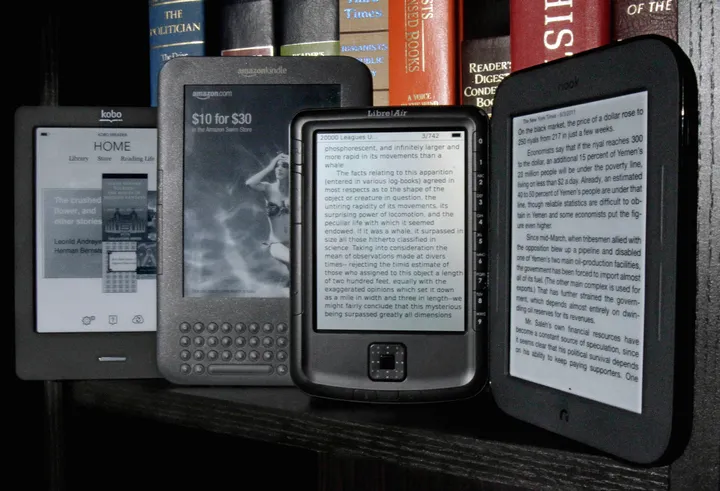
Last Thursday Apple announced a new way for textbooks to be both published and distributed to students. It is another step in disruptive practices that continues to erode a publishing model that has existed for five hundred years. Digital is here to stay. It will continue to change the way we both publish and consume the written word. The following article was co-authored with my CTO Chris Skaggs of Code-Monkeys. It is a call for seeing digital publishing in a new light.
- We meet an excited, tech-savvy, and often under 50 individual within an organization who sees potential in bringing some existing body of written content to new mediums like the web, iPad or even a video game.
- We talk; we brainstorm; we all get excited about a solid proposal.
- The proposal goes up the chain until it falls on the desk of either -- The somewhat older executive who uses words like 'new-fangled.' or -- The book purist who feels a kind of distaste for electronic media because it sullies the joy of reading.
- The project then disappears and the crestfallen techster tries to make her mark some other way.
Let me be clear. I too am a bibliophile. I love all kinds of books. I read Sandra Boynton to my kids and then Pushkin. I grew up devouring Sherlock Holmes and Homer. Despite my better judgment, Easton Press catalogs have become for me what the old Sears toy catalog used to be. So I really do understand the joy of reading.
But what I really love most about books is what they contain.
Don't get me wrong -- nothing is quite like the smell of old or new pages and the first crack of a spine. A tall stack of dusty tomes is enough to make me giddy. So please don't think I don't understand and experience the real pleasure a book can bring just for the sake of its very existence.
But I do find myself troubled by the folks who seem to treat books as a kind of idol. It is almost always associated with a notion that somehow books are natural and an iPad is un-natural. It is insinuated that books are somehow morally superior to a Kindle because of a never-quite-articulated notion that electronic devices pull people apart and discourage both community and intelligence.
Books were one of the most disruptive technologies ever invented , but they are also remarkably good for humanity. Socrates feared that writing would destroy the 'life of the mind' he loved so much. European theologians called the printing press the 'work of the Devil.' And when books became commonplace many intellectuals bemoaned the way salons were dying and that people were no longer talking to one another. Telephones were expected to destroy writing. The train was predicted to destroy communities all together.
Human nature is both communal and curious. When disruptive technologies appear, there is always a period of adjustment and adoption that unquestionably alters existing behavior. Technology though, can never really change who we are.
As eBooks explode in popularity and the iPad reigns as the most quickly adopted new technology ever, there is often a fifth step to the pattern I described above... Our aforementioned sub-50 publisher returns to us, sometimes sheepishly, 'Remember that thing we talked about 18 months ago? Can we bring that back up again?'
Of course we can my friend. After all, we're all in this together.