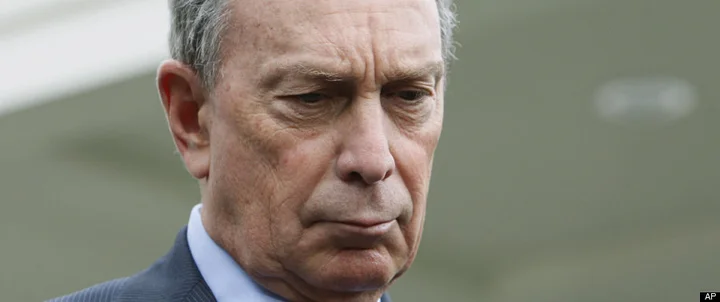
How do you solve a problem like Mike Bloomberg? That is to say, how do newspapers label a candidate like Mike Bloomberg? In light of last week's Quinnipiac University poll -- in which being called "a Republican and an Independent" dropped the mayor's lead from 22 points to 10 -- the answer matters a great deal.
Because though Bloomberg notably changed his registration from Republican to Independent in 2007, he is currently the candidate of both the city's Republican and Independence parties. So, should newspapers I.D. Bloomberg as "an independent," as his campaign would like? Couldn't his opponents argue that he ought to be labeled "Bloomberg, Republican-Independent?" Or, to compromise, "Independent-Republican?" Who decides what is fair?
It's not clear.
Take the example of John Lindsay. By July of 1965, Lindsay had a lock on both the Republican and Liberal Party nominations for mayor. Newspapers summarily began referring to him as the "Republican-Liberal" candidate in the race. No one has ever explained why, exactly. Here are a few of the possible explanations.
1. Lindsay was a registered member of the Republican Party. Hence, this affiliation received top billing.
2. The party with more members leads the label. The Liberals were a force in New York City politics, but their roll never even came close to matching the GOP's. That some affiliations were so insignificant as to barely ever warrant a mention also bolsters the case for I.D.-ing by size. Lindsay's third backer was the Independent Citizens party (an organization his campaign founded specifically for voters who wouldn't pull the Republican or Liberal levers). Yet the papers never referred to him as the "Republican-Liberal-Independent Citizens" nominee.
3. Habit. While running for mayor, Lindsay was serving in Congress, an office he won as a Republican four times over. Newspapers had been identifying him as a Republican for the eight years leading up to his '65 campaign.
4. The papers deferred to the candidate. It seems Lindsay never asked to be called by anything other than the "Republican-Liberal" label.
Either for or against him, any political operative worth his salt should be angling editors on how Bloomberg is addressed. Of course, Bloomberg has an option Lindsay didn't have: he could insist on being called 'Mayor' with no party at all.