More

Featuring fresh takes and real-time analysis from HuffPost's signature lineup of contributors
HuffPost Social Reading
John Dominic Crossan

GET UPDATES FROM John Dominic Crossan
 

The Search for the Historical Paul: How to Read The Letters of Paul

Posted: 09/23/2011 3:10 pm

It was the sheerest of sheer coincidences, and I cite it as such only to introduce my present subject. It happened in early May of 2011 as Marianne and Marcus Borg along, with Sarah and myself, were leading our annual pilgrimage In the Footsteps of Paul across western Turkey.

On Saturday the seventh we visited Antioch in Pisidia -- you will recall that Paul was there in Acts 13:14-52 -- and our group had lunch in nearby YalvaƧ. Since the local museum was not on our itinerary, Sarah and I gulped some soup and left the group to visit it for ourselves.

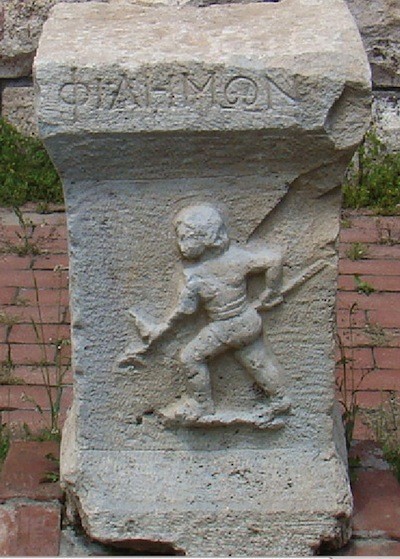
In the garden we found what looked like the funeral stele of a laborer whose Greek name was clearly: PHILEMON.

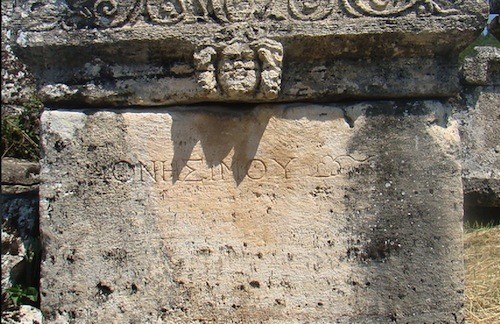
Next day, Sunday the eighth, our group was walking through the northern cemetery of Hierapolis, with its ancient mounds, broken sarcophagi and shattered house-tombs tossed one upon another as if by some irreverent giant (earthquake?). Amid those multiple inscriptions in wall-to-wall Greek, one name suddenly jumped out at us:

ONESIMUS.
To its right was an etrog, a lemon-like fruit usually associated with the Jewish Feast of Booths and therefore symbolizing a Jewish presence.

How, then, do you read a letter by the Apostle Paul to another Philemon about another Onesimus? Remember, first of all, that Paul's missives are closed letters to specific recipients -- not open epistles like, say, our "Letters to the Editor." In other words, reading them is reading somebody else's mail. If we do not understand them, Paul and his recipients did, and so the problem is mine and yours, not his and theirs.

The only way, therefore, to understand such a not-intended-for-you letter is to imagine its narrative -- that is, to expand over, under, around and through its given content until textual letter has finally morphed into contextual story. What, then, is the story behind Paul's Letter to Philemom with its one chapter of 25 verses?

Paul is in a governor's jail, chained to a soldier in the barracks, probably at Ephesus, capital of Rome's Asia Minor province. (From there, by the way, he also wrote a Letter to the Philippians.) He mentions his imprisonments four times and his advanced age once (1,9,10,13). That is not to whine -- something Paul never learned to do -- but is simply part of the powerful rhetorical persuasion unleashed by Paul on Philemon in this letter. But persuasion to do what?
Onesimus was a slave under threat of serious or maybe even fatal punishment from his master Philemon. Following an option allowed by Roman Law, he fled for intercession to Paul as his master's most important friend. But when Paul converted Onesimus to Christianity, a problem arose immediately. Could a Christian master own a Christian slave since "as many of you as were baptized into Christ have clothed yourselves with Christ" so that "there is no longer slave or free ... for all of you are one in Christ Jesus" (Galatians 3:27-28). How could Christians, as Christians, be equal and unequal at the same time?

Paul, therefore, writes this letter and sends it back to Philemon by Onesimus, calling him "my own very heart," and proclaiming him "no longer a slave but more than a slave, a beloved brother -- especially to me but how much more to you, both in the flesh and in the Lord" (16). Imagine Onesimus knocking on Philemon's door to announce that he had good news and bad news for his master: good that he was back, bad that he was free.

But why such a long letter to say, in effect, "Dear Philemon, Free Onesimus. Yours, Paul"? Because Paul is trying -- paradoxically -- to command Philemon to free Onesimus freely since, as he says, "I preferred to do nothing without your consent, in order that your good deed might be voluntary and not something forced" (14). Poor Philemon is on what we might see as a yo-yo of emotional manipulation but which advanced Greco-Roman education would have seen as a small masterpiece of very successful rhetorical persuasion created by a relentless oscillation of Good-Cop and Bad-Cop verses.

As just one example, compare these two verses at either end of the letter. Good-Cop Paul: "Though I am bold enough in Christ to command you to do your duty, yet I would rather appeal to you on the basis of love -- and I, Paul, do this as an old man, and now also as a prisoner of Christ Jesus" (8-9). Bad-Cop Paul: "Confident of your obedience, I am writing to you, knowing that you will do even more than I say" (21).

Did Philemon free Onesimus? Oh yes, because otherwise it would not have been necessary for those later post-, pseudo- and anti-pauline letters -- seen in an earlier blog -- to deradicalize Paul back into a compassionate conservatism acceptable to Roman cultural normalcy. To repeat, once again: Constantine, here we come.


It was the sheerest of sheer coincidences, and I cite it as such only to introduce my present subject. It happened in early May of 2011 as Marianne and Marcus Borg along, with Sarah and myself, were l...
 
 
  • Comments
  • 270
  • Pending Comments
  • 0
  • View FAQ
Comments are closed for this entry
View All
Favorites
Bloggers
Recency  | 
Popularity
Page: 1 2  Next ›  Last »  (2 total)
photo
Redhunteur
If I damn yer POV will u turn the other cheek?
07:16 AM on 09/28/2011
"When Paul converted Onesimus to Christianity, a problem arose immediately. Could a Christian master own a Christian slave since "as many of you as were baptized into Christ have clothed yourselves with Christ" so that "there is no longer slave or free ... for all of you are one in Christ Jesus" (Galatians 3:27-28). How could Christians, as Christians, be equal and unequal at the same time?"

All they had to do was proclaim allegiance to jesus and they could be free? Nice loophole for them. Too bad slaves were uneducated.
photo
HUFFPOST SUPER USER
Herkv
Caught in a loop . . .
12:17 AM on 09/28/2011
Since Acts is so late, it's doubtful that the information contained in there can be accurate about any early figures. The things we know about Paul from Acts are not things Paul says about himself.

Further, I mistrust anything by Paul. With the large numbers of Pauline forgeries, it's difficult to take any of it seriously. Also, the confusion with the figure of Appolonius of Tyana makes Paul's very existence a question.
photo
HUFFPOST SUPER USER
QuarkGluonSoup
11:51 AM on 09/28/2011
Acts isn't late (almost no one would argue it to be older than the 80s, which is only two decades after the events it discribes. Oh and none of the Pauline letters are forgeries. Only a minority of fringe scholars, like Crossan, doubt the "disputed" non-pastorals. Most also agree with Pauline authorship on the pastorals, even if you exclude fundemenatlist and devotional commentators. Crossan the founder of the Jesus Seminar, and because of this he has discredited himself among scholars.
photo
HeevenSteven
20 Minutes into the future.
01:48 PM on 09/28/2011
"..none of the Pauline letters are forgeries. Only a minority of fringe scholars.."

Source for that?
photo
HeevenSteven
20 Minutes into the future.
10:35 PM on 09/28/2011
Well? C'mon, show me the money.
03:46 PM on 09/28/2011
There is no evidence for a late date for Acts. The dating that makes the most sense, given that Paul is a major topic of the book and the narrative ends abruptly with Paul under house arrest in Rome, is that it was completed in the early 60s AD.
photo
HUFFPOST SUPER USER
Herkv
Caught in a loop . . .
11:12 AM on 09/29/2011
Of course there is evidence for a late Acts. Some think that it contains information that parallels Josephus' The Wars of the Jews. Also, traces of the work that are not disputed don't show up until late in the 2nd century. Perhaps it was a work in progress. J.C. O'Neill dates acts around 130 CE,
This user has chosen to opt out of the Badges program
photo
02:27 AM on 09/27/2011
Generic comment:
I want to make a simple clarification to dissipate any misunderstanding. When I speak of a birth certificate for Jesus or any other Biblical character, I mean it as a Hyperbole (figure of speech) to emphasize the lack of historical source(s), other than the NT.
If need be to be more lengthy and specific; there are no documents emanating from a Roman (Pontius Pilate), Greek, or Jewish (Caifas) Magistrate, a Roman or Greek historian, etc. that mentions a Jesus the Christ. There are no other verifiable, objective, sources, mentioning a JC or a SAUL (aka PAUL) in all of history. A letter signed Paul can be confused with another Paul.
Therefore, analyzing texts they may or may not have written (or have said) may be a pleasant philosophical exercise, but we cannot take this too seriously; unless of course, once again, there is corroboration.
photo
HUFFPOST SUPER USER
TheWM
aka The Wrong Monkey
09:47 AM on 09/27/2011
Until the mid-20th century, there was no known contemporary Roman record of Pontius Pilate. Then in 1961 a piece of limestone bearing an inscription from Pilate dedicated to Tiberius was found in the ruins of the Roman capital of Judea. Up until then Pilate's existence had been about as well-documented as Jesus'. That's the governor of the entire Roman province of Judea, as compared to Jesus, a wandering preacher with 12 followers who offended the authorities and got crucified. Crucifixion was reserved for the lower classes, and ancient history was primarily about the upper classes. The only other person I can think of who may have been crucified by the Romans whom we know by name is Spartacus, who led an army of thousands. (There may be others, I can't think of anyone besides Spartacus.)

This notion that we have detailed Roman records of everything that went on the Empire is a myth. Roman officials recorded many things, but almost all of their written records are long gone.

I'm not sure whether Jesus existed or not. But if he did I see no reason why any official Roman record of his existence, if there ever was one to begin with, should have survived
02:47 PM on 09/27/2011
WM - thank you for your objective remarks. The same things may be said of the "Miriam Ossuary" which mentions the name of "Caiaphas" - the high priest residing over the illegal trial of Jesus as found in John 18/Mt 26.

The HuffPo ran an article on this ossurary - check it out for yourselves.

www.huffingtonpost.com/2011/06/29/ancient-israeli-ossuary-genuine...
11:55 AM on 10/01/2011
One thing many people forget as to why the historical record is so sparse on many subjects has to do with the ignorance and arrogance of the church itself. Once in power they supressed, altered and destroyed any thing not towing the official line. Entire libraries, temples and artwork were purposely burned, smashed and obliterated. And they continued this crime against humanity for nearly 2000 years. Only a few Myans books remain today, thousands of them burned as works of the devil. Entire histories of many civilizations were entirely wiped out. As the old adage says, history is written by the victors. The church is evil and committed the most vile of crimes humanity by denying us our shared histories. All the while fabricating and whitewashing their own sordid history.
This user has chosen to opt out of the Badges program
photo
02:23 AM on 09/27/2011
Dear HeevenSteven (9/25),

I hope that I have not unintentionally caused you any dismay. When I address a specific comment or a specific person, if you notice in my other comments, I start with 'Dear (name of person)' or date of post. My comment concerning the existence of a Jesus was a generic remark and not intended for you in particular. Sometimes the shuffle after 'pending comment' creates confusion. I apologize for any grief.

Cheers
photo
HeevenSteven
20 Minutes into the future.
06:47 AM on 09/27/2011
No sweat. My comment should have been more clear. I really should read and edit before I hit the post button... but that's not as much fun;-)
photo
HeevenSteven
20 Minutes into the future.
05:37 PM on 09/26/2011
hanery 2. I responded below my comment, If you respond start a new thread up top.
10:35 AM on 09/27/2011
Thanks for the reply Heeven.

Doherty's theories are not taken seriously.You will not find it quoted in by scholars in the field, or in University libraries. I am a historian in a British university and we use Copac to search across pretty much every academic library in the country, and a search on Doherty's book reveals no University has his books. As for Price, but he is on the extreme fringes (and with neglible presence in academic libraries and books), he does not have a teaching position at a University, nor does he publish in any of the recognized series in the field. So quoting him does not indicate represent an acceptance of Doherty's research in academia. We have a process of peer-review and a society that generally defers to the results of scholarship. Those who don't and depend on internet myths or self-published books by amateurs such as creationists, climate-change deniers, and general conspiracy theorists are rightly put on the fringes. I see little difference in this case. As for Paul not knowing or quoting from Jesus that is a rather old, stale trope that has been rebuffed by the likes of Bruce, Dunn, Wehman, Barnett etc...

Also, the Jesus Seminar never (despite what you suggested) voted on whether Jesus existed. Someone actually offered them money to do so, and they refused.
photo
HeevenSteven
20 Minutes into the future.
12:37 PM on 09/27/2011
Thanks for your response.

My mistake; I've since found the Jesus Seminar votes on statements by Jesus and events. Your points about peer review and academia are well taken. I'm an engineer, and well read on climate science, so you know where I'm coming from there; but of course science is a different ballgame from history.

I can and have read Paul's letters myself, although I can't read the original Greek. I can can see for myself that he doesn't seem to know about the stories or sayings in the gospels. Bart Ehrman--of course everyone knows him and his credentials--makes the same point, and he's not fringe. It's my understanding he usually represents a consensus view, so I don't know why you call it a "stale trope", unless of course you have theological motivations.

Now stretching that into a theory of a non existent Jesus is of course not ever provable, but it like all historical judgements can't ever be anything but provisional. But then so is an actual living historical Jesus. Thanks for inspiring me to read more.
This user has chosen to opt out of the Badges program
photo
02:47 PM on 09/27/2011
No scholars in the field quote him or take him seriously?
I have heard Hector Avalos and Robert Price quote him (Price numerous times). And no, Bob Price is not "on the extreme fringes" just because you disagree with his conclusions. How about Joseph Hoffmann?

" ... we use Copac to search across pretty much every academic library in the country, and a search on Doherty's book reveals no University has his books."

This is the result I get when I search Copac for 'The Jesus puzzle' - http://copac.ac.uk/search?rn=2&au=Earl+Doherty&sort-order=ti%2C-date
And, here's the result for the 'King James Bible' - http://copac.ac.uk/search?rn=1&ti=king+james+bible - hmmmm, that's not listed in any University libraries either?

And, "As for Paul not knowing or quoting from Jesus that is a rather old, stale trope that has been rebuffed by the likes of Bruce, Dunn, Wehman, Barnett etc... "

Rebuffed? Maybe so, but certainly not refuted. If you can point to where this is wrong, please do.
02:45 PM on 09/26/2011
One thing for certain is the Romans could not do matter how hard they tried make themselves God' chosen people the 12 Tribes of Israelites. Whom Jesus own sayings says. Jesus said. I have been sent to the lost Tribes of Israel. The time Jesus enters lives on earth, 10 tribes have fled into other Nations because of the Roman wars, they were all scattered. Some leaving by choice returning back to their own Nations from where they came, escape Roman persecution and many sadly were captured by other Nations around them, taken as slaves and over time lost their own identity who they are for they took on their slave masters name and country they were held slaves in. Jesus said. I have been sent to the lost tribes of Israel (Jacob). God said in the end of time, not man but God will place it in their hearts to know who they are. God will call them home. God said I Will gather the lost tribes of Israel from the 4 quarters of the earth. I Will not man will. For they till this day know not who they are still. Those lost tribes turned into larger Nations. Jesus also mentions it will be like in the time of Noah. Noah was the only man with his family to repopulate the world after the flood. Noah had 3 sons. Ham, Shem, Japheth. What interest me who they are, where they first settled and what blood line all came from,for they all had the one father right? They say in the bible OT the Isralities Nation began in Egypt, which they called the Land of Ham. Interesting no one teaches us about the sons of Noah or breaks it down for us. What I have found is that scripture gives us facts about Israel (Ysrahyl) is regard to their physical appearances. Stating Ham (Knawm) in Hebrew means Black, Hot, Burnt-Ham had 4 sons. Cush (Ethiopian/Cushites and Nubians), Mizraim (Egyptians/Khemel) Put (Ancient Somalia) Canaan ( Canaanite, the original inhabits of the Land of Israel) Geneses 10:6-19 Now Moses marries an Ethiopian and gets critized for this. (Cushite, stems from Ham) woman number 12:1-16 Interesting find. Israelite Heritage, interesting find, if one has an open mind. Love all dearly. Jesus mentions tells us it will be like in the time of Noah. Reason why I believe Jesus mentions Noah name also, I ask?
HUFFPOST SUPER USER
larry cifuentes
10:58 AM on 09/26/2011
The church’s one whole wall,
is mural dedicated to ā€œPaul.ā€
This man is believed to be the gun,
Jesus came down, to face one to one.

Paul the wise Owl, Paul the Foxy smart,
is all to all answers, astrological like chart.
Whether indirectly subtle and other times not,
Paul, the most quoted oracle, is this world’s despot.

All of Paul’s ideas come off the church’s wall,
with Paul’s self-snobbery surpassing them all.
Paul tells you are God’s special, yet makes it belief
Paul’s opinions be your answer to life’s each grief.
This user has chosen to opt out of the Badges program
Cindy Tregan
Proud D.F.H. Lib'rul
10:11 AM on 09/26/2011
"How to read the letters of Paul (sic)"
A) As the misogynist rantings of the killer of the followers of Jesus, Saul of Tarsus.
B) See A - above.
photo
HUFFPOST SUPER USER
TheWM
aka The Wrong Monkey
10:59 AM on 09/26/2011
A couple of thoughts about the misogyny. For some reason I was reminded of the literary critic Alfred Kazin, who happened to be Jewish, ethnically. (He wasn't particularly religious, in a Jewish way or otherwise.) He had given a lecture on T S Eliot, and afterwords, someone approached him and asked, "How can you read that awful anti-Semite?" Kazin said, "He's a good writer. If I never read any anti-Semites I wouldn't have much to read." Similarly, if you want to study writings of ancient Romans, Greeks, Jews and their neighbors, and decide not to read any misogynists, you may find your reading choices severely limited. Unfortunately it was a very widespread tendency. Also, some of the worst misogyny associated with Paul is expressed in 1 Timothy, which, it is generally agreed today, Paul. Actually. Didn't. Write. Take 1 Timothy out of the equation and Paul looks somewhat different.
photo
SayBlade
This micro bio intentionally left blank.
11:28 AM on 09/26/2011
I agree. An example of this is my noting that people I know strongly disagree with the writings of Ayn Rand. Then, I read something about Ayn Rand and some excerpts of her writings and I understand better why they disagree. Another issue in the discussion of scriptures of course is the fact they were written a long time ago and filtered through the lens of translators and cultural biases over hundreds and hundreds of years. Even looking at the "original" manuscripts one must be aware that even these were copies.

For possibly another discussion thread, there are also gospels and letters not in the current canon of scripture that change the angle of the light used to view them.
02:54 PM on 09/27/2011
The rant of subjetive secularism.

Saul repented - but you probably missed that - or ignored it.
photo
HUFFPOST SUPER USER
TaiJi2
06:51 PM on 09/29/2011
Yeah, sorry, but that didn't make him any less of a legalistic fanatic. The leopard may have changed his religion, but even a cursory read shows he didn't change his spots.
08:07 AM on 09/26/2011
First I am surprised that St Paul being in prison so long in Rome and with so many gospels burned lost , destroyed, hidden and not found till centuries later, yet half missing pages, writings lost  etc in asking is  it not greatly amazing that St Paul's lengthy many letters are in full, perfect  tact and not in pieces, were not destroyed, burned, lost, and stating things Jesus never said or talked about? Interesting?  

 St Luke and St Paul were in prison together. ST Luke was a gentle. St Paul in his letters says only Luke is here with me.  Even St Timothy leaves St Paul. ST Luke was also known as a slave for in those times St Luke was known as physician and they were slaves and where St Luke his name comes from his slave Master. Why all the letters? St Paul is in prison? A question St Paul is asking Philemom to free Onesimus as a slave, but St Paul has not asking Philemon to free St Paul himself out of prison? Interesting. St Paul is in Prison why many letters, and why ST Paul does not go directly to Philemon? Amazing how St Paul letters are not destroyed?
This user has chosen to opt out of the Badges program
photo
01:47 PM on 09/26/2011
Hi Sunshine, from my memory, Luke was not in prison, Paul was under house arrest, meaning he was not in a dungeon cell, he lived with sympathetic Christian supporters in their home, we have that same thing going on today with court monitored ankle bracelets for those who have house or time restrictions, being they are not a harm to the public, and influential people or bail as surety of trial appearance, I remember Paul while under house arrest asking in a letter for others to bring him certain items like his correspondence writings and his jacket, a Julian Assange situation.
05:14 PM on 09/26/2011
Agreed. And "prison" was a harsh term. Almost like someone saying that Bernie Madoff is in "prison."
photo
buggeroffyou666
Hierophant of the Crawling Chaos
06:35 PM on 09/25/2011
Shouldn't you start out by asking who really wrote the letters of Paul and why they did it?
photo
HUFFPOST SUPER USER
TheWM
aka The Wrong Monkey
12:36 AM on 09/26/2011
This may surprise you, but he actually does far more in his article to legitimize Evangelical Christianity by saying that Romans, and 1st & 2nd Corinthians are genuine, as these are the large books that outline basic Christian theology and instructions for behavior.

The only books he claims are outright fakes are 1st and 2nd Timothy and Titus. These are not nearly as significant as they are small books that mostly deal with practical orders to ministers to rebuke false teachers and preach the gospel.

If he really wanted to "shake things up" he should have claimed that Romans was a forgery. Most Evangelical theology comes directly from there.
09:22 AM on 09/26/2011
my opinion only the question not in understanding is, if  St Paul way in saying to enter the Kingdom, one must believe in Jesus, yet Jesus states clearly in his sayings to enter the Kingdom each one must obey fully the Commandments of God, then if by St Paul's way is a far more easy way, just believe in Jesus the cross. Your sins are forgiven, only what is needed to enter the Kingdom then all are going to heaven, even those who do not obey the commandments or live their own personal way regardless if one does not obey the commandments. Then all are forgiven why then is there going to be judgment all over again? Jesus preached fully about God, St Paul preached about Jesus the cross? With Jesus then it was all about God, not about Jesus was it? So if one believes in God but not in Jesus I am confused. St Paul makes it all about Jesus, but Jesus Moses, Abraham, Noah, Elijah, John the Baptize Issiah made it also all about what is pleasing to God, was never about themselves was it? Obey believe accept the Word of God and what God ask of all of us, if one believes in Me, God then obey my commandments to enter the Kingdom. Clearly what Jesus did fully obeyed God first did all that pleases God, Jesus came to choose us the Way, The Truth, was the Light in Darkness follow me, what I have done, telling us also do not think because you follow me, you to will not be persecuted for your belief in God like all the other anointed ones, where all known as messengers sent by God,  who came before Jesus also suffered and died, persecuted also by others. All before Jesus like Jesus were called after when Judged, Righteous men of God, Righteousness enters the Kingdom, ones personal faith, living their life justly doing all that pleases God first, obey the commandments. Why it is not over, return to me and I will return to you. Obey the commandments to enter the Kingdom is what Jesus taught, like Jesus did. God said. Why do you call me Lord Lord and do not obey my commandments? God said Get away from me I know you not. Jesus and ST Paul's teaching seem opposite to each other?
photo
YannosB
I REASON, THINK, LEARN Equally
09:45 AM on 09/26/2011
I do not find that Paul is circumventing obeying the commandments at all. In his holding us to 'follow' Christ, the meaning is not simply in saying 'yeah, He is the One", and such as that; but in following, as in doing and mimicking all That Christ showed by example, and that indeed would lead to obeying all of the commandments, would it not?
Paul clearly puts responsibility on us to preform the faith ...'faith with out works is dead', and similar calls all show that Accepting Christ is much more than mere ideological or intellectualism; it is living that which Christ himself upheld.
The Beauty of Christ, is that even in our most sincere effort, none would succeed, for all have fallen short. But in our belief and acceptance of the true sacrifice, the fulfillment by Christ of the requirements of God; In Christ we can cover those area's where we do not make the mark, by His Marks.
photo
jokamachi
You're doing it wrong.
05:19 PM on 09/25/2011
The "letter's" of Paul? Really?
photo
HUFFPOST SUPER USER
TheWM
aka The Wrong Monkey
07:46 PM on 09/25/2011
No, not the letter's, the letters.
02:55 AM on 09/26/2011
my first thought too. at least they got it right in the actual article.
photo
HeevenSteven
20 Minutes into the future.
11:40 AM on 09/25/2011
I haven't read much by this author. Does anyone know his opinion about whether Paul was writing about an actual historical Jesus? I know the Jesus Seminar he once chaired votes on this every year.
This user has chosen to opt out of the Badges program
photo
12:26 PM on 09/25/2011
There is no such thing as a historical Jesus until someone finds his birth certificate, his bones (probably already lost to science) and/or establishes historical corroboration for such an individual; it is all hearsay and myth otherwise, to be taken on faith only.
photo
HUFFPOST SUPER USER
TheWM
aka The Wrong Monkey
12:44 PM on 09/25/2011
"There is no such thing as a historical Jesus until someone finds his birth certificatĀ­e"

Great point. Why don't you get right on that. Go. Go now. go and search for Jesus' birth certificate, and come back when you've got something interesting and/or informative to contribute to the discussion. I'm sure we're all looking forward to it.
photo
HeevenSteven
20 Minutes into the future.
03:18 PM on 09/25/2011
Well I don't think we have a birth cert for Homer or Plato et al; but what I'm referring to is the Jesus of the gospels, the Rabbi from Nazareth with a ministry in Galilee. The fact that we don't DNA evidence is irrelevant. I'm talking about the person in the gospels fictional or otherwise. You see Paul doesn't seem to know anything about him.
photo
HUFFPOST SUPER USER
TheWM
aka The Wrong Monkey
12:30 PM on 09/25/2011
If you're asking whether Crossan believes there really was a Jesus -- yes, he does. His portrait of Jesus is that of a radical egalitarian peasant, more of a socialist and less of a preacher than the way Jesus is presented by some other scholars. For example, he sees the stories of Jesus healing lepers arising from Jesus being willing to interact with people who weren't kosher. A term for "unclean," Crossan says, originally meant "un-kosher," and was misinterpreted as "leprous." He also believes in the Q document, and he dates Q and the Gospel of Thomas and the Gospel of John earlier than the canonical Gospels. The Q hypothesis is controversial, and Crossan's dating of the Gospels of Thomas and Peter is very controversial. Most experts assign them to the mid-second century.
photo
HeevenSteven
20 Minutes into the future.
03:20 PM on 09/25/2011
Ah, thanks! Of course I could use the google, but...
08:29 AM on 09/26/2011
leprosy was leprosy now changing the definitions of what leprosy was? Clearly leprosy turned one skin white for all to see read Moses. Who is the author of Q where did it come from who wrote them? Jesus teaches the great importance to obey the Commandments to enter the Kingdom.Jesus came not to change the laws but Jesus preaches about God. St Paul teaches about Jesus? ST Paul teaches the opposite what Jesus taught, obey the commandments and says so to enter the Kingdom. St Paul teaches about the cross, to enter the Kingdom?. Which Jesus never preaches about but Jesus personally meets with individual sinners as his teaching and cured them of their wrong way of living, personal choices,  they repent sin no more? Interesting?
photo
HUFFPOST SUPER USER
TheWM
aka The Wrong Monkey
11:05 AM on 09/25/2011
"It was the sheerest of sheer coincidences, and I cite it as such only to introduce my present subject."

Or perhaps because you have very little to say about your ostensible subject.

"Remember, first of all, that Paul's missives are closed letters to specific recipients -- not open epistles like, say, our 'Letters to the Editor.'"

How do you know Paul didn't have a wider audience in mind when he wrote his letters?

"The only way, therefore, to understand such a not-intended-for-you letter is to imagine its narrative -- that is, to expand over, under, around and through its given content until textual letter has finally morphed into contextual story."

Imaginative expansion. I imagine that must be easier than trying to actually prove things.
08:45 AM on 09/26/2011
What Jesus message work was unsuccessful? Yes, St Paul was he out to have a wider audience then Jesus? Why? Interesting. Like St Paul is creating more laws of his own? Not what Jesus said or preached about?
photo
HUFFPOST SUPER USER
TheWM
aka The Wrong Monkey
10:33 AM on 09/26/2011
Please stop talking to me.
10:43 AM on 09/25/2011
Mr. Saul of Tarsus is the cause of all troubles in the christian world. He created a religion of his own based in some others philosophies.
photo
HUFFPOST SUPER USER
TheWM
aka The Wrong Monkey
11:14 AM on 09/25/2011
No, people who scapegoat other are responsible for all the troubles in the world.
This user has chosen to opt out of the Badges program
03:32 PM on 09/25/2011
Gee whiz.. he could at least have named his religion after himself . Paulitian sounds rather nice.
This user has chosen to opt out of the Badges program
photo
Sunwyn Ravenwood
Farewell my friends, time to go...
07:36 AM on 09/25/2011
I don't see why anyone would even bother to read the letters of Saul of Tarsus. In the first place, half of them are complete forgeries, and the ones that aren't have had verses inserted in them by later editors that put the editor's opinions in Saul's mouth. And that being said, even the real parts of the real letters are full of lies. There are three or four different stories about how Saul had his vision, who heard what, who saw what, who said what, where he went afterward, etc. There are only two certain things about Saul: one, he never saw Jesus in his life, was never a disciple, never an apostle, never heard one sermon by Jesus, and two, he spent most of his time arguing with the real apostles, defaming them, telling lies about them, and misrepresenting the authentic teachings of Jesus. There are a lot of Paulines in the world but the number of real followers of Jesus is pretty close to zero.
09:39 AM on 09/25/2011
I assure you, I follow Jesus every step of my life. I am defiantly not perfect, but I do my best to follow his teachings. I am not as hard as you on Paul because we can see his conversion from a persecuting man into a kind loving man even if someone did alter his writing some. So even if he did not see Christ in person, he followed his salvation plan through the Holy Spirit. So in this way, he does have great value to all of Christianity.
12:08 AM on 09/26/2011
Name me one thing that Paul said that runs counter to what Jesus said. Back it up with direct quotations.
This user has chosen to opt out of the Badges program
photo
Sunwyn Ravenwood
Farewell my friends, time to go...
12:56 AM on 09/26/2011
Mathew 5:17 & 18. Jesus upheld the Law saying it would be valid until Heaven and Earth passed away. So did James the brother of Jesus. The entire Epistle of James is a countervail to the false teachings of Paul. Paul taught that the Law was invalid and that only faith in the Risen Christ was needed for salvation. He turned the religion OF Jesus, a faithful and observant Jew into the religion ABOUT Jesus and corrupted the Law and the Prophets.
09:01 AM on 09/26/2011
When asked what must I do to enter the Kingdom,  Jesus said:  Obey the commandments if one wants to enter the Kingdom. That runs fully counter to what later St Paul's is teaching, St Paul preaches now about Jesus the cross if one wants to enter the Kingdom, not the commandments.
Jesus said: Why do you call me Lord Lord, and you do not obey the Laws?  Jesus, read all his sayings, preaches to enter the Kingdom obey the commandments, repent sin no more.  Jesus preaches about God, St Paul preaches about Jesus. Jesus said. Do not think I have come to change 1 Tittle of the Laws of Moses, but to add a new one, Love your neighbor as you love yourself. Commandments were greatly important to Jesus which he himself fully obeyed, to enter the Kingdom, with Jesus was not the cross was it? But with St Paul teaches the opposite the way to enter the kingdom is the cross,not what Jesus taught at all. Interesting. Jesus said I Am the Way the Light and the Truth. Follow me, we too will suffer persecution for God all who believe, but obey the commandments if one wants to enter the Kingdom.