

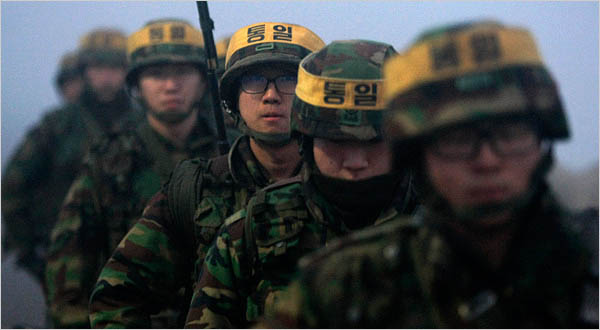
Ahnyoung-Joon/Associated Press
If you look closely at the AP photograph above of the South Korean marines conducting a drill on Yeonpyoeong island, you can see that their yellow headbands read tongil. That's the Korean word for reunification. With the South Korean government conducting another round of live-fire artillery drills in contested waters near North Korea, the message of the headband is unambiguous. Rather than waiting patiently for reunification to take place through negotiations, the Lee Myoung-bak administration wants to accelerate the process, by force if necessary.
When South Korea conducted live-fire drills in the area last month, North Korea responded by shelling Yeonpyeong island, killing two soldiers and two civilians. The South shelled back. This time around, the South disregarded pleas by China and Russia to postpone its military exercise. On Monday, it conducted 90 minutes of artillery shelling from Yeonpyeong island as South Korean jet fighters flew overhead. Despite initial threats to retaliate, North Korea has so far refrained from responding to what it has called a "despicable military provocation."
South Korea's resolve to go through with the test was simply a refusal to be bullied, argued many analysts, including former South Korean foreign minister Han Sung-Joo. "If each North Korean threat tied our hands, we would become hostage to their threats," he commented.
As the yellow headbands indicate, however, the current South Korean government is not just sending a message of deterrence. The Lee Myung-bak government, like its recent predecessors, sees an opportunity to break the stalemate on the peninsula. But unlike either the Kim Dae-Jung or Roh Moo-Hyun administration, Lee doesn't see a long, slow process of negotiating reunification.
When Lee looks north, he sees an ailing dictator, a struggling economy, and a desperate national-security apparatus. The WikiLeaks documents, meanwhile, suggested that China was losing patience with its North Korean ally. All of this contributed to last week's statement by the South Korean president that "unification is drawing near." The South Korean government is putting money into preparing for regime collapse in the north in much the way the Kim and Roh governments put money into engaging the north economically and politically.
The U.S. government has generally backed the South Korean government's more aggressive posture. Twenty U.S. soldiers participated in the recent live-fire drill. Joint South Korean-U.S. military exercises in these contested wars have ratcheted up the tensions. And at the United Nations, the United States has pushed for a condemnation of North Korea's November 23 artillery attack to be included in a statement otherwise designed to calm the waters. China has blocked consensus, sensibly pointing out that such a statement would only roil the waters more.
At the same time, New Mexico Governor Bill Richardson just returned from Pyongyang with the outlines of a possible deal that could bring the disputing parties back to the negotiating table. North Korea is willing to allow back UN nuclear inspectors, send fuel rods out of the country, and establish a hot line between the two Koreas and the United States. While in Pyongyang, Richardson urged the North Korean leadership to show "maximum restraint" in dealing with South Korea's drills.
Today North Korea followed Richardson's advice. Now it's the South Korean and U.S. turn to show maximum restraint. By following up on the offer on the table, all sides can step away from the precipice and go back to pursuing reunification the old-fashioned way: by talking, not fighting.
Subscribe to FPIF's World Beat here.
Sign up with FPIF on Facebook.
Follow FPIF on Twitter.
Follow John Feffer on Twitter.