iPhone app iPad app Android phone app Android tablet app More

Featuring fresh takes and real-time analysis from HuffPost's signature lineup of contributors
John Fox

GET UPDATES FROM John Fox
 

SEO Doesn't Matter...To The 1%

Posted: 08/01/2012 9:06 pm

Seems the top 1 percent get special treatment no matter the subject, even when it comes to search engine ranking.

If you happen to be one of the top sites on the Internet, you can ignore the fundamental optimization "rules." You don't have to worry about SEO minutia like the rest of us. While we're counting Title-tag character length, wondering if our Meta-descriptions are meaningful (or complete nonsense) and rewriting H1 (heading) tags for the tenth time, the lucky 1% can rest easy.
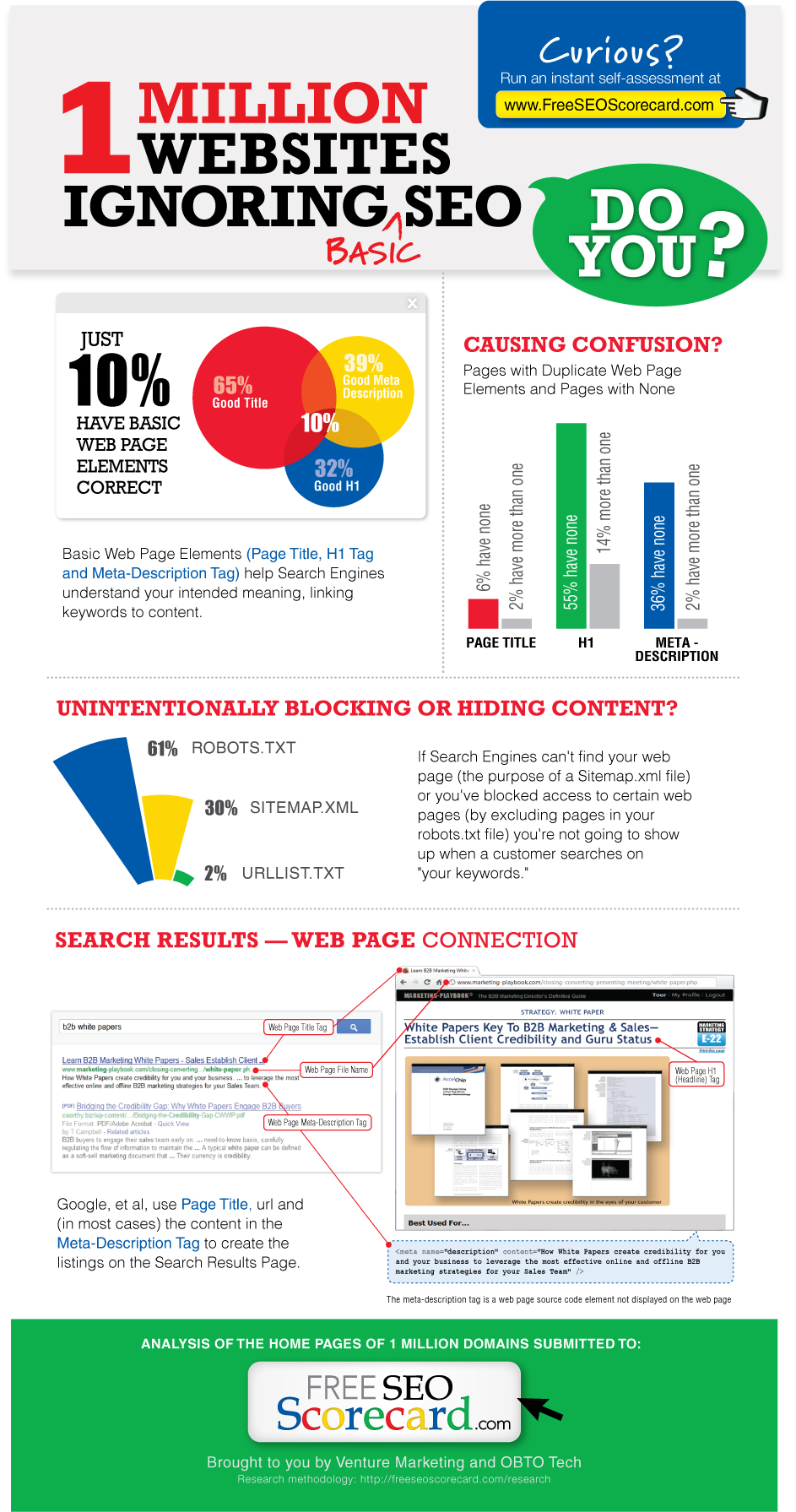
1 million websites ignoring SEO

We just finished analyzing 1 million home pages of the top 1 percent of all 141 million active websites* on the internet (see Infographic). We found that just 9.6 percent had all three basic web page elements correct.

And yet, the 1-percenters are still on top. What gives?

Why 1-Percenters Can Ignore SEO

It turns out the vast majority of people are interested in content on the most popular, top 1% of sites.

This makes sense most of the time. For instance:

  • If you search for insurance, most likely you want to see links to insurance companies like Allstate (#8299), State Farm (#5120), Progressive (#4103) or Geico (#3031). **
  • If you search for iPad, chances are you're looking for Apple's website (#36), a review on CNET (#100) or a used iPad on eBay (#23).

Not only does Google understand that what you're looking for is probably on a 1-percenter website, they have a huge financial incentive to get it right. Providing search results with links to those top sites is just too valuable to Google. [translation: Google wouldn't be able to sell ads on the right side of the page corresponding to the search results on the left side of the page]

To do its ranking, Google relies on the power of social media and the millions of inbound links to these top websites to make meaning of the content, even when the website content does not follow fundamental SEO guidelines.

In other words, the sheer volume of inbound links to these 1-percenter sites more than compensates for messy content.

Why Your Site Cannot Ignore SEO

Odds are that your site is probably in the 99%:

  • Your site shows up on page 6 when someone Googles "your keywords"
  • 50 or fewer visits per day
  • Alexa.com reports your site's rank higher than 1,000,000
  • Only a few sites link to your website

In your case, the main thing Google relies on IS the content on your web pages. If your content has been poorly formatted or is incomplete, guess what? You're likely to confuse Google's indexing engine.

So yes, those title tags and H1 elements do matter!

This doesn't mean your pages won't get indexed. If Google can find your content they will index your website. It's just that your big, important keywords may carry a less weight in comparison to other content. And when that happens, your big, important keywords aren't interpreted as important to Google.

Knowing What To Fix

If you're curious to find out how you're doing (or how your competitor's website stacks up), I've set up a free site for you to generate an instant scorecard of any web page at: http://FreeSEOScorecard.com

And full disclosure: I was part of the team that conceived and built FreeSEOScorecard.com

See how you do and report back.

Sources:
* 141 million active websites as reported by Whois Source (http://www.whois.sc/internet-statistics)
** Website rankings as reported by Alexa.com

Infographic provided by Venture Marketing under Creative Commons Attribution-NoDerivs 2.5 Generic (CC BY-ND 2.5)


Follow John Fox on Twitter: www.twitter.com/b2bmarketing

FOLLOW TECH
 
 
  • Comments
  • 4
  • Pending Comments
  • 0
  • View FAQ
Comments are closed for this entry
View All
Recency  | 
Popularity
11:19 AM on 08/17/2012
Quality content not only includes proper SEO formatting. Quality content includes proper grammar, punctuation, ease of readability, and sentence and paragraph structure. Your articles contain quality content! Thanks for not boring me.
This user has chosen to opt out of the Badges program
12:48 PM on 08/02/2012
I have a slightly different professional opinion on the matter. . .

People don't "first find the web site, then find the business." That's the premise of SEO and I frankly think that it's wrong. People today "talk to their friends," get recommendations, see advertisements, and click on the links that are in the signature-lines of blog and forum postings that they have come to like. They click on links on map pages. In other words, they encounter your page because of something =other= than a keyword search.

In a typical Google search result, NEVER MIND the number of pages that they claim to have retrieved. The true result-set is 150 to 300 pages; never more. If the page length is 20 sites per page, then there's a 14-in-15 chance that your site is not on page one, and a 13-in-15 chance that it's neither on page one nor two. But that whole concern presupposes that, in their attempt to find you, people just blindly typed in a keyword and picked a link. That's simply not an efficient way to do it.

"The efficient way to do it," of course, is to do what you did: publish an article, and include a hotlink in that article. People look for people who have something to say. They skip entirely the whole keyword-search approach, which after all is simply being carried out by a digital computer ... and digital computers can't read.
This user has chosen to opt out of the Badges program
10:48 PM on 08/02/2012
Postscript:

Please note that, in the above comment, I do not wish to imply that SEO is totally without merit. "Google is a fantastic editor" because it =is= a computer. Since it really =doesn't= "understand one single word you're saying," even as its algorithms mightily attempt to mimic 'human' behavior, it is a marvelous if somewhat unconventional "editor" for your prose.

But ... real-world people (like you and me, for "obvious" reasons) do not strictly rely upon keyword searches. And, (sorry, Google...) we don't find Google search-results to be all that tremendously useful(!). (Google IS "just a dumb computer," after all...) So, "Google has its place," yes, and it is a good place, yes, BUT ... in our human world, "it's not the end of the world." And most of us are probably okay with that, are we not? :->
11:16 AM on 08/02/2012
Google is, of course, an advertising company. But they became the advertising giant they are today because of one key technical innovation in web search: the idea that the number of external pages linking to a site/page is a strong indicator of the quality of that site/page. If other sites are linking to your site, then Google will more readily link to your site.

It's not just the top 1%. The whole way down the Alexa charts, Google is measuring and ranking sites based on their external reference counts. They're measuring how much people are sharing links to your site on social networks. They're measuring how often people choose your site from the list of search results. They're measuring a bunch of statistically significant factors which have no direct relation to the content, structure, or metadata of your HTML documents.

And it seems inevitable that the connectivity of your site with respect to the world wide web and the types of navigation chains that users tend to follow to your site will have an increasing influence on search results because of the rise of social content feeds and client-side web applications.

In particular, it's tricky to do traditional SEO on the slick new breed of client-side web apps and even trickier for indexing web crawlers to make sense of their content. It may be that the role of traditional web search is evolving toward pointing the user to the content platform(s) most likely to host the kind of content the user is requesting and, whenever possible, redirecting their queries to the specialized search functionality on those platforms.