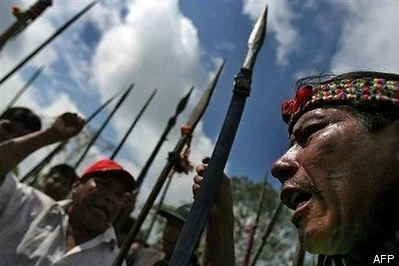
(On assignment for Amazon Watch)
Before dawn on Friday, June 5, an estimated 650 Peruvian National Police and Special Forces officers attacked several thousand Awajun and Wambis indigenous people at their roadside blockade on the Fernando Belaunde Terry highway. 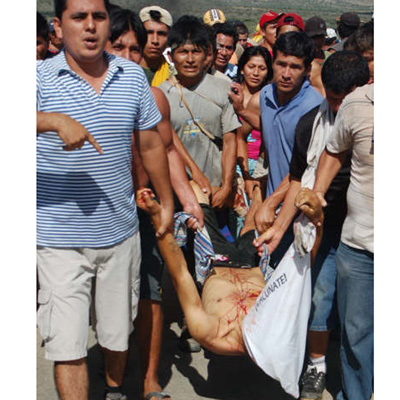
The Awajun and Wambis indigenous peoples had been participating in a general strike called to demand the Peruvian Government repeal a series of laws and executive orders that would allow the government to make it easy to grant indigenous lands to multinational oil, mining, and energy corporations. A Peruvian congressional committee declared several of the laws to be unconstitutional, but President Alan Garcia and his APRA party (American Popular Revolutionary Alliance) have repeatedly blocked congressional debate that would vote to revoke the laws.
The broad coalition of Amazonian indigenous peoples fighting the laws called a general strike on April 9 and has since been carrying out well-coordinated acts of civil disobedience throughout the region.
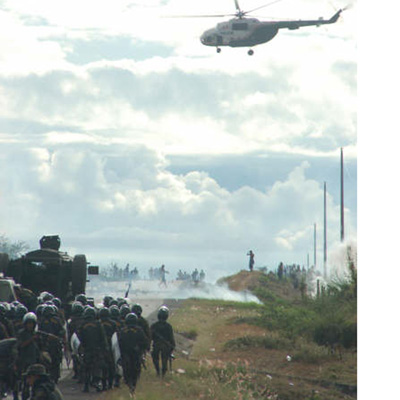
At about 6 am on June 5, the police attacked the indigenous peoples' highway blockade, ignoring their pleas for dialogue and opening fire with automatic weapons on two sides of the blockade and firing teargas grenades and live rounds from helicopters. The protesters were unarmed or carrying traditional wooden spears. Many fled into the surrounding hillsides and became trapped. Many hid. And some fought back in self-defense.
The government reports that 22 police officers have been killed; indigenous representatives report that at least 40 protesters have been killed by police gunfire and that over 150 are missing or being detained by police.
However the government report on the number of police killed -- widely circulated by the media--deliberately conflates conflicts in two distinct locations that took place on different days, adding to the Bagua count, deaths that occurred the following day during a police operation to reclaim an occupied oil pumping station.
The order of events is important for it determines the chain of responsibility. When police surround and attack from land and air using live rounds on a group of peaceful protesters the responsibility for violence is clearly on the aggressors and their unjustifiable and disproportionate use of force.
The initial press reports however preferred to report on generic "clashes" and thus fold the responsibility for bloodshed into what would seem to be an authorless or inexplicable confrontation.
With the authorship of violence obscured, the citations of government speculation and slander coupled with a failure to even engage with the indigenous participants' perspective, serves to insinuate the old colonial stereotype of "uncivilized" and "barbarous" "Indians" and to subtly displace the responsibility for violence on those who suffered the attack.
The Los Angeles Times article, "Insurgents threaten Peru's Stability" (published online on June 5 at 6:30 pm, headline subsequently changed) illustrates the problem. The headline represents protesters engaged in a two-month long campaign of non-violent civil disobedience as "insurgents" and claims that they are the ones "threatening" Peru, rather than defending their ancestral and communal lands.
The article opens with the following declaration: "Protests by indigenous communities over oil drilling and mining in the Peruvian Amazon region turned violent Friday, leaving at least 13 people dead in clashes with police and subsequent rioting."
The Los Angeles Times here presents the violence as a continuation of the protests themselves ("Protests... turned violent") and then describes the predawn police raid as "clashes with police" and even adds the unexplained claim of "subsequent rioting." No other news report from June 5 or since has described riots. Thus "subsequent rioting" must be left hanging there to describe the chaos of indigenous protesters running from gunfire, local residents taking to the streets outraged by the repression, and people fighting back in self-defense.
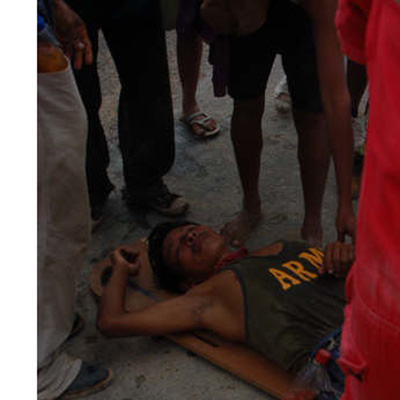
In the chaos some non-indigenous and mestizo townspeople burned government offices and vehicles. The Los Angeles Times however, conflates the protest blockade on the road, the police attack and the subsequent acts of property destruction altogether in "clashes" and "rioting."
The Los Angeles Times article is somewhat conflicting however, for eight paragraphs down the reporters write: "The clash between protesters and security forces occurred after the government sent 650 police to clear protesters..." Here the reporters hint at police culpability, but only hint, for they fail to mention that the act of "clearing" the protesters involved shooting at them from land and air.
Other initial reports in The New York Times ("Fatal Clashes Erupt in Peru at Roadblock," June 6) and Reuters ("At least 20 dead in Peru clash over Amazon resources," June 5) described the violence as generic "clashes" with police, though they cited early on indigenous testimony of the police attack.
The Guardian led with a more factual headline, "Peruvian police fire on unarmed indigenous tribes' oil and gas protest" also published on June 5. They also write, "Indigenous tribes... clashed with Peruvian security forces," but then immediately clarify the nature of the clash: "The bloodshed broke out before dawn when police tried to lift a road blockade..."
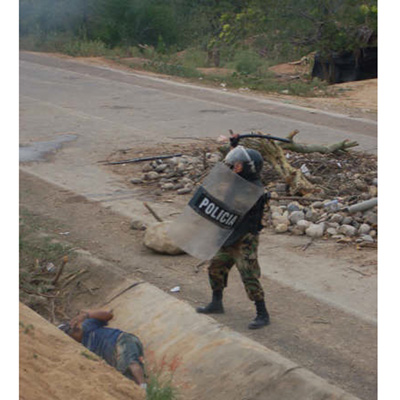
It is difficult to cover outbreaks of violence from distant capital cities where most foreign correspondents are based, but in cases where both witnesses describe and readily available photographs show 650 police in full riot gear, armed with assault rifles, and flying in military helicopters firing teargas grenades and live rounds on unarmed protesters wearing shorts and t-shirts from the air, it is not difficult to discern the basic order of events.
Obscuring the order of events makes it easier to displace responsibility for violence, especially when the demands and tactics of the indigenous protesters are also unstated or misrepresented.
The Los Angeles Times article, as mentioned above, elides two months of coordinated civil disobedience with unexplained "riots" and also states later on: "There were reports of protesters dragging bodies of police through the street." Who precisely reported this is left unstated. And, in fact, no other media outlet included a similar report then or since. The Los Angeles Times did not include here the numerous reports of police burning bodies and dumping bodies in the river.
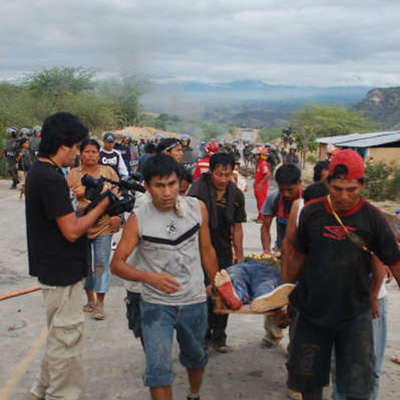
"I spoke to many eyewitnesses in Bagua reporting that they saw police throw the bodies of the dead into the Marañon River from a helicopter in an apparent attempt by the Government to underreport the number of indigenous people killed by police," said Gregor MacLennan, spokesperson for Amazon Watch who arrived in Bagua on June 6.
"Hospital workers in Bagua Chica and Bagua Grande corroborated that the police took bodies of the dead from their premises to an undisclosed location. I spoke to several people who reported that there are bodies lying at the bottom of a deep crevasse up in the hills, about a mile from the incident site. When the Church and local leaders went to investigate, the police stopped them from approaching the area," reported MacLennan.
Though such reports have been widely circulated since Friday, most media have failed to include them.
The New York Times article also leaves out the necessary context and trivializes the indigenous demands as "the government's failure to involve them in their plans."
The article also quotes critics who "pointed out the potential" that the indigenous could link to the Shining Path and "speculated" that Venezuela and Bolivia were behind the protests. Such "potential" and "speculation" are not only inaccurate; they conjure up fear and doubt that only serve to denigrate the indigenous peoples' autonomous protests. The New York Times did not include quotes from indigenous organizations that have pointed out the potential for a policy of genocide against the indigenous peoples of the Amazon.
The Amazonian indigenous peoples' mobilizations have been peaceful, locally coordinated, and extremely well organized for nearly two months. Yet President Alan Garcia insists on calling them terrorist acts and anti-democratic. Appealing dangerously to underlying racism against indigenous peoples, Garcia has even gone so far as to describe their mobilizations as "savage and barbaric."
The media have widely reported Garcia's vague and insidious attempts to link the autonomous indigenous protests with the Shinning Path and unnamed South American governments (undoubtedly those of Hugo Chavez, Evo Morales, and Rafael Correa) without including critical commentary.
"It is unfortunate that President Garcia has invoked the terrifying history of the Shining Path to describe what happened," Robin Kirk wrote in an email response to questions. Kirk is the author of The Monkey's Paw: New Chronicles from Peru and co-editor of The Peru Reader: History, Culture, Politics; she reported extensively on the Shining Path in the early 1990s and is now the director of the Duke Human Rights Center at Duke University.
"There is no credible information showing that such ties exist; to the contrary, these groups have a long and well-documented history of independence regarding their geographic, political and cultural heritage," Kirk wrote, "To link them even indirectly to the Shining Path only serves to obscure and confuse issues which the government must try to solve in peaceful and productive ways. At a time when the government should be investigating what happened and seeking to calm the waters, this kind of language only inflames the situation."
The initial media response to the violence obscured the order and nature of events and thus the responsibility for violence, converting a bloody police raid into generic "clashes." The Peruvian government has in turn attempted to recast state violence as the necessary response to "terrorism" with insidious speculative claims linking the indigenous protesters with an array of demonized outsiders, and the media have largely lent the government a hand in this task by widely and uncritically reporting their insinuations and slander.
What has been missing, and what is urgently needed, to understand what happened are precisely the voices and testimonies of the indigenous participants in the roadblock, the victims of the initial attack, and witnesses to the full unfolding of events from police raid to self-defense to the police cover-up operations, using helicopters to dump the bodies of slain indigenous protesters into the Maranon River.
The Peruvian Congress suspended the one of the divisive decrees, 1090, on Wednesday, June 10. That very action could have happened a week earlier, as was originally scheduled, had the Garcia administration and his supporters not blocked the debate, another fact left out of most of the recent reporting: the bloodshed could have been avoided.
John Gibler is a reporter based in Mexico and author of Mexico Unconquered: Chronicles of Power and Revolt (City Lights, 2009).