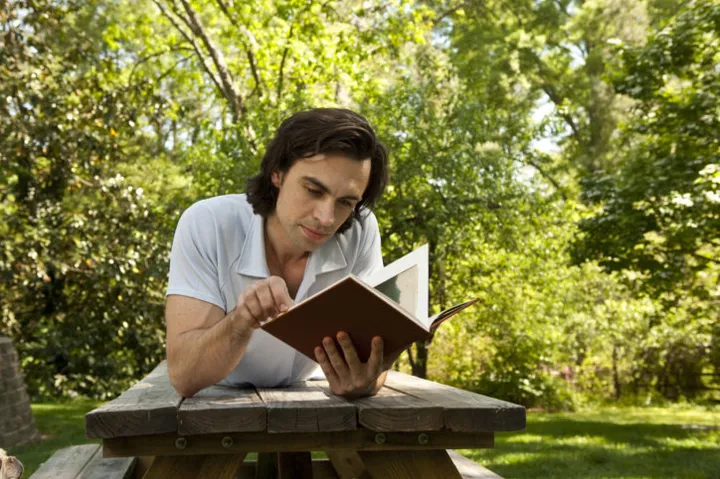
Shortly after I discovered poetry, a more experienced poet gave me grief for choosing not to buy a book because it had an ugly cover. Older and wiser now, I realize that I should have smacked him up side of the head with a faux-leather Barnes and Noble classic. He was absolutely wrong. You can turn down a book because it's ugly, even if the poetry inside is not.
A cover, like it or not, sets the mood for a book. And while that might not make a big difference when I'm reading Stieg Larsson or some non-fiction, it makes a big difference when I'm reading poetry.
That's because reading poetry is something of a ceremony for me. I want it to be quiet. I want to feel stress free. And, at the risk of seeming high-maintenance, I want to do it with a hot cup of coffee. All of this helps me to meditate on poems, and great poems should be meditated on. Here's how Wallace Stevens put it in his poem "The House Was Quiet and the World Was Calm":
The house was quiet and the world was calm.
The reader became the book; and summer night
Was like the conscious being of the book.
The house was quiet and the world was calm.
The words were spoken as if there was no book,
Except that the reader leaned above the page,
Wanted to lean, wanted much to be
The scholar to whom his book is true, to whom
The summer night is like a perfection of thought.
The house was quiet because it had to be.
The quiet was part of the meaning, part of the mind:
The access of perfection to the page.
And the world was calm. The truth in a calm world,
In which there is no other meaning, itself
Is calm, itself is summer and night, itself
Is the reader leaning late and reading there.
I don't mean to say that one should deny oneself a poem completely due to an ugly book cover. But if you have a choice, why not pick the book that makes you want to lean above the page? One that helps set the mood for the ceremony?
This brings me to an AP article that Hillel Italie published this past week (picked up by Travis Nichols here on the Huffington Post) on how poetry has proven slow to catch on with the new digital readers. Italie interviewed Billy Collins, who had just downloaded some of his poems to his Kindle only to find that the little device had done a number on them:
"I found that even in a very small font that if the original line is beyond a certain length, they will take the extra word and have it flush left on the screen, so that instead of a three-line stanza you actually have a four-line stanza. And that screws everything up,"
Form is almost universally critical to poetry. And a digital medium that allows for such easy and dramatic disruption of form is worrisome. Collins, as poets are wont to due, shed light on the matter with metaphor: "The critical difference between prose and poetry is that prose is kind of like water and will become the shape of any vessel you pour it into to. Poetry is like a piece of sculpture and can easily break,"
To win over poets, E-book publishers are going to have to derive a way to prevent such breakage. It shouldn't be that difficult; books, after all, are also constrained by a right margin. But a far bigger obstacle to successfully marrying E-books and poetry is the aesthetic one. Can you imagine Stevens writing, "The reader became the Kindle; and summer night was like the conscious being of the backlit screen."
Poetry can be presented well in a digital format. Websites run by the Academy of American Poets and Poetry magazine present poems in a pleasant, readable format. And I've written before about the enjoyable aesthetics of the Poem Flow app for the Iphone (though I'm not a fan of the "flow," which obliterates form).
But I'll wait for the E-book reader that makes me want to sit down and meditate with it before I take the digital leap with poetry. Until then, I'll stick to (the not-so-ugly) books.
Our 2024 Coverage Needs You
It's Another Trump-Biden Showdown — And We Need Your Help
The Future Of Democracy Is At Stake
Our 2024 Coverage Needs You
Your Loyalty Means The World To Us
As Americans head to the polls in 2024, the very future of our country is at stake. At HuffPost, we believe that a free press is critical to creating well-informed voters. That's why our journalism is free for everyone, even though other newsrooms retreat behind expensive paywalls.
Our journalists will continue to cover the twists and turns during this historic presidential election. With your help, we'll bring you hard-hitting investigations, well-researched analysis and timely takes you can't find elsewhere. Reporting in this current political climate is a responsibility we do not take lightly, and we thank you for your support.
Contribute as little as $2 to keep our news free for all.
Can't afford to donate? Support HuffPost by creating a free account and log in while you read.
The 2024 election is heating up, and women's rights, health care, voting rights, and the very future of democracy are all at stake. Donald Trump will face Joe Biden in the most consequential vote of our time. And HuffPost will be there, covering every twist and turn. America's future hangs in the balance. Would you consider contributing to support our journalism and keep it free for all during this critical season?
HuffPost believes news should be accessible to everyone, regardless of their ability to pay for it. We rely on readers like you to help fund our work. Any contribution you can make — even as little as $2 — goes directly toward supporting the impactful journalism that we will continue to produce this year. Thank you for being part of our story.
Can't afford to donate? Support HuffPost by creating a free account and log in while you read.
It's official: Donald Trump will face Joe Biden this fall in the presidential election. As we face the most consequential presidential election of our time, HuffPost is committed to bringing you up-to-date, accurate news about the 2024 race. While other outlets have retreated behind paywalls, you can trust our news will stay free.
But we can't do it without your help. Reader funding is one of the key ways we support our newsroom. Would you consider making a donation to help fund our news during this critical time? Your contributions are vital to supporting a free press.
Contribute as little as $2 to keep our journalism free and accessible to all.
Can't afford to donate? Support HuffPost by creating a free account and log in while you read.
As Americans head to the polls in 2024, the very future of our country is at stake. At HuffPost, we believe that a free press is critical to creating well-informed voters. That's why our journalism is free for everyone, even though other newsrooms retreat behind expensive paywalls.
Our journalists will continue to cover the twists and turns during this historic presidential election. With your help, we'll bring you hard-hitting investigations, well-researched analysis and timely takes you can't find elsewhere. Reporting in this current political climate is a responsibility we do not take lightly, and we thank you for your support.
Contribute as little as $2 to keep our news free for all.
Can't afford to donate? Support HuffPost by creating a free account and log in while you read.
Dear HuffPost Reader
Thank you for your past contribution to HuffPost. We are sincerely grateful for readers like you who help us ensure that we can keep our journalism free for everyone.
The stakes are high this year, and our 2024 coverage could use continued support. Would you consider becoming a regular HuffPost contributor?
Dear HuffPost Reader
Thank you for your past contribution to HuffPost. We are sincerely grateful for readers like you who help us ensure that we can keep our journalism free for everyone.
The stakes are high this year, and our 2024 coverage could use continued support. If circumstances have changed since you last contributed, we hope you'll consider contributing to HuffPost once more.
Already contributed? Log in to hide these messages.