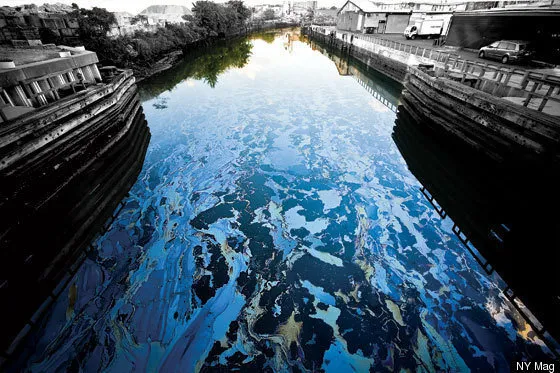
The Gowanus Canal: both a site for a future Whole Foods and a potential federal Superfund site. Only in New York.
Last weekend the New York Times Magazine featured the canal and the politics surrounding its cleanup . Before the housing bust, developers were drawing up plans for a thousand new units of housing along the polluted waterway, a testament to the value of New York City real estate. The city has a plan that would partially clean up the canal by rehabilitating a flushing tunnel to divert raw sewage that occasionally flows through the canal during very heavy rains. The city's plan has two merits: it is quick and relatively cheap at $175 million. It also has one serious drawback: it would do nothing to clean up the toxic sediments that have settled into the canal's muddy bed or to remediate the soil on adjacent properties.
With a Superfund designation, the cleanup would be more comprehensive but would take much longer and would cost much more. The total cost is uncertain, but according to the EPA, "Sediment removal and disposal likely to cost hundreds of millions of dollars." In addition, the EPA would carry out remediation on the land adjacent to the canal, which the agency says is essential to prevent future contamination of the canal. The EPA does not know how much it would cost to remediate this land, but says that the cost could be "significant."
The city opposes the Superfund designation, citing the long process of litigation and cleanup as well as the stigma that will be attached to the area around the canal.
But with the housing downturn we have to ask, "What is the hurry?" One developer that recently put plans for a new housing project by the canal on hold lamented, "We're talking decades," in reference to the Superfund process.
But 20 years is a blink of the eye in terms of the lifespan of a great city like New York. Development plans will have to be put on hold, but it is important that the site is made completely safe before we allow thousands of families to live there.
The good news is that cities now have a much more receptive partner at the White House than they have had for quite some time. President Obama has vowed to reevaluate federal programs that relate to cities to gauge which ones are working and which ones are not. The Gowanus Canal could be an issue to press the White House on, especially the new White House Office of Urban Affairs. The administration has also been touting its new Sustainable Communities initiative, which links affordable housing to public transportation and other environmental initiatives. This initiative coordinates the efforts of HUD, the EPA, and DOT to create affordable housing opportunities near mass transit. The Gowanus already has a heavy-rail line in place. The federal government should be interested in leveraging the transit investments that we have already made in the area. A coordinated effort between these federal agencies could ensure that the canal is clean, that affordable housing in built, and that renovations are made to the viaduct that carries trains over the canal.
The Obama White House is looking for cities to approach them with innovative strategies to solve entrenched urban problems. New York City should use this moment to do what is right for the city's future.