
Why is Coca-Cola often more affordable than clean water? Why are candy bars and cigarettes often more readily available than fresh fruits and vegetables?
If you want to eat healthfully, you have to fight an uphill battle. Why are government subsidies pushing in the wrong direction?
Who would it hurt if we enacted policies that actually encouraged the foods that are healthiest for people and for our world? Who opposes the efforts to make it easier, rather than harder, for people to make healthy food choices?
Government Policy Consistently Favors Big Agribusiness
As I describe in my new book No Happy Cows, agrichemical companies, factory farms and junk food manufacturers are quite happy with things the way they are. Thanks to their lobbying clout, government policies consistently favor the financial interests of these special interests over public health, even though the result is trillions of dollars in additional health care expenses.
Here's an example: In just the last two years, 24 states have considered legislation that would place a tax on soft drinks. These "soda taxes" would discourage consumption of drinks high in sugar, thus reducing obesity and health care costs. And they would also raise money that could be used to subsidize healthier foods. But in every single state, the legislation has been defeated. PepsiCo Inc., the Coca-Cola Company, and the American Beverage Association have spent hundreds of millions of dollars to determine the outcome.
"In the political arena, one side is winning the war on child obesity," a new Reuters report on the food lobby begins. "The side with the fattest wallets."
The Center for Science in the Public Interest, perhaps the best-financed lobbying force for healthier food, spent about $70,000 lobbying last year -- roughly what those opposing stricter guidelines on sugary sodas in the U.S. spent every 13 hours.
Spending $1 Trillion on the Wrong Things
Next week, the U.S. Senate will begin floor debate on the 2012 Farm Bill, which lays the groundwork for nearly $1 trillion in U.S. government spending over the next decade. Most of that spending goes to the Supplemental Nutrition Assistance Program (SNAP -- still sometimes referred to as food stamps), and to subsidies and incentives for farmers.
Efforts to restrict SNAP spending to healthier foods have been fought bitterly, and successfully, by the junk food lobbies.
Meanwhile, the current Senate proposal would give tens of billions of dollars in subsidies to Big Agribusiness, but would give next to nothing to programs benefiting the environment, organic food, nutrition, or small farmers. The food blog Civil Eats calls the proposal an "all-you-can-eat-buffet for the subsidy lobby."
In a national poll last year, 78 percent said making nutritious and healthy foods more affordable and accessible should be a top priority in the farm bill. But that's not what's on the table in this year's "agri-business as usual" farm bill.
Kari Hamerschlag, Senior Food and Agriculture Analyst for the Environmental Working Group, explains that the current proposal would actually "slash programs for conservation, nutrition, rural development and beginning and socially disadvantaged farmers."
For example, funding for research in organic farming would be cut to almost nothing, while corn growers, who have received $73.8 billion in subsidies in the last 15 years, would get even more now. Subsidized GMO corn is used to produce cheap high-fructose corn syrup, a substance that even Vice President Joe Biden says is more likely to kill an American than terrorism.
This heavily subsidized genetically modified corn is also fed to livestock in factory farms and feedlots -- at unfairly reduced prices.
"Factory farms pose a serious public health hazard, so why are they subsidized by public money?" asks Food Revolution Summit speaker Dr. Neal Barnard. "These facilities pump out high-fat, high-cholesterol meat products and often pollute waterways -- yet they also receive generous subsidies under the Farm Bill. We want Congress to stop rewarding facilities that endanger public health."
These subsidies aren't just costing U.S. taxpayers and enriching big agribusiness. They are also having a devastating impact on the health of tens of millions of people.
With all that we now know about nutrition, what kind of sense do these government policies make?
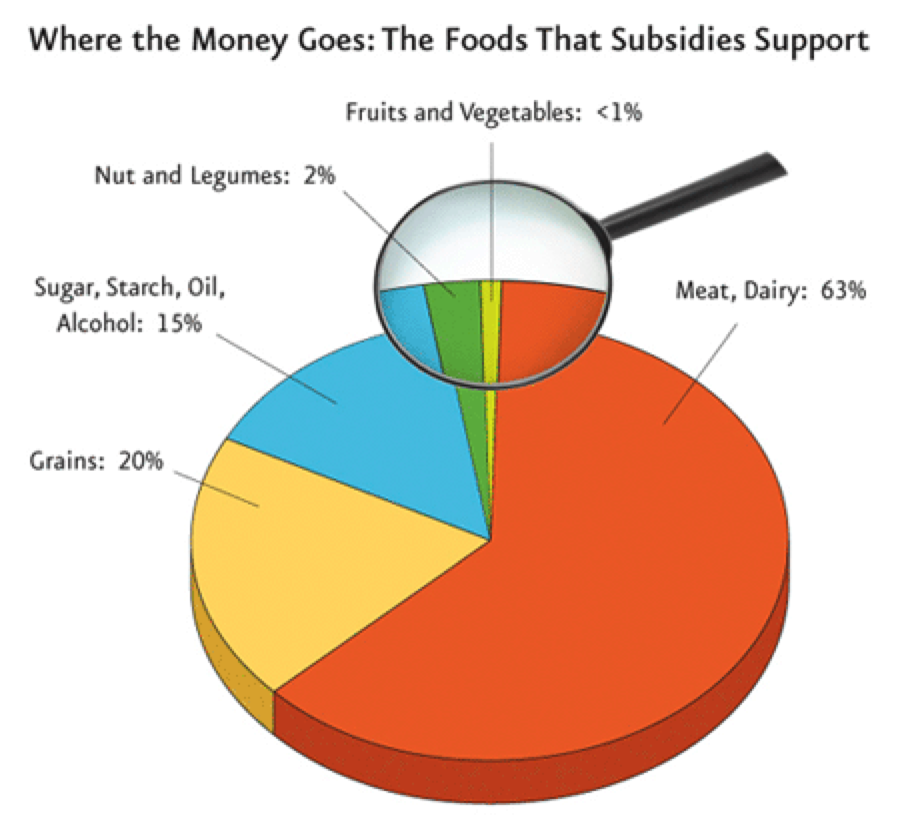
Chart courtesy of Physicians Committee for Responsible Medicine
The USDA's Dietary Guidelines say eating more healthful plant-based foods and less saturated fat and cholesterol helps prevent heart problems and other life-threatening medical conditions.
But 63 percent of the government's agricultural subsidies for domestic food products in recent history have supported meat and dairy production -- the very foods highest in saturated fat and cholesterol. Less than 1 percent of these subsidies have gone to fruits and vegetables.
Food Revolution, Anyone?
The good news is that people are waking up, and you can join in the movement! Increasing numbers of people across partisan lines are calling for government policy to stop supporting the loudest lobbyists, and to start supporting the health of the population. And with the Farm Bill coming up for vote soon, this is a great time to get involved.
- Call the U.S. Capitol Switchboard at (202) 224-3121 and ask for your senators' and/or representative's office. Tell them the Farm Bill should invest in food that is healthy for people and the earth. Tell them that instead of cutting support for nutrition, conservation and anti-hunger programs, they should cut crop insurance programs that only benefit the largest and wealthiest agribusiness operations.
- Physicians Committee for Responsible Medicine is one of many organizations doing brilliant work on this issue in the U.S. Find out more and sign up to take action here.
- Educate yourself by reading books like No Happy Cows. You'll learn how to protect yourself in an age of predatory marketing. And your body will thank you for the rest of your life.
John Robbins is the author of many bestsellers including No Happy Cows: Dispatches From The Frontlines of The Food Revolution and Diet For A New America. He and his son, Ocean Robbins, are co-hosts of the 32,000 member Food Revolution Network. He is the recipient of the Rachel Carson Award, the Albert Schweitzer Humanitarian Award, the Peace Abbey's Courage of Conscience Award, and Green America's Lifetime Achievement Award. To learn more about his work, visit http://www.johnrobbins.info.
For more by John Robbins, click here.
For more healthy living health news, click here.