The U.S. public debt is currently $9 trillion. That's an average debt for 303 million U.S. residents of about $30,000, or for 135 million U.S. taxpayers of about $67,000. (The numbers are about six times bigger if we add unreported U.S. liabilities.) This debt is being financed by our children and by the rest of the world, at the cost of U.S. influence in the world arena.
U.S. debt has grown 14-fold in real terms over the past 65 years. It grew five-fold during World War II and since Reagan's accession it has grown another 350 percent. Under Reagan the United States flipped from being the world's largest creditor nation to being the world's largest debtor nation. The growth of the national debt slowed and briefly reversed during the Clinton years, but then resumed its rapid upward march. (See chart.)
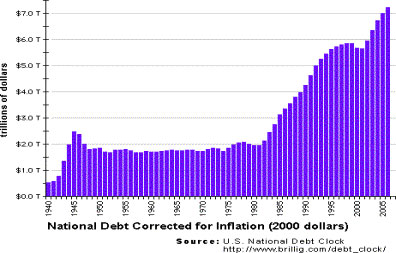
US National Debt, corrected for inflation (2000 dollars)
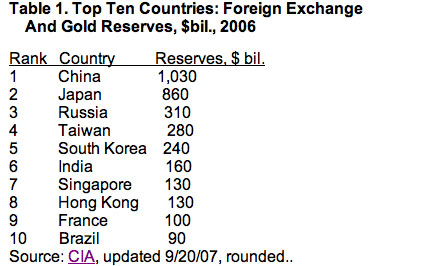
In World War II, we sold the debt largely to ourselves, for example through savings bonds to pay for the war effort. During the Reagan and first Bush Administrations, Asian countries were persuaded to contribute to U.S. war efforts with gifts and loans, out of gratitude for our bearing the main burden of the Cold War arms race. As U.S. budget and current-account deficits have continued, the Asian loans have accumulated. The eight countries with the highest foreign-exchange reserves are all Asian. (See Table 1.)
Of 163 countries covered by the CIA, 99 run current-account deficits and only 64 run surpluses. It takes the surpluses of the top eight of the 64 surplus countries to pay for the $862 billion (in 2006) deficit of the largest deficit country, i.e., the United States. The Japanese yen and other Asian countries have not appreciated as much as the euro because their central banks have been accumulating dollar securities, thereby financing the U.S. current-account deficit. The countries with the highest current-account surpluses either export manufactures or oil and gas, or have substantial overseas investments. (See Table 2.)
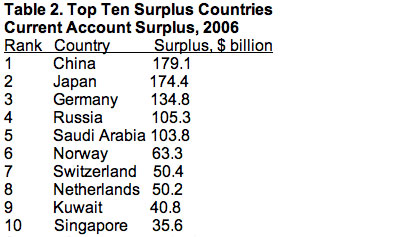
Source: CIA, updated 9/20/07. The current account surplus is the trade balance (net exports of goods and services) + net factor income from abroad (such as interest and dividends) + net unilateral transfers from abroad (such as foreign aid or workers' remittances from overseas).
These developments help explain the 42 percent decline in the value of of the dollar to 0.70 euros from its high on October 26, 2000, when the dollar was worth 1.21 euros. Currency appreciation is supposed to help fix trade imbalances as a weaker U.S. dollar discourages imports and encourages exports. But it may not happen as quickly or smoothly as we may wish. A Chinese statistics official observed that during recent years when Japan's currency appreciated three-and-a-half times, its trade surplus with the United States grew eight-fold.
Unlike private companies that must now report pension-fund liabilities via Form 5500, the U.S. Government does not include its social insurance fund liabilities in the national debt. The GAO in January 2007 estimated U.S. government liabilities including net social insurance commitments at about $50 trillion. The U.S. Treasury concurred and added: "$50 trillion [is] approximately four times the nation's total output (GDP) in FY 2006, up from about $20 trillion, or two times GDP in fiscal year 2000... This translates into a current burden of about $170,000 per American or approximately $440,000 per American household."
Does it matter who is financing U.S. current-account deficits? It will matter if the United States has disputes with its creditors. Thomas Jefferson favored eliminating the national debt, arguing that "banking establishments are more dangerous than standing armies." A possible trillion U.S. dollars in China's central bank and another $100 billion in Hong Kong are the global financial equivalent of standing armies. At the moment, China is heavily reliant on U.S. consumers to buy its products. But one price of our growing debt is a shrinking ability, and right, to control what happens in a dangerous world.
John Tepper Marlin, Ph.D.
Principal, CityEconomist, Adjunct Professor, Pace University and NYU.
HOW YOU GONNA LIVE WHEN YOU CAN'T KEEP THE LIGHTS ON OR THE WATER?
exports what do we export but jobs?
if there is anyone that has screwed this country up worst than bush it is bean counters and economists that preach debt and cheap labor as a good thing.
if you spend more than you make you are going to get into trouble.
middle class voters will vote this country right into skyrocketing inflation then fascism with full support from the economists.
and the haves and the have mores will smile all the way to the bank.
One of the biggest lies of the globalists is the "vast new markets" argument
The difficulty is managing the inflation.
Another side effect is that it makes American companies attractive takeover targets. Even as they appear more profitable (the illusion of converting stable foreign earnings) their values continue to erode.
Every investor is just waiting for that bottom so they can repatriate their foreign holdings.
Pity , but we are like the British , they couldn't move London and we can't move Washington DC.
Regarding the idea that a cheaper dollar makes exports cheaper; since we manufacture next to nothing anymore, what good will a fallen dollar do for the owners of non-existent factories? So, instead of manufactured goods being cheaper, our farm products and raw materials will be cheaper for foreign buyers. Getting less money for corn, sugar, and coal will not help the producers of those products, but it will make it more difficult for them to pay their bills.
Our spending on "defense" is up to about 3/4 of a trillion dollars per year. Since we are not paying our bills, and getting so little for our "defense" spending, one can only worry about the effects of the Republican trickle down economy.
(Ref: Ben Bernanke. Also, Weimar Republic, Argentina, Brazil, Mexico, Russia, Asian Contation)
$20 trillion -> 50 Trillion in 6 years. This is based on the window. If you look over an infinite horizon, the unfunded liabilities aren't growing as fast. But most people don't want to look at those numbers because they are too large (roughly $89 trillion). Instead they look at the 75 year window, or the 50 year window. Each narrowing shrinks the total amount, but accelerates the increases each year.
Just for Social Security (the SMALLER of the two major entitlement problems), each year we move forward in a 75 year window we LOSE a year of $200 billion surplus and ADD a year of $400 billion deficits. So, the total unfunded liability grows by $600 billion each year. Medicare is even worse. By inferring between the two numbers, Medicare must be adding 4.4 trillion in unfunded liabilities each year over a 50 year window.
Also, you must remember that those numbers are the amount that would need to be put into those programs TODAY to fully fund them. Not 10 years from now, now over the next 50 years, today. In financial terms the closest approximation would be if you handed every newborn a $170k mortgage that had to be paid off by they time they kicked the bucket. And every day that passes while they are learning how to roll over or drink from a sippy cup, their mortgage is INCREASING, as the unpaid interest gets added to the principle.
By the time they are old enough to start earning some money to pay some of that back, it would be far higher.
The Dems in Congress get tears in their eyes thinking of those poor, picked on college grads with 20, 30, or 50 thousand dollars in student loans to pay off (at a discounted interest rate, no less). Where are the crocodile tears over this nearly insurmountable financial burden we're foisting on our kids and grandkids so that baby boomers can be on the government dole during their retirement?
The TRUE MIDDLE INCOME is over $280,000.00 + a year but the Government removes high incomes earners so they can get the public to accept lower wages saying $37,000 to $50,000 is middle income wages.
"At the moment, China is heavily reliant on U.S. consumers to buy its products."
However, China has begun to discourage exportation of certain raw materials strategic to her future as well as increase the VAT on energy intensive materials and products to 15 percent. China has also discounted the VAT rebate on many exports. This would signal that China has already become less dependent on exports and is focusing efforts on developing her own internal economy.
At a 10 percent annual growth rate in GDP and an asset investment rate that is nearly double their GDP, China's reliance on Western consumers appears to be diminishing. With estimates of an economy that could exceed our own by a factor of four to five, China will no longer need to maintain her foreign exchange holdings.
Is that the time to worry or will there be a preemptive effort to avoid losses? Looking at the investment strategies of Gates and Buffet indicates they've been betting against the dollar for years. And wisely so at approximately 35 percent depreciation against the EURO since 2002. Finally, will it be a long slow decline or calamity?
That could be the one good thing about the rising debt - diminished capacity of the United States to interfere with people trying to gain control over their own country and its assets.
all politics and tax policy and pissing away money to your corporate shills...
They may pay it off in cheaper dollars, but when the gov has paid a fortune in interest, what have they gained?