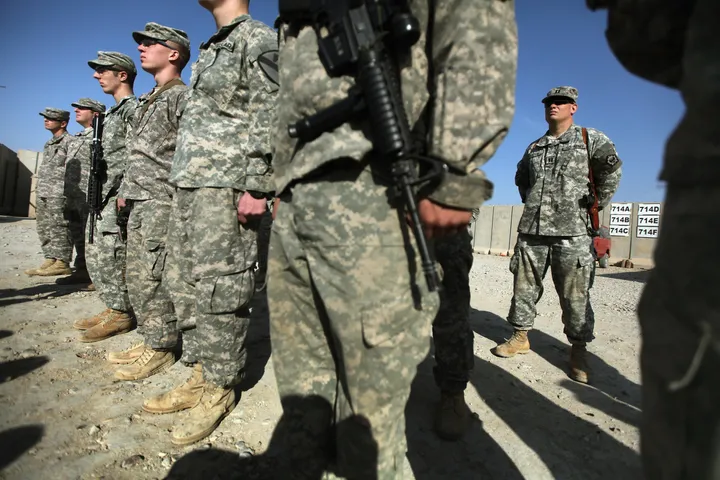
As America's involvement diminished last autumn, I wondered how the Iraq War would be remembered. Would we recall only the U.S. sacrifice of blood and treasure, or would we grapple with its broader meaning -- not least the hundreds of thousands dead, the millions displaced, the "smoking ruin" of a once-modern country?
The answer is trickling in, and it is precisely what I expected. Consider first the photo exhibit in New York, "
Or consider another type of forgetting. The New York Times published a forum online last week, "Does the U.S. Have a Plan for Iraq?" Five contributors, four of which could fairly be described as conservatives, made brief comments. Several of them took up one of the Republican talking points, that President Obama has essentially cut-and-run from Iraq. "The arbitrary timelines for withdrawal coupled with desultory political engagement produced a predictable Iraqi political crisis," charged Kori Schake of the Hoover Institution. Marisa Sullivan of something called the Institute for the Study of War asserts, "The United States has fewer ways to influence the situation in Iraq than it has had in the past, given the significant (but largely self-imposed) loss of leverage caused by a single focus on disengagement and withdrawal." They are not only upset about the hasty retreat, but the residual support for Prime Minister Nouri al-Maliki, whom they find distasteful.
Putting aside for a moment the fact that the timetable for withdrawal was set by President Bush, the impossibility of extending that timeline foiled by the Haditha massacre (the result of which is Iraq's refusal to sustain U.S. criminal immunity), that Maliki's power was consolidated under Bush, and that a major promise of Obama's 2008 election was withdrawal from Iraq. What is more troubling about the right-wing moaning is that they fail to mention that eight-year war that just ravaged the country.
Schake, who worked in the Bush White House, notes the "not uncommon conspiracy-mindedness of societies emerging out of decades of authoritarianism" to account for Iraqis' suspicion of U.S. motives. She might have read opinion polls in Iraq that for years has pinned responsibility for the colossal violence and devastation of the war -- yes, our war in Iraq -- squarely on the U.S.
Another, more sophisticated contributor to the forum, Kenneth Pollack of the Brookings Institution, made a similar point. "Iraq is an incredibly fragile state whose democratic institutions are weak and mostly overwhelmed by the residual fear, anger, avarice and competing aspirations of its various leaders and communities," he notes, but doesn't mention why that might be.
What was common to all the commentators is a failure to mention that there was a war, started by the United States, pursued in violation of international law, and resulting in the deaths and displacement of more people than virtually anyone cares to acknowledge. If it's not mentioned, it just might not have happened, at least for those who urged it on.
The war's destruction escapes nearly all discussions of the U.S. history in Iraq. It's a destruction that includes 20 years of war and sanctions. The 12-year sanctions period resulted in more than a doubling of infant mortality with estimates ranging to 500,000 additional children dead. (This is bipartisan callousness: Clinton's Secretary of State Madeleine Albright declared such infant deaths as "worth it" to get rid of Saddam, which of course they did not do.) The 2003-2011 war took hundreds of thousands of lives through direct violence and indirect causes like malnutrition and demolished health services. The most accurate method of estimating mortality--randomized, household surveys -- held that between 400,000 and 650,000 "excess deaths" had occurred as a consequence of the war, and those surveys were done nearly six years ago, at the peak of the violence. Since 1991, the United States' actions -- sanctions, invasion, occupation, failure to provide security when a civil war broke out -- have resulted in well over a million dead Iraqis.
No wonder the war and sanctions enthusiasts don't want to mention any of this.
As the photo exhibit shows, however, this capacity to forget is not limited to the right wing. Virtually no journalists or political leaders have explored the destruction of Iraq. President Obama never mentioned the Iraqis' sacrifices in his speeches announcing or celebrating the end of the U.S. war. Journalists like Anderson Cooper routinely describe the death toll in the "tens of thousands." Rachel Maddow has aired more stories about the lack of victory parades for Iraq War vets than she has about Iraqi civilians killed in the war. NPR and PBS are reluctant to take up the issue as well.
Of course, Republicans are keenest to tag Obama with fecklessness in Iraq -- hence the proliferation of red herrings in the New York Times forum. We will hear more of this as the campaign drags on and violence continues to beset the country, but the plain fact is that Americans didn't care much about Iraq when the war raged and certainly don't care now.
Unless a thorough investigation of the war's consequences for Iraqis is undertaken, however, the forgetting will soon be hardened into America's national narrative -- a "tragedy" (so many wasted American lives), a "noble mistake," and certainly that useful catch-all, a "mess." And because we have mentally buried the destruction of Iraq so quickly, the next war will be so much easier to start.
John Tirman is the author of The Deaths of Others: The Fate of Civilians in America's Wars
What we screwed up the invasion in the first place is that we:
1. Saddam freed a bunch of convicts who pillaged things.
2. We fired most of the old military and that put unemployed upset Iraq men on the streets.
3. We destroyed some infrastructure and was not able to repair it. Have you ever lived in an area that was about 120 degrees without electricity or running water. Most of our major cities would implode if forced to live under these conditions.
4. We did not send nearly enough occupation troops in the beginning.
5. Corrupt Iraqi politicians and police force did little to protect civilians against thugs and victims of thugs sought retaliation which insurgents were happy to provide.
-Plato
We are famous as a people for not being able to find nearly anyplace beyond our own borders on a map of the world. That's not because we're stupid. it's because to us, those places are unimportant in themselves, and only matter as to the uses we have for them-- whenever we have them.
The day after 9-11, here at my job in uber-liberal NYC, I had the sad experience of listening to folks I had considered nominally reasonable as they spoke with misapplied fury in support of an attack on Iraq. Yes, Iraq. Yet when I challenged them to show me where that nation was on a map of the world, none could.
In the long run, if we are able, we will forget nearly everything about Iraq we ever knew, and what we do remember will be most of all about ourselves.
http://www.youtube.com/watch?v=3mn-1LuLhrw.
Which is not to say I don't believe our foreign misadventures have not made us the object of much more hatred the world over than we previously had been. But only, that we killed more -- Vietnam alone lost 2 million a few decades back at our hands, and the result? Now, nearly nobody outside that nation can recall we caused so many to die.
Pakistan is indeed a failed state or soon will be incontrovertibly so, and yet, I imagine one of the chief aims at all times amongst our elite anti-terror forces is moment's-notice readiness to chopper in and take way those nukes when the government falls.
The asymmetrical warfare capacities of our self-proclaimed enemies will only grow, I suppose, and we here in NYC can expect to and will be expected to bear the brunt of whatever they manage to do, if anything. Wish us luck.
Sorry, revising history is forbidden.
I seem to recall that the UN backed this country in removing Saddam from power, that 33 other countries joined us (the Coalition of the willing), that Saddam was targeting and occasionally shooting at US warplanes while performing their UN required tasks (an act of war), that the USA spent 14 months negotiating with Saddam to allow inspectors unfettered access to suspected WMD sites and that they were never allowed to properly inspect. Under those conditions there was no other choice but to remove the mad man from power.
Our war killed millions, and we destroyed the entire country...No need for a parade here, nothing to be proud of...just wonton killing and mass destruction. Jesus wept!
Calling Iraq a war is to misuse the term and to soften what the word means. War is more like Stalingrad and Pearl Harbor. You know big battles with an enemy!
Was Saddam worthy of being removed. Well of course, so are many like him including many America allies like the rulers in Saudi Arabia. In Africa there are many insane dictators left. Why Iraq?
Ask G W Bush what were the real motives. So far he has not been honest about it.
Iraq made cowards out of the opposition Democratic Party, who were gutless in prevention of it.But worse it made the US public into a bunch of suckers It left our military to be used and abused for nothing..It has wrecked our ability to be taken seriously in the Middle East. Nothing we say is believed anymore.
Lastly there are the unfortunate innocent people in Iraq who were not supporters of Saddam who were ground up like hamburger to satisfy Bush and Cheney and the neo-cons appetite for power and blood and oil. No, it was not a war at all.
The GOP has no claim to defense and national security any longer.
They are in it for personal profit, nothing more.
The real financial cost of W's Folly in Iraq is not.
We need to pound the GOP with the costs to this nation.
With the impact of the invasion on our deficit.
They need to be reminded that there are costs still being borne for their failure to do due diligence.
The US DID NOT invade Iraq. Saddam agreed to terms of ending the Gulf war, which he ignored. Pres Clinton ordered bombings periodically when Saddam got too far outside the agreement.
When Saddam kicked the weapons inspectors out, and evidence made it clear that Saddam was trying to reconstitute WMDs (eg, the head of Saddam's nuclear weapons program in Niger to buy yellow cake), the US did initiate (with the help of other concerned countries, some in the Middle East) an effort in the UN to do what the Gulf war resolutions specified; going back in to topple Saddam. It was a UN INVASION (yes, led by the US & Britain) that went into Iraq.
And don't forget the reaction of Iraquis when Saddam was defeated, and the reaction of the Iraquis when Saddam was captured. They were delighted then.
It was al Quaeda operatives who blew up the first Shi'ite mosque, blaming Sunnis; then blew up a Sunni mosque, blaming Shi'ites when Shi'ites did nothing ro avenge the bombing of their mosque. That led to the civil war that killed Iraquis. And how many more would have died if our military hadn't been between the 2 forces.
If you want to criticize the way the war was prosecuted, that is fair game; I do that often. Had the administration listened to Ambassador Bremmer, we wouldn't be having this discussion.
But don't revise history of the invasion. You have no facts to support your preposterous ideas.
Thats the most poignant yet frightening part of your article. Already you hear battle drums beating for Iran.