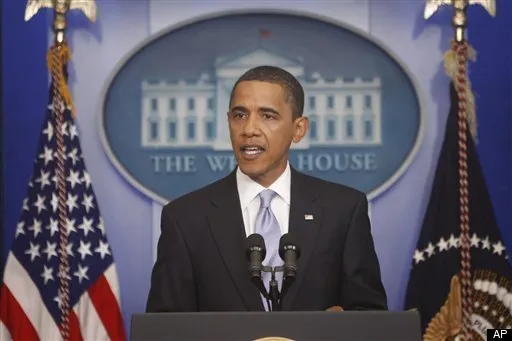
Tomorrow, under an agreement with the Iraqi government, American troops are slated to completely pull back from major cities. The Iraqi security forces don't seem ready for it. And, while it seems counter-intuitive, if they aren't getting their act together, we need to speed up our departure.
In his trip to Iraq in April, President Obama said, "It is time for us to transition to the Iraqis. They need to take responsibility for their country."
That much is true. What is also true is that it hasn't happened. What's true is that the Iraqis seem less interested in political progress that would lead to a relatively peaceful Iraq, and more interested in US Forces staying indefinitely to protect them from killing each other. Sure, Prime Minister Maliki says the right things about wanting the US out of Iraq, but that's purely political - he has to say those things so as not to look like a US puppet.
But, beneath the surface, there's been no political progress. There still is no oil sharing agreement, no resolution to the strife that has continued to affect Kirkuk, and no settlement among the many factions that will allow them to live side by side in peace.
And so, if the US pulls back, there's a powder keg ready to explode, with an ill-equipped Iraqi military left to try to hold things together. Frankly, the Iraqi military will never be well-trained enough to handle major explosions of violence, only minor disputes. Iraqis know this, which is why they'll continue to rely on us as a crutch as long as they can.
The problem with that is, if we have one foot in Iraq and one foot out, we are going to have a scenario when Americans think this was is over and one day they wake up to 8 or 9 dead troops in the streets of Iraq. Besides being a disaster in and of itself, it becomes a political problem for President Obama and Democrats, who own the situation now. To borrow a phrase from John McCain on Afghanistan, we'd merely be "muddling through" Iraq. That's not in US troops' interest, and certainly not in American interests.
We've already seen violence ramp up in Iraq, as surge troops have left and others pulled back. Just last week, over thirty people were killed in a series of attacks, on June 22, with at least two dozen more injured. It's exactly what I and others said it would be. We were the cork on the bottle, and for all the talk about the surge being a success, without political and diplomatic progress, it ultimately meant absolutely nothing.
I was on Hardball in July of last year about it, and said the surge was a failure in that sense, and guest-host Mike Barnicle was nearly apoplectic about it.
BARNICLE: Did I hear you correctly that you said you didn't think the surge was a success?
SOLTZ: It's not a success. I mean, we've not seen political reconciliation in Iraq. We are about to have a complete stir-up in Kirkuk. We have a situation in Afghanistan where it's totally, you know, less secure now than it was before.The purpose of the surge is to make America safer. And I don't think anybody believes that. And I think that Senator McCain is, you know, off base like George Bush. And that Senator Obama is specifically right to continue to talk about strategy and diplomacy and defeating al Qaeda worldwide than get stuck talking about, you know, a tank platoon or an infantry platoon in the streets of Baghdad.
Now we see that, indeed, the surge meant nothing without political progress.
The question is, where do we go from here? President Obama has got to get tough with the Iraqis and make good on what he said during the campaign. I'm not privy to all the negotiations with Iraq, or any attempts to bring sides together. What I do know, however, is that there haven't been any results, either because President Obama hasn't tried hard enough, or because his efforts have failed.
Whatever the case, the President absolutely has to resist any temptation to buy more time for political progress by keeping troops there to continue to coddle Iraq. All it will mean is more violence that has American troops in the cross-hairs. The President must tell the Iraqis that, if anything, we're going to speed up our timeline to leave Iraq if they continue to stall political progress - that their internal political problems aren't worth American blood.
Like any political leaders, those in Iraq don't want to lose power, which they most certainly would if the nation falls apart into a loose patchwork of clans and fiefdoms. So, in the end, only the realization that their nation is about to fall apart and they won't have Americans around to keep it together, will be the kick in the pants Iraqi political leaders need to settle their major differences.
It's time for President Obama to recognize that, and get tough. If the Iraqis aren't committed to dealing with their internal problems then we should expedite our withdrawal. American troops should never be more committed to the peace and security of a foreign country more than those who live there.
Crossposted at VetVoice.com
Follow Jon Soltz on Twitter: www.twitter.com/jonsoltz
USATODAY.com - House rejects setting timetable for troop withdrawl ...
OBAMA backs off timetable for IRAQ troop withdrawl | San Francisco ...
We re-invaded Iraq in 2003 to finish the job botched by the Bush admin in 1991, which had made the problems in the region worse, indirectly supporting the fundamentalists efforts to destabilize and increase power. The Saudis still need a buffer, and in fact, the sizeable Shi'ia population in Iraq is now an even closer threat to SA. Our brass has known that we are the Saudi's pawns for a long time, as a buffer for them, that is the reason for the permanent bases, that's the reason they speak about Iranian interference in Iraq, but not Saudi interference. Our administrations have known that we need a sizeable presence on behalf of oil producers in the region to be able to respond to Iranian aggression and to keep the straits of Hormuz open. Obama has certainly been briefed on the situation.
So you are right Jon, there will be a lot of talk and very little changed.
Take a broader look at the region over the past thirty years.
In 1979 the Islamic "revolution" burned our embassy in Pakistan, took hostages from our embassy in Iran, and took over the Grand Mosque in Mecca, Saudi Arabia. The revolution only succeeded in Iran. There was already a tension between Persian/Arab and Sunni/Shi'ia, which the Iranian revolution exacerbated and was manipulated by the cold war. So, during the 1980's a proxy war was fought between Iraq and Iran, with the Arab's bankrolling Iraq. Iraq felt entitled for its efforts, so it took over Kuwait. Because their oil field were within easy reach of Saddam, the Saudi Royals had western consumers defend it. Rather than bringing Saddam to account, George HW Bush declared a unilateral cease-fire in 1991, apparently to leave Saddam in place to maintain a buffer between SA and Persia, which turned out to be a mistake.
So, to the author's point about "get[ting tough," if the boys in the Pentagon and their GOP masters in Congress want to stand up and demand that U.S. troops pull out immediately, am certain that Obama will accommodate them.
We need to get out of that place. They have been fighting for centuries over their 3 tribes and will continue forever.
As of July 1, our troops are out of the major cities.
Oil companies are bidding on the commercial rights to Iraq's oil fields
The republicans already told us, "The surge was a success." I have to believe them, because they're always right about everything (not).
If the people of Iraq want to continue to kill each other as a solution to their social and religious differences, that is for them to determine and pay the consequences for. It is not for the US to decide, or intervene in at the sacrifice of our own young people.
As far as I'm concerned, President Obama is keeping his campaign promise - just not as quickly as some of us would like.
Sorry to say but Iraqi history suggests otherwise. In the 1920's Great Britain liberated them - then known as the Mesopotamian province of the former Ottoman Emprire. The Brits were given a year by the locals to get their act together then the locals started killing British Troops in brutal and gory ways. About 2000 were killed before the Brits MOD led by Winston Churchill gased and carpet bombed the Iraqiis into submission. The Brits then installed a Parlimentary government figure headed by a former "Royal" making it a Constitutional Monarchy. This lasted peacably through WWII until some Generals decided the Republic wasn't Republic enough in 1958.
Otherwise, I agree with the rest of your sentiment which is why real energy reform is essential.
We need to learn the lesson that Japan learned so painfully in WWII. You can peaceably and commercially obtain what you need if you pay a fair price. You do not need to physically control the land from which resources are drawn.
This is possible, but time consuming. Since questioning of this illusion needs to be relevant to the individual concerned, in order to be processed effectively by them.
Simply posing such queries causes individuals to reveal to themselves (the one person they are always prepared to believe), how much they do and do not actually know. This in itself cannot eradicate the underlying problem. But it can expose it, and perhaps allow a degree of compensation to occur.
It is impractical to convert all individuals to one way of thinking. Unless that way of thinking is that, all ways of thinking are open to question.
The British were in India for a hundred years. They introduced European democracy and railroads and accepted the children of native leaders into English schools. And, millions died upon their withdrawal as India was sundered with ethnic cleansing according to the new divisions. Yet, England was glad to get out and the Indians were glad to see them go. Their re ordering improved both countries.
The sad part, besides the Iraqi's peoples tragedies, past and future, is that even though this is totally Bush and Cheney's responsibility, all efforts will be to pin the blame on Obama.
This must not be allowed to happen. The Bush-Cheney administration must be put on trial for war crimes.