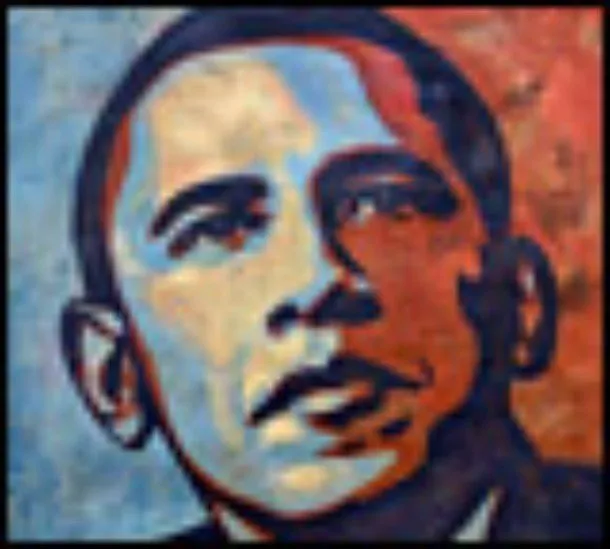
A few days ago, the Associated Press announced that Obama's famous HOPE poster amounts to copyright infringement. The artist behind the poster, Shepard Fairey, has never hidden the fact that he based his iconic creation on a photograph he found through Google. The AP thinks it owns the copyright to that photograph, since Mannie Garcia was freelancing for the AP when he shot it. With posters sold out, a special edition in the National Portrait Gallery, and major exhibitions in New York and Boston, the AP wants in on the windfall.
But the AP would very likely lose this case if it ever ended up in court. That's because, under copyright law, Fairey's work almost certainly qualifies as "fair use" of Garcia's photograph.
The term "fair use" gets batted around a lot, often incorrectly, and so deserves some explanation. At the most general level, copyright law prohibits you from copying another person's original creative work. That means you're typically not allowed to create work using someone else's original unless you pay that person. "Fair use" is an exception to this rule: it says that sometimes you don't have to pay someone to use his or her original work. Whether you do--that is, whether your new work qualifies as "fair use"--depends on what, exactly, the original work is, how much of it you're using, how you transform it, and whether your new work hurts the commercial market for the original. (Note that the issue has nothing to do with whether anyone thinks your use is "fair.")
By far the most important factor is how you transform the original work--but, contrary to popular belief, the transformation that really matters is the
conceptual one, not the physical one.
Take, for example, an influential 2006 decision vindicating Jeff Koons. A fashion photographer named Andrea Blanch sued Koons for using a picture of hers in one of his paintings without paying her. Koons had scanned her photograph, which she had taken for a
Gucci ad, and cut and pasted it into a digital composition he then
painted. The federal appeals court said that Koons didn't need to pay Blanch to do what he did, because of how thoroughly Koons had transformed the photograph.
The court explained that a "transformative" work adds something new to the original work, alters its message or meaning, takes on a different character or furthers a different purpose. It treats the original work as raw material in the creation of new expression, new aesthetics or new insights. Koons's painting was "transformative" because it made a new statement altogether different from Blanch's. Whereas Blanch said she was interested in creating an "erotic sense," Koons explained that he wanted his audience to reassess its experience with commercial products and to consider how mass-marketed images "affect our lives."
The other "fair use" factors matter too, and courts have to assess all of them. Taking from a published work is more likely to constitute "fair use" than taking from an unpublished one. The less you use of an original work, and the less your work harms the commercial value of the original, the more likely your work will fall under "fair use." But these factors pale in comparison to the issue of transformation. (This, by the way, is why it is never a question of what "percentage" you use of an original work--a pervasive misunderstanding in the art world. The question is how significant to the original was the part you used, and how much did you transform that part to create your new work?)
Fairey's HOPE poster is clearly a "transformative" work. Just compare the purposes behind the photograph and the poster. Garcia told me that when he shoots for a wire service, as he did the day he took his famous photograph of Obama, his goal is "to show the who, what, where, when and why." This makes sense, as the function of a news photograph is to convey news. It is supposed to be descriptive, accurate. "There's an expression [on Obama's face] that gives it some kind of essence," Garcia said. He also strives to make the location evident in his photos ("If there's a rally in DC, you want to put a monument in the picture"), which is why, even for this "clean headshot," Garcia wanted one of the flags lining the National Press Club room to appear in the background.
Fairey, on the other hand, set out to make an image for a political campaign: something that would inspire people to support a presidential candidate and
symbolize their hope. He was creating something aspirational, not descriptive; his message was subjective opinion, not objective fact. To accomplish this goal,
as Fairey explained to the Washington Post last year, he simplified the original image, straightening lines to make Obama look "strong"; distilled the color scheme into a modified flag motif; added a hybrid Fairey/campaign logo; and slapped on a large PROGRESS banner. (The campaign later asked Fairey change the banner to HOPE.) Taken together, these artistic choices--and others, such as positioning Obama above the banner, rather than below it, suggesting a leader gazing into the distance instead of a man looking up at a speaker--altered the meaning of Garcia's photograph in service of a significantly different purpose. In short, they rendered Fairey's work "transformative."
And the other "fair use" factors? Well, Fairey didn't harm the commercial value of Garcia's photograph--he vastly increased it. Danziger Projects, a contemporary gallery in New York City, is selling a limited edition of the original picture, signed by Garcia, for $1200 each. (The Museum of Fine Arts in Houston has already bought one for its permanent collection.) The original photograph was published, of course, another factor in favor of a "fair use" finding (though a relatively minor one). In fact, the only factor that probably weighs against a "fair use" finding is that Fairey took the most important part of the original photograph--Obama's face and shoulders--but that factor alone cannot possibly overcome all the others.
It's also worth noting that there's a real question as to whether the AP owns the copyright to Garcia's photograph in the first place. Under copyright law, you own the copyright to whatever you create unless you grant it to someone else in writing. Garcia told me that none of the documents he signed granted the AP the copyright to any of his photographs. He said he was "caught completely off guard" when, according to Garcia, the AP told him in January that they owned the copyright. And he was shocked when he found out the AP was going after Fairey. "I told the AP I don't want to be a part of it," said Garcia. "I don't want to sue anybody."
So why is the AP acting like it has a case? Because juries are unpredictable, copyright law is confusing and defending a copyright lawsuit is extremely expensive. So powerful companies like the AP don't necessarily care whether they would win. They know that most artists cannot afford to hire lawyers, and that even the ones who can will probably prefer to settle out of court than get dragged through three years of litigation. (This kind of attitude isn't really surprising for a news organization that tries to charge the public by the word to quote from its articles.) Fortunately, Fairey is represented by Stanford Law School's Fair Use Project (founded by Lawrence Lessig, the copyright guru behind Creative Commons, and directed by Tony Falzone). You almost want the case end up in court, since a win for Fairey would protect artistic freedom and discourage those who seek to stifle it.
**UPDATE** James Danziger "objects" on his blog to what he calls
the implication that defining yourself as an 'artist' as opposed to a 'photographer' makes you more important and gives you a special privilege. It also implies that a straightforward photograph is of lesser significance or value than a painting or conceptual work of art.
This is a very important aspect of the discussion that, given Danziger's reaction, I probably should have explained more clearly: There is
no difference, in value, significance or privilege, between a conceptual work of art and a photograph. It is not an issue of heirarchy, or a debate about what counts as art.
Photographers
are artists, and copyright law protects them as much as any other kind of artist. They may create new images using the images of other people's artwork (photographs, paintings, video stills, sculpture, etc.) as long as what they do meets the "fair use" test I describe above. And they may prevent other people from using their images in a way that doesn't count as "fair use."
There are artists, for example, who draw scenes from courtroom trials for news organizations. The fact that their work serves a news function doesn't diminish the value of drawing, or suggest that drawing is "of lesser significance" than other art.
The "fair use" question is not focused on the perceived value of one work of art compared to another, but rather the functional or qualitative differences between them. Had Fairey made his image to accompany a news story about the conference Obama was attending at the National Press Club, he would have a much weaker "fair use" case.
Jonathan Melber is an attorney and co-author, with Heather Darcy Bhandari, of ART/WORK: Everything You Need to Know (And Do) As You Pursue Your Art Career (Free Press), a professional-development guide for visual artists. He and Heather twitter here.
Want to reply to a comment? Hint: Click "Reply" at the bottom of the comment; after being approved your comment will appear directly underneath the comment you replied to
"Fair use"?????
That's an interesting new way to describe intellectual property theft.
There's no way Fairey's image qualifies as seriously transformed. You can see it's an image of Obama taken without attribution from Manny Garcia's photograph and so can I.
Fairey is not Matisse. He did not paint an image of Obama, he did not draw an image of Obama, he copied Manny Garcia's image of Obama and the few changes he made are in no way a true transformation.
There's no way its use on thousands and thousands of posters, in print media, and on the Internet is 'fair use'. A use like that was never the intent of the fair use provision.
'Fair use' is, if you teach an art history course, you incorporate pictures of Leonardo's work you took in a museum in Europe (after paying the museum a fee to photograph it) and add them to a PowerPoint presentation to be seen by a few college or university students as you explain what the Italian Renaissance was about.
You don't show it as your own work just because you added a background to it in Photoshop.
Manny Garcia, the photographer, the man who created the image, owns the copyright unless he specifically signed it over to the AP.
Shepard Fairey deserves to be challenged, especially by artists; he's a sacred cow worshipped in the Popular Culture.
Long Live THE SPLASHER: http://www.nytimes.com/2007/06/28/arts/design/28stin.html
“Art is not a mirror held up to reality, but a hammer with which to shape it.”
--Bertolt Brecht
I've got three words for all you copyright attorneys here:
"Warhol's Campbell Soup Cans"
...I mean four words.
zzzzzzzzzzzz
Melber, correct me if I'm wrong, but can the AP legal team bring up past quotes from Shepard's interviews in court?
One last thing. Artistic freedom has become the battle cry of this case because of the AP being involved. What needs to be remember is that many artists and dozens of art organizations helped stop the orphan works legislation of 2008 which if passed would have made fair use like this, false use, rampant because statutory damages would have been gone. Most artists don't want to see copyright exploited. Copyright is meant to protect creators. It is not designed to allow other creators to take advantage of legal loop holes in order to infringe legally.
Shepard Fairey is not a poor street artist trying to scrape by. He owns two businesses that I'm aware of and was earning up to $50,000 per exhibit before Obama entered the picture. This is a rich artist exploiting the copyright of others while protecting his own copyright with petty threats even though most of his celebrated works are perfect for fair use claims of parody and social comment. Remember that this is not the first time that Shepard Fairey infringed. He settled out of court in 2007 with Rene Mederos. He is also not a supporter of fair use because he has sent cease and desist letters to artists who have made perfect examples of parody of his works under fair use both in copyright and trademark law. He only cares about fair use when he is the one using it. He only cares about copyright when it is his copyright.
One key issue of fair use is that viewers should know the work that is being commented on. That is the whole point of doing a parody or social comment on an image with another image. If the AP and Garcia did not notice that the Garcia image was used it shows just how bad Fairey is at fair use. That goes for transformative pieces as well. It does not mean that the work needs to be transformed beyond recognition. The communication should still be there. Take away the stencil outline from the photograph and you are left with a poster that is just fields of color with text. The photograph is a crucial part of the work.
If the AP is the copyright owner they have missed out on a lot of profit. They could have earned $10,000 from the initial use and earned over $100,000 in royalties. Garcia may have rights to sell prints, but he may not have rights to the image itself. The point though is that this time it was an AP photograph. The next time it might be your art.
I think you are wrong about the AP not having a case. If they are in fact the copyright owner I believe they have a strong case against Shepard Fairey. Fairey has said in interviews that he used a random image, did not know who the photographer was, and chose the image because he felt it captured the essence of Obama. In hindsight we know that Shepard Fairey lied about not knowing who the photographer was. His gallery knew and contacted Garcia and Fairey alter admitted that it was Garcia. He is a liar.
How can anyone say that the photograph does not have meaning when it is obvious that the photographer knew the shot would capture the essence of Obama. That is what attracted Shepard Fairey to the photograph in the first place. Garcia originally said that he wanted to talk to Shepard Fairey about appropriation and how he felt Fairey went over the line. He stated that he was tired of seeing photographer being ripped off. If he is selling photographs at the gallery that represents Shepard Fairey it only means that Fairey has once again talked someone into a deal. If the AP does own the copyright that deal won't matter and the ethics of Shepard Fairey and Garcia should both be questioned.
Darn right they have no case.
And they got the police to arrest Fairey and make him miss his special museum opening night.
I sense an anti-OBAMA agenda here more than a belief there's any money at stake.....
Legally, you maybe right.But you are missing a good deal of context. This is a guy who has made his entire career off of taking other people's work and not crediting them. Look at all the images on this page:
http://www.art-for-a-change.com/Obey/index.htm
If you look at this in the context of his previous lifting I think you might come to a different conclusion...
So the hell what?
You can't use other people's stuff? Then what exactly is the internet for anyways? Besides pr0n
Vendeta? No. I think what's happening here is a sense of "no fair" (not to be confused with "fair use".
What Fairey is doing is playing both sides in a hypocritical and snarky way, which people find distasteful. .
To call what he did with the photograph "transformative" is more than a stretch. To call the source photograph merely "descriptive, acurate" is nonsense. It has a strong point of view and it is clearly up-angle, admiring, catching just the right expression: the stuff of political portraits (see Roland Barthes). Consider also the famous photo of Obama with his collar turned up against the rain- iconic! not just accruate or descriptive; the NYTiimes is selling that one special edition. Look at any "news" photo and it is perfectly clear that "descriptive" comes with a lot of unspoken commentary. In any case, the original photo and Fairey's use of it are aligned in purpose. I don't see transformative. .
The other point to underline is that Fairey's other "usages" run a better chance of a being "fair use", as described in the Jeff Koons example, because his stated purpose was a disinterested and ambiguous look at propaganda. This is not; it is very interested in being pro-Obama. So, in that sense, it doesn't fit his program. .
On balance, I think Fairey screwed up and, by suing others for what he does, being a jerk. I support fair use, I support Obama. I think Fairey should pay Garcia for using his art.
He has ALWAYS credited the AP photograph.
But it is also clear he DEFINITELY changed it significantly--transformed much more than just the colors and style.
It's a vendetta, imo. What animates it, I'm not sure....
"He has ALWAYS credited the AP photograph."
At first he said he found the image on a random Google search and that he could not remember where he found the image or who the photographer was. Even after his gallery acknowledged Garcia it took Shepard over three weeks to admit it himself. He should have been honest from the start. I've also noticed that he has changed the method he used. Until the story broke out he stated it was a stencil portrait of Obama and now he is saying it was hand drawn. Shepard might win the case but he will never undue the damage he has done to his image.
Coleman Cedes Ground, Suggests that Franken Should Add Additional Rejected Absentee Ballots:
http://voteforamerica.net/editorials/Comments.aspx?ArticleId=209&ArticleName=Coleman+Allows+Franken+Latitude
I'd love to see Mannie Garcia sue AP falsely claiming they own the copyright to his photo. :-)
I would think that one crucial aspect is that not only did Fairey's use of the photo not diminish the commercial market for the original photo, but actually expanded its market way beyond what the otherwise obscure photo could ever have hoped to achieve. Hell, the AP should be paying Fairey!
Shepard's lawsuit noted the success that Garcia's original photograph has had in the last week or two but it fails to mention that it is being sold at a gallery that represented Shepard. The same gallery that contacted Garcia in the first place. Who cares if it making money now. Shepard had no intention of revealing the origin of the photograph and now his legal team is creating 'proof' of market advancement of the photograph that is simply not true. It is staged. I'm sure the AP owns the copyright to the image or they would not be going through this hassle.
The famed US Marine Corp memorial statue that stands outside Washington DC that depicts four soldiers raising an American flag on Mt. Suribachi in Iwo Jima was based upon an AP photograph. I want to know, did the Associated Press sue that artist?
Excellent point.
Here is an update:
http://www.bostonherald.com/entertainment/arts_culture/view/2009_02_09_Shepard_Fairey_sues_AP_over_image_of_Obama/
Fairey's lawyers are making the first move, it looks to me like they are asking for declaratory relief. Your best defence is a good offence.
I want to commend you on your article, Fair Use is a difficult topic to cover as news. Especially in comparison to others who cover the topic and seem to have a misunderstanding of copyright law. See this article for example:
http://www.ipwatchdog.com/2009/02/06/ap-goes-after-obama-artist-for-copyright-violation/id=1941/#comments
You must be logged in to comment. Log in or connect with