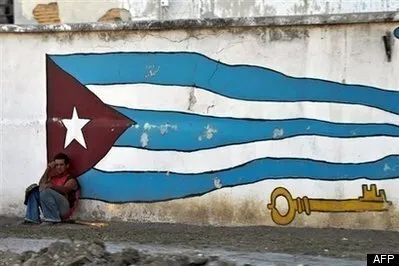
In a crucial vote this week, the Organization of American States could decide whether to lift Cuba's almost 50-year suspension from the key regional body. OAS secretary general José Miguel Insulza wants to bring the issue to a vote as early as June 2 at a General Assembly meeting. Such a move would be bad for civil society in Cuba and bad for the OAS.
Cuba was suspended from participating in the OAS in 1962 because its Marxist-Leninist government was deemed "incompatible" with the inter-American system. But recently, a growing number of Latin American countries--among them not only Cuban allies like Venezuela but also influential players like Brazil--have called for revoking the suspension. With the only public opposition coming from the US and Canada, there is a realistic chance that the suspension may soon be lifted.
At best, proponents of Cuba's return to the OAS fold suffer from wishful thinking. At worst, utter denial.
For the denial argument take Insulza, who said in an interview earlier this month that "there are other countries in America with problems of democracy, not just Cuba." The suggestion is that Cuba's "problems" are not so different from those of its neighbors. But such an assertion directly contradicts the findings of the OAS's own monitor, the Inter-American Commission of Human Rights, which found in a report released three days before Insulza's interview that: "Restrictions on political rights, freedom of expression and dissemination of ideas have created, over a period of decades, a situation of permanent and systematic violations of the fundamental rights of Cuban citizens."
Cuba is the only country in the region that represses nearly all forms of political dissent. For decades, the Cuban government has enforced political conformity using criminal prosecutions, long- and short-term detentions, physical abuse, and surveillance. This abysmal record has not improved since the handover of power from Fidel to Raul Castro.
The wishful thinking argument holds that welcoming Cuba back into the fold will open a new space for dialogue. However, the Castro brothers have left little doubt of what they think of the OAS. In April, Fidel Castro condemned the OAS as "the hateful tool of the superpower," and dismissed its principles and aspirations as "delirious dreams." His brother Raul has said the institution should disappear.
Nor do Cuba's official exchanges with the OAS inspire much confidence. The OAS charter encourages ongoing diplomatic efforts with suspended members. Yet for decades, Cuba has responded to all reports by the Inter-American Commission with the same letter rejecting the institution's legitimacy. These reports address serious rights violations, such as the groundless prosecution and imprisonment in March 2003 of 75 journalists, labor leaders, and human rights defenders, 54 of whom are still in jail.
Those who think revoking Cuba's suspension might make the government more open to engagement would be wise to look at Cuba's non-cooperation with the UN Human Rights Council, which it joined in 2007. The Cuban government continues to ignore the requests for visits from independent UN experts on freedom of expression and religion, and in February submitted a report for its Universal Periodic Review that denied the existence of political prisoners.
One of the most compelling arguments for not inviting Cuba back into the OAS is the extent to which other member states have progressed, as opposed to Cuba. When Cuba was suspended in 1962, Guatemala was run by a military junta brought to power by a CIA-sponsored overthrow, and Haiti by the brutal dictator, "Papa Doc" Duvalier. Over the span of a few years, coups toppled governments in Bolivia, Brazil, the Dominican Republic, Ecuador and El Salvador.
These days, most leaders in the Americas come to power through the ballot box rather than the gun. Surely, serious problems persist. The same OAS report that recently criticized Cuba also denounced the lack of an independent judiciary in Venezuela and attacks on human rights defenders in Colombia. On the whole, though, the region is making incremental progress toward establishing the rule of law. In 2001, OAS members signed the Inter-American Democratic Charter, which not only affirmed their commitment to democratic principles, but also established a collective responsibility to actively defend them.
To readmit Cuba would make a mockery of these commitments. It would reward a government that has failed utterly to improve its abysmal human rights record, and thereby weaken rights protections throughout the region. It would be a step towards tacit acceptance--not constructive engagement. Instead of lowering the region's bar to accommodate Cuba, the OAS should push Cuba to raise its respect for human rights to meet a higher collective standard. Leaders from the North and the South should work together to forge a targeted, multilateral strategy that will pressure Cuba to curb its systematic abuses.
This will not be easy, and will not happen overnight. But to think that simply welcoming Cuba into the democratic club will dismantle the government's repressive machinery may be--in Fidel Castro's own words--the most "delirious dream" of all.
Want to reply to a comment? Hint: Click "Reply" at the bottom of the comment; after being approved your comment will appear directly underneath the comment you replied to
Vivanco has his head in the sand. He pleases the rejectionist Cuban-American elements in Miami and Union City, New Jersey, some of whom no doubt fund his "research".
Obama is moving--albeit too slowly--towards a position similar to ALL of Latin America...e.g., bringing Cuba back into full status as a member of the Western Hemispheric Community, whether via the OAS or other multi-lateral organizations. Vivanco should have no doubts about this--it's decades past time that this was done. The US has squandered the trust of the vast majority of Latin Americans by its behavior towards Cuba--and, in Cuba, at Guantanamo.
As another letter points out, there are more political prisoners at Gitmo than in Cuban prisons.
The OAS is a creature of the US government, and irrelevant. It was set up to fight communism. Communism has ceased to be a threat.
Constructive change has the best chance of evolving in Cuba with improved ties and the ability of information to reach Cubans more freely via increased contacts. Eventually, Fidel will die, be put into a sacred shrine, and Cuba can get on with its business.
A lot has happened since Cuba "went communist."
First, Marxism-Leninism proved itself a failure, the USSR collapsed and Cuba lost its artificial economic props.
More recently, "free market" capitalism collapsed -- the verdict is still out on whether the current administration will alter or economic system or merely restore the intellectual frauds, financial criminals and political hacks who caused the downfall.
I'd guess the Cubans are unlikely to embrace the other failed system.
But these developments clear the table for a more practical discussion of relations with Cuba, free of political religions. Cuba may transform into a nation with a single-party system that allows economic prosperity to germinate, like the Chinese model. Cubans are still probably nationalistic, and may end up supporting "the party" as many Chinese support their government.
Who knows how these societies will evolve? No one, but it's clear that we need to engage with Cuba realistically.
"Marxist-Leninist government was deemed "incompatible" with the inter-American system. " I haven't heard that Marxist-Leninist mantra from an American writer since the wall fell down.
Methinks writer Vivanco should do some American introspection before he ventures out to condemn an insignificant small island and its human rights record.
The shoddy historical record of human rights in the USA has been horrible from the time of plantation slavery to the current day. There are strong and powerful reactionary forces that wish the worst for the new President. Vivanco and the organization that he works for should work towards cleaning up the real mess on home turf first-something that Americans fail to learn.
Many of us at HP know there's a propaganda war going on against Chavez.
This is an excellent report, and worth keeping on file. -
http://www.venezuelanalysis.com/indicators
Abyssmal? Not only does Cuban have fewer political prisoners than the US, it has fewer political prisoners IN CUBA than the US has.
Is there any reason to keep the OAS in existence?
LMPE - Chavez seems to be onboard with that, and excluding the US in a new organization.
When it comes to foreign policy it may make sense.
The US is the only member of OAS that has a history of attacking third world countries.
Argentina is the only other candidate. (Faulkland Islands ?)
Two-thirds of the Central American officers who were trained at the former School of the Americas run by the U.S. Army in Panama were accused of human rights violations before they even attended. When the base closed US Army manuals were found that showed how to torture. US Army personnel confirmed this. So, perhaps we should kick America out of the OAS for its human rights violations, not just becuause of its actions at this former "school" but because of its tacit support of death-squads throughout Latin America.
In Columbia union leaders are murdered with government officials approval.
It's Columbia that doesn't belong. (US and Canada also)
HRW says Cuba imprisons disidents - Cuba denies it. (I'll take Cuba's word on this on)
That's not to say that HRW never does good work. There are politics involved ,at some times, though.
SOTA has just changed its name.
It's now WHINSEC.
It also changed its location to Fort Benning, Georgia.
I was in the National Guard in the 80's and early 90's and we went to El Salvador to build roads. We were picketed by left wing protesters when we came home. They accused us of training "Death Squads". We were engineers and the closest I came to a death squad was when some Salvadoran soldiers were spraying for mosquitos with insecticide. That made us all feel good.
Here's just one example, among many, of US military involvement that wasn't nearly as benign as yours dan-o;
U.S. Green Berets train Guatemalan army in counterinsurgency techniques. Guatemalan efforts against its insurgents include aerial bombing, scorched-earth assaults on towns suspected of aiding the rebels, and death squads, which killed 20,000 people between 1966 and 1976. U.S. Army Col. John Webber claims that it was at his instigation that "the technique of counter-terror had been implemented by the army."
LuxSF - Let's compare some numbers - Your crowd vs Chavez
Primary Physicians
1998 - 1,628
2007 - 19,571
Primary education (number of students enrolled in public schools)
1999 - 271,593
2005 - 1,098,489
Looks like an improvement to me,
Do you think its sustainable, with him continuing to cannabilize his economy for these social programs?
I am all for more teacher's and doctors, but I doubt that the Venezuelan government can continue spending like this, without seriously damaging their economy.
Some of he worst abuses of human rights in the 20th century were committed after WWII by members of the OAS armed with US weapons and training. If respect for human rights and adherence to the rule of law had been required for membership in the OAS most of their meetings could have been held in a broom closet.
The US ran Cuba out of the OAS under Kennedy and in that time what has changed? Maybe it's time for something new. Perhaps we should try a rational adult approach to inter-American affairs.
Noam Chomsky's take on HRW
Forth question down. -
http://www.globalresearch.ca/index.php?context=va&aid=13785
Where were you during the Pinochet regime?
Querido Sr. Vivanco:
As a Venezuelan and as a former Venezuelan diplomat I would like to express my gratitude for being among the few progressive personalities who has documented and talked about the reality in the region. I currently live in the United States after being forced to quit my job as a career diplomat for political reasons. Your work has played a key role denouncing political persecution in Venezuela despite how polarizing the debate has been surrounding President Chavez.
Certainly the problem is not only the possibility of readmitting Cuba to the OAS, but also the state of democracy and human rights in the Americas. A decision to include Cuba's government once again will not have any positive consequences; on the contrary, it would lower our democratic standards.
As a President Obama supporter I hope his foreign policy will be more active defending human rights in the Americas. Recently, in a Washington Post editorial, the newspaper criticized the Administration for not condemning President Chavez's actions against the opposition. I am afraid that having this discussion in the OAS is partly due to a diplomatic effort encouraged by the Venezuelan government
Ignoring Chavez, just like Bush did with Latin America for a long time, would be a mistake. Unfortunately, such mistake will have real consequences for the people in Latin America, not for our corrupt and incompetent governments.
Thank you and keep up the good work!
A Venezuelan from San Francisco, CA
You must be logged in to comment. Log in or connect with