How many House seats will the Republicans gain in 2010? To answer this question, we have run 1,000 simulations of the 2010 House elections. The simulations are based on information from past elections going back to 1946. Our methodology replicates that for our ultimately successful forecast of the 2006 midterm. Two weeks before Election Day in 2006, we posted a prediction that the Democrats would gain 32 seats and recapture the House majority. The Democrats gained 30 seats in 2006. Our current forecast for 2010 shows that the Republicans are likely to regain the House majority.
Our preliminary 2010 forecast will appear (with other forecasts by political scientists) in the October issue of PS: Political Science. By our reckoning, the most likely scenario is a Republican majority in the neighborhood of 229 seats versus 206 for the Democrats for a 50-seat loss for the Democrats. Taking into account the uncertainty in our model, the Republicans have a 79% chance of winning the House.
The model has two steps. Step 1 predicts the midterm vote division from only two variables -- the generic poll result and the party of the president. With this estimate of the partisan tide in place, step 2 forecasts the winners of 435 House races using separate statistical models for open seats and races with incumbent candidates. At each step, the forecast takes into account uncertainty about the inputs.
First, we simulate 1,000 separate outcomes of the national vote. The pooled generic polls
conducted 121 to 180 days in advance of the 2010 election show a very close division of 49.1% Democratic and 50.9% Republican. But a near tie in the polls in mid-summer projects to a significant vote plurality for the Republicans in November, close to a 53%-47% split. This prediction is not due to any bias in the polls, but rather stems from the electorate's tendency in past midterm cycles to gravitate further toward the "out" party over the election year -- ultimately gaining about two extra points beyond what summer polls would otherwise show.
The national vote only tells us part of the story, and we still need to determine how it would translate into seats. For each of the 1000 simulated values of the national vote, we simulate the outcome in 435 congressional districts. Open seats and incumbent seats are treated separately. Open-seat outcomes are estimated based on the simulated national vote swing plus the 2008 presidential vote in that district. Outcomes with the incumbent on the ballot are estimated based on the simulated national swing plus the incumbent's vote margin in 2008 and whether the incumbent is running as a freshman. The weight that these variables are given in predicting the final outcome depends on their explanatory power in past elections. Full details are presented in our forthcoming PS paper.
To sum up, first we generated 1,000 simulations of the national vote. Then, we applied each of the 1,000 simulated national outcomes to each congressional district, noting the party of the "winner." For each of the 1,000 simulated outcomes of the national vote, we project the partisan division of the 435 congressional districts.
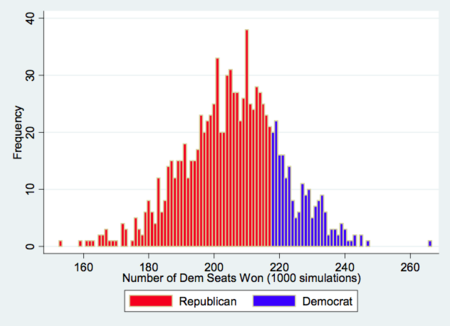
The figure below displays the range of simulated results. As can be seen from the predominance of red bars, the Republicans win the majority of seats in 79% of the trials. On average, the Republicans win 229 seats, 23 more than the Democrats and 11 more than the 218 needed for a majority. However, the simulations yield considerable variation, with a 95% confidence interval of 176 to 236 Republican seats.
This prediction comes with important caveats. Applying our model to 2010 assumes that the forces at work in 2010 are unchanged from past midterm elections. However, we should be wary of the possibility that the underlying model of the national vote works differently in 2010 or is influenced by variables we have not taken into account. Because the 2010 campaign started to heat up earlier than usual, the usual tilt toward the out party may already be complete, with no further drift to the Republicans. It is also uncertain how voters will react to the tea-party movement as the public face of the Republican Party.
The key will be to follow the generic polls from now to November. If the polls stay close, the Democrats have a decent chance to hold the House. But if the polls follow the past pattern of moving toward the "out" party and move further toward the Republicans -- even by a little -- the Republicans should be heavily favored.
Joseph Bafumi is an assistant professor in the government department at Dartmouth College. Robert S. Erikson is a professor in the political science department and faculty fellow at the Institute for Social and Economic Research and Policy at Columbia University. Christopher Wlezien is a professor in the political science department and faculty affiliate in the Institute for Public Affairs at Temple University.
Stuart Whatley: This Side of Democracy
Good enough.
"So what are they going to do? Cut taxes? deregulate, cut entitlements thats going to make things better?"
Among other things, yes.
"Didn't we try this from 2000 on?"
Um, up until 2006...now Bush inherited a worsening economy and was working to make it better until 9/11 hit. Now we were recovering and doing ok...but the Democrats, if you recall, took the legislature in 2006. After that, it was a Democratic House and Senate...and as we all know, the Congress holds the pursestrings.
Now, can you tell me how the stimulus has recovered the economy? It appears to have made a small jump but only for as long as the money held out. Point is, government cannot create jobs, it can only create an environment for creating jobs.
Cut taxes? deregulate, cut entitlements thats going to make things better? Didn't we try this from 2000 on? If the economy does not improve in 2011 and on it becomes their problem as well. if it worsens they will be blames. If they continue to bash immigration (they need villains thats how they work) What happens to the growing Hispanic voting bloc (who is not going to be that inspired because they are mad at the Democrats for not doing what they were put their to do.
Also, the Tea Party here is threatening to stay home in Nov because McCain beat Hayworth.
'J.D. Hayworth Election Night Fiesta Turns to I-Hate-John-McCain-Apalooza as J.D. Concedes' - http://tiny.cc/2yiu3
But conditions have deteriorated badly for Democrats over the summer. The economy appears rotten, with little chance of a substantial comeback by November 2nd. Unemployment is very high, income growth sluggish, and public confidence quite low. The Democrats’ self-proclaimed “Recovery Summer” has become a term of derision, and to most voters—fair or not—it seems that President Obama has over-promised and under-delivered.
Given what we can see at this moment, Republicans have a good chance to win the House by picking up as many as 47 seats. This estimate, which may be raised or lowered by Election Day, is based on a careful district-by-district analysis, plus electoral modeling based on trends in President Obama’s Gallup job approval rating and the Democratic-versus-Republican congressional generic ballot. If anything, we have been conservative in estimating the probable GOP House gains, if the election were being held today.
In the Senate, we now believe the GOP will do a bit better than our long-time prediction of +7 seats. Republicans have an outside shot at winning full control (+10), but are more likely to end up with +8 or +9. If the Republican wave on November 2 is as large as some polls are suggesting it may be, then the surprise on election night could be a full GOP takeover
Read more: http://dailycaller.com/2010/09/02/sixty-days-until-midterm-elections/#ixzz0yNSe8Ind
All a government can do is cultivate an environment to create private sector jobs.
Unless, of course, you're talking about increasing the government bureaucracy...THAT a government can in fact do.
Furthermore, you can't blame a president as much as his congress for this. So you can't give all credit or place all blame on Bush no more than you can Clinton Bush 1, or Reagan.
All you can really do is look at the policies that are put forth to fight a bad economy or sustain/grow a good one.
GOP Takes Ten Point Lead In 2010 Generic Ballot
Doug Mataconis | Monday, August 30, 2010
The latest Gallup Generic Ballot poll is enough to send Democrats on Capitol Hill heading for the bunkers:
PRINCETON, NJ — Republicans lead by 51% to 41% among registered voters in Gallup weekly tracking of 2010 congressional voting preferences. The 10-percentage-point lead is the GOP’s largest so far this year and is its largest in Gallup’s history of tracking the midterm generic ballot for Congress.
The Republican leads of 6, 7, and 10 points this month are all higher than any previous midterm Republican advantage in Gallup’s history of tracking the generic ballot, which dates to 1942. Prior to this year, the highest such gap was five points, measured in June 2002 and July 1994. Elections in both of these years resulted in significant Republican gains in House seats.
http://www.outsidethebeltway.com/gop-takes-ten-point-lead-in-2010-generic-ballot/
There's plenty of time left for things to turn around.
Any guesses which industry is the largest employer? Government (all levels) is 16.3%
Next on the list is Healthcare at 12.4%
Retail is next at 11.2%
Then Leisure at 10.6%
Followed by Manufacturing at 9.0%
Financial services at 6.0%
Professional services at 5.7%
Finally we get to housing or construction at 4.8%
This accounts for about 75% of all the jobs in the USA. I found it interesting. So where do you think the jobs will come from as we recover? The stimulus pretty much was used to shore up the 16.3% who work for government.
So you have a crystal ball that sees into the future? You seem so happy with being a Republican. You must be one of those who makes over $200,000 a year, so you don't want to have to pay your Fair Share of Taxes and you want an extension of W. Bush's tax cuts to go on forever...
Be careful what you wish for because you may find out that you're not 'rich' enough to be a Republican!
Being poor doesn't mean that you can't be sensible and realize you have to create wealth before it can be distributed.
Obama is now under 50% approval by all economic groups including those making under $2000 per month.
Now for the quote above, that is the prediction of a number of pundits on BOTH sides of the aisle. I think the Senate is also in play and the Republicans could take control there (gain 10 seats), but it is not a slamdunk. The House majority for the Democrats is pretty much over.
We're heading in the right direction but can't let the majority go to Republicans. With the Tea Party, it should be even easier to win with some EFFORT.
Point two. How is it possible when President Bush had SMALLER majorities in congress he was still able to do just about everything he wanted to do? And had no problem going on TV to stir the pot and scare people into calling their congressman?
As far as Democratic policies go Nancy Pelosi has been a good Dem Speaker of the House. She could have gotten a lot more Democratic bills passed if she had ANY help from Reid in the Senate or from dis-engaged, dis-interested Barak Obama. Even if you don't agree with their agenda it is unfortunate that Ms. Pelosi will probably be the only one to suffer losing her position while the other two will keep theirs and have done less for their party.
Republican voters also need to stop drinking their parties kool-aid also. We have already been through one Great Depression caused by having too much wealth in too few hands. Tax cuts won't fix this.
Yes, the GOP is Lockstep. But when they go over the cliff, they will all go together...
Better for the rest of us that the GOP goes over the cliff before the Mid Terms in November. They have been taken over by the Ultra Right Wing who want to go back to the past, and people want to go forward to the Future. But the Tea Party is coming up with some really loony things--cancel the 14th Amendment, tell Muslims where they can worship in a country that supposed to be #1 in Freedom of Religion, get rid of Federal Social Services (Welfare, Food Stamps, Medicaid), cut back on Social Security and Medicare. BUT they want the 'haves and have mores' to not pay taxes, own everything and every piece of land, run the country under THEIR religious and conservative terms. NO, the GOP is not going to be able to convince this country that 'Tax Cuts' will make jobs (if the cuts made jobs, then why are the top US corporations sitting on over $1.8 TRILLION right now, using the excuse that they have to 'save' the money for Obama's new Regulations Law, but actually keeping the money because they are mad that Obama won't let them do their 'business as usual' (making up their own rules and doing whatever they want--not having to answer to anyone on how safe or secure their business practices are) It Won't Work...
Stop whining about not getting everything we wanted. We need to make sure that the pundits are proven wrong and that we keep control of both houses, we just need some stronger progressives in both houses.
I also say that when they get back from their vacation, that the Democrats push things through and hold those Rethugs accountable if they want a filibuster give them one!
Fanned/Faved
publicans-plan-mccarthyite-persecutions"
GDP annual growth rate:
Fourth quarter 2009 5%
First Quarter 2010 3%
Second Quarter 2010 1.6%
Projected 3rd qtr >1%
Mort Zuckerman writes a recent column titled "The Most Fiscally Irresponsible Government in U.S. History"
You are dreaming.