- A father who falls asleep on the couch after having several drinks three or four days a week, thereby missing out on time with his kids and wife.
- A sales executive who likes to "sip" scotch on the rocks from the time he finishes his dinner to the time he goes to bed.
- A college student who repeatedly has trouble making it to class because he was drunk the night before.
- A mother who looks forward to her daily double glass of wine to help her get through the day.
- An assisted living resident who finds that two or three brandies every day helps to relieve her boredom.
What do all of the above people have in common? They are almost alcoholics. And there are many more "almost alcoholics" like them than there are true alcoholics in the world.
A New Look at an Old Problem
For many years, health care professionals have been accustomed to thinking about drinking in terms of just two diagnostic categories: alcohol abuse, and alcohol dependence. In order to qualify for one of these diagnoses, an individual has to suffer some fairly severe and obvious consequences directly related to drinking: a major health crisis, an arrest, loss of a job, etc. To be diagnosed as alcohol dependent, a person also has to experience physical symptoms of withdrawal if he or she stops drinking. Meanwhile, men and women whose drinking is not severe enough to qualify for one of these two diagnoses have essentially been considered "normal." A major limitation of this approach to diagnosis is that it fails to address the very real problems caused by drinking that doesn't rise to the level needed for a diagnosis.
As it works on the first major revision of its Diagnostic and Statistical Manual (DSM) in 15 years, the American Psychiatric Association is contemplating moving from categorical thinking like the above with respect to a number of diagnoses. In its place, they are considering viewing a number of diagnoses in terms of a spectrum. This is where the concept of almost alcoholic fits in -- and it may apply to you or someone you love.
Could You (or a Loved One) Be an Almost Alcoholic?
Rather than thinking in terms of just three categories (normal, alcohol abuse, alcoholism), it is probably more productive to look at drinking in terms of a spectrum like that depicted below:
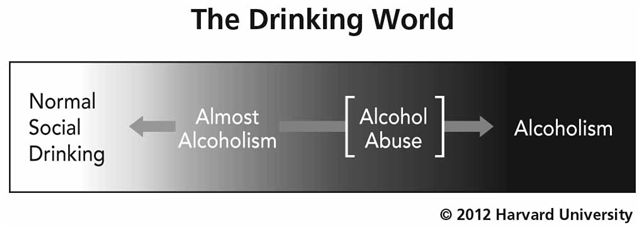
This illustration more accurately reflects the real "drinking world." What it suggests is that an individual's drinking can range anywhere from normal social drinking at one end of the spectrum, to almost alcoholic in the mid-range, to alcohol abuse or dependence. Moreover, these different areas are not separated by sharp lines; rather, they blend into one another. Of the three "problem" zones, the almost alcoholic zone is by far the largest.
Normal social drinking is the person who has a beer or two, or a glass of wine or two, not more than a few times a month, and almost always in a social context. This is the man or woman who meets friends for happy hour after work on Friday, who joins friends to watch a game on television, or who is invited to a party. Millions of people are normal social drinkers, and many of them never go on to be more than normal social drinkers.
As the illustration suggests, there is a large "gray area" that lies beyond normal social drinking but falls short of alcohol abuse and dependence. Many people slip into this gray zone. Some go only a short distance; others venture much deeper over time, but still are not alcoholics. That said, men and women whose drinking patterns lie in the almost alcoholic zone are likely to be suffering, as are their loved ones. For example, they may be experiencing one or more of the following:
- Trouble sleeping soundly
- Mild depression
- Marital or family conflict
- Health problems that aren't recognized as related to drinking
- Declining performance at work
Connecting the Dots
One thing that has become very clear to us -- and a major motivation for writing our book -- is that most almost alcoholics (as well as health care professionals) often fail to see the link between drinking and any problems these people may complain of. Being able to "connect the dots" and see the relationship between drinking and such problems allows the almost alcoholic to make a decision: to remain in the almost alcoholic zone (and risk venturing further toward alcoholism), or to "shift left" back toward normal social drinking.
Many Pathways, Many Solutions
No one sets out intending to become an almost alcoholic. Similarly, people do not become almost alcoholics for the same reason. There are many pathways into the almost alcoholic zone, and for that reason there needs to be many solutions. I will discuss some of these pathways and solutions in future posts.
For further information visit www.TheAlmostEffect.com or read Almost Alcoholic: Is My (or My Loved One's) Drinking a Problem?
For more by Joseph Nowinski, Ph.D., click here.
For more on mental health, click here.