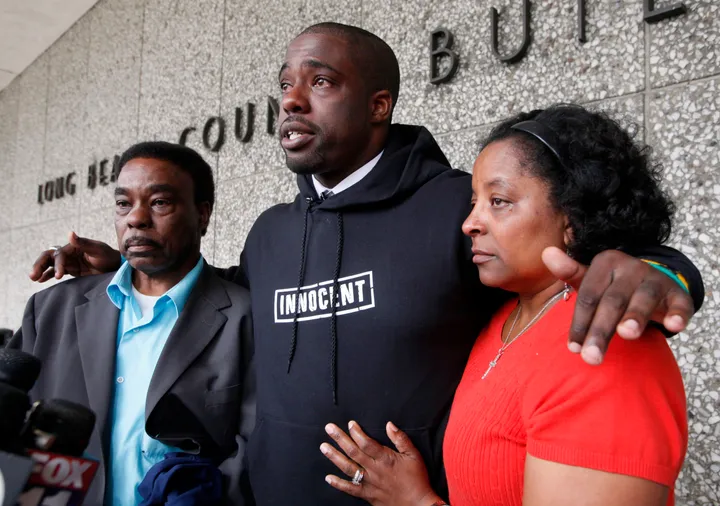
Prison is Hell for the guilty; it is difficult to envision what it must be like for the innocent. Brian Banks is yet another story of a person not only wrongfully imprisoned, but imprisoned based upon his own "voluntary" act. He was exonerated after serving five years for a rape he did not commit. How and why do innocent people confess or plead guilty to crimes that they did not commit? Roughly 20 percent of those that have been exonerated confessed to the crimes with which they were charged and convicted. Most of those involved persons who had actually gone to trial, but we have no way of knowing how many there are who merely entered guilty pleas through bargains and never appealed as a result. Although we hear and read about criminal trials, the reality is that only about 5 percent actually go to trial and the balance are resolved by plea agreements.
In this case Mr. Banks pleaded "no contest" or nolo contendere, a plea in which the defendant neither admits nor disputes the charges against him. In most instances, a defendant will be required to make a choice between a plea of guilty or not guilty. When pleading guilty a defendant is required to "allocate" before the judge -- admit the crime and furnish sufficient details to satisfy the court that he is indeed guilty. (One cannot help wonder how and by whom an innocent defendant is furnished with enough information about the crime to satisfy the court of his guilt.) That is not always the requirement in "no contest" pleas, and I do not know what transpired in the Banks case. If he had pled guilty he would have been required to admit the rape and testify to the details.
What apparently happened here (based upon his version) is all too typical of what happens in the criminal justice system. I call it the "Ins of Court" -- intimidation by the prosecution and incompetence by the defense. The defendant, frightened, most often poor, uneducated, a minority member is advised that a trial is likely to end with a conviction and a long sentence, whereas a plea will guarantee a much shorter sentence. Despite his protestations of innocence, the defendant seeks guidance frequently from an over-worked, underpaid defense lawyer who would much prefer a quick deal rather than a long drawn out trial. Of course, not all defense counsel fit that description. Many do not, but even the best and most devoted are required to put this draconian choice to their clients -- a guaranteed short sentence versus a potentially long one -- possibly life in prison.
The problem is further complicated by the fact that it is more difficult to set aside a guilty plea than a conviction after trial. Once a person has admitted guilt and spelled out the details of the crime sufficient for the court to accept the plea, the chances of reversing such convictions are very slight if not nil. Most do not try. Mr. Banks had the fortitude to continue his fight even after he had been paroled and was fortunate in eliciting a recantation from the complaining witness. Such instances are very rare. Thanks to the tenacity of the California Innocence Project it happened here.
The reality is that without plea bargains the entire criminal justice system would come to a halt. Charges would be tried ten years after they were made. The only solution is vigilance by all those involved. The prosecutor, defense counsel and the court must be satisfied of the defendant's guilt before urging or accepting a plea. I recognize that there is no avenue to absolute certainty because the knowledge of guilt or innocence lies with the defendant, but all involved must strive not to imprison the innocent -- even those who profess to be guilty.
In the Banks case, as a juvenile he was probably not allowed a jury trial, or threatened with adult charges as a juvenile if he did not comply.
In these cases you no longer have the right to confront your accuser, hear say evidence is admissible, syndrome evidence and specualtion is accepted as "real" proof, and you can be convicted without any physical evidence.
In an Aflord plea, you are allowed to maintain your innocence, but "agree" there is enough evidence to convict. If there IS enough evidence to convict, then WHY DONT' THEY?
Because they don't - all they have to do is threaten you, truthfully, with sure conviction and a much longer prison term.
After accepting the plea, YOU are held to the "bargain", YOU are no considered guilty,while the court can invoke an "manifest injustice" and change the terms if they choose.
The case I was knew, the accused was offered a plea for no jail time after passing multiple polygraphs and the lack of physical evidence (the accuser was virginally intact after claiming over a dozen attacks).
He was jailed anyway after passing another polygraph during the pre sentencing investigation. He was now "in denial" since he "took a guilty plea" even though it was a "I'm innocent but pleading guilty anyway" plea.
It's just a big evil chess game, heads they win, tails you lose.
Innocent people never willingly accept plea bargains. Why would you insult our intelligence?
The System runs on pleas - you over charge the accused, you terrify them - rightly - by pointing out all the innocent people still in prison or bankrupted who refused to "cooperate" by accepting guilty pleas. Not even a terrified 16 year old black kid is blind to the fact that taking your case to trial will most likely get you convicted(over 90% of the time) and MUCH harsher punishment meted out.
Throw in a few "prison bitch" comments and voila: an innocent person "willingly" accepts a plea.
It's a dirty deal, sir, and you know it.
The whole situation is wrong, the false accusation and the pleading to a crime never committed, but the false accusation comes first and sets the whole misfortunate episode in motion. What is the psychology of falsely accusing another of a horrible wrong?
http://www.californiainnocenceproject.org/index.php?option=com_content&view=article&id=75:puracal&catid=8:news&Itemid=23
The war on drugs has been worse than the drugs: in money, personal tragedy, erosion of civil liberties, official corruption, militarization of policing, wrongful convictions, theft by forfeiture , and prosecutorial misconduct and abuse. And governments, judges and bar associations have been very negligent about disciplining the latter.
Google " Elimination of Constituitional Rights" by attorney Paul Stuckle.
I enjoyed the "Ins of Court" pun; Horace Rumpole would probably have approved.
As for the substance, given the extreme pressure innocent defendants are under to cop a plea, guilty and no-contest pleas should probably be given no more weight than contested convictions when subsequently challenged.
As bread and salt in US isn't under monopoly, likewise the divine is no any religion's monopoly either.
BTW the divine cause, is people's truth; to honor the truth in people, in the long run, creates the best society ever.
If taken in for questioning the most effective thing to do is shut up and demand a lawyer.
It's a chess game to them - you aren't important, and the Truth never has anything to do with it in the first palce.
What no one wants to talk about is this-if you add up the day-to-day instances of criminal misconduct by law enforcement and prosecutors, -you could make the argument that criminal misconduct by those within the criminal justice system constitutes one of the largest crime waves in the country-there is just no accountability for these crimes-only cases thrown out. Add to that jurors who are brainwashed into believing that being on trial equals guilt and that police don't lie, and the fact that almost all criminal court judges are ex-prosecutors and bring that mind-set with them. I was brought up to believe that when those in authority 'cross the line' that they should be dealt with harshly. Instead we have a steady stream of folks ground through the largest criminal justice system on the planet-guilty or not, while criminals within the system just keep on going..
Sometimes the cops aren't even involved.
Google "Nifong".
Are those good enough reasons why innocent men confess to a crime they did not commit?
When faced with this reality ( it IS reality, no lies needed) yes, 90% of the time the accused will accept the plea offer.