
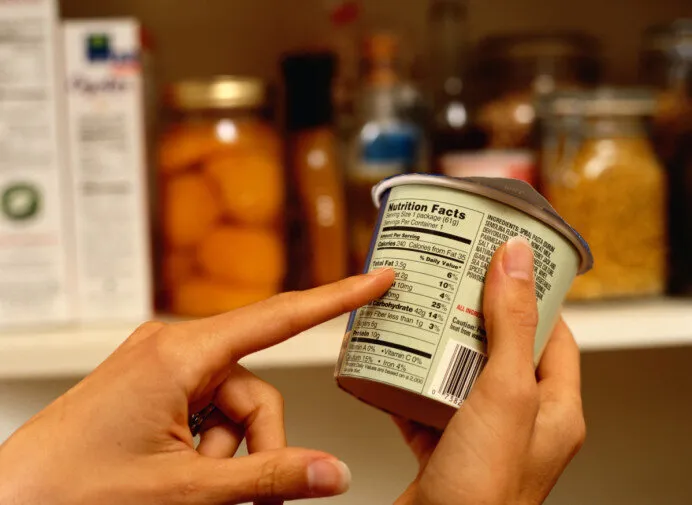
Have you looked carefully at a nutrition label recently? I did so only because I had the label from a protein bar in my hand while waiting on a long line without anything to read.
The print is large enough to read without a magnifying glass and there was enough information to keep me occupied until I reached the cashier. Like many people who turn over a box or bar to look at the food label, I was immediately drawn to the serving size and calories per serving. Underneath this crucial information (at least crucial for anyone attempting to watch calorie intake) was the number of calories from fat. Having just eaten the protein bar, I was gratified to see that the number was 60--not low but at least not astonishingly high either.
Serving size may not seem very important, but it is. Some very high-calorie, high-fat snack foods get away with a low-calorie count by claiming an unrealistic number of servings. I remember looking at a package of cupcakes and was horrified to see that a serving was half a cupcake. Who eats half a cupcake? But by stating such an absurd serving size, the manufacturer could say this was a low-calorie food. Serving size is important but often overlooked when buying a main course meal such as macaroni and cheese or a chicken-rice bowl. The meal may seem to have a reasonable amount of calories for the serving size given. But if you are planning to make a meal out of mac and cheese and are really hungry, would you be satisfied with the one-cup serving stated on the label? Probably not. And eating another serving could increase the calorie count to an unacceptable number. Fat calories are a revelation as well, especially if the food doesn't appear to be made with much fat. Baked goods like cookies that taste more doughy than fatty may contain more than half their calories from fat.
The right side of the label lists the amounts of certain nutrients in grams and on the same line also gives the %DV, which means percent of daily value. It is the amount of a nutrient public health experts believe we should all be eating daily. However, the percent DV is a little tricky to understand. It is the percent of the nutrient in the food item relative to the daily requirement. An asterisk by the %DV sent me peering at the bottom of the label. There, in tiny print, was a statement that percent daily values are based on a 2000-calorie a day diet. This means that if I am planning on consuming 2000 calories today, I will need to eat a certain quota of various nutrients. If I eat 4000 calories or 1000 calories, my nutrient needs will go up or down accordingly.
This information may be misleading. The bar says that the protein content is equivalent to 30 percent of the protein needs of someone on a 2,000-calorie diet. But if I go on a diet and decide to eat 1,400 calories a day, do I need less protein? What if I'm training for the Iron Man competition and use a 4000-calorie diet? Do I require more protein? How do I calculate my own needs if my calorie intake is not 2000 a day? Is algebra required to do this? Is there an App for that?
Many nutrient needs are not based on caloric intake but on other criteria such as muscle mass or, in the case of calcium, on age and gender. For instance, adolescent girls and menopausal women need more calcium than women of other ages. Perhaps the next edition of food labels will make this concept easier to understand.
On the other hand, the label makes it easy to spot a food with high levels of things like sodium. If the label indicates that the sodium content of the food is l00 percent of the daily value, then it is probably too high for most people, regardless of how many calories they are eating.
There is more information. The bottom half of the label displays the vitamin and mineral content. The bar I ate contained quite a few, which may explain why it tasted faintly of a vitamin pill. The list does not give actual amounts of the vitamins and minerals but does list the percent of the daily value, again based on eating 2,000 calories a day.
And the final bit of information, which runs like a banner at the bottom of a TV newscast, tells me I should be eating 40 percent of my calories from carbohydrates and 30 percent each from protein and fat.
Is this information helpful? It certainly is in making decision about what foods to buy. Think how easy it is to decide what yogurt to buy if you want one with a substantial amount of protein and calcium. Or, if you are deciding between two high-fiber breads, you might discover that one really doesn't have that much fiber, even if it is called whole grain. People with medical conditions that make it necessary to limit certain nutrients such as protein, sodium or cholesterol depend on food labels.
Certain medications require avoiding or consuming particular nutrients, and I know someone whose medication for Parkinson's disease works better when foods with a particular ratio of protein to carbohydrate are consumed. Our book, "The Serotonin Power Diet," advises the dieter to eat, at specific times of day, foods with a high-carbohydrate, low-protein and low-fat content so their brains make new serotonin. Since we couldn't list all the foods that would meet this requirement in the book, we asked our readers to check the food labels.
My major reservation with food labels concerns the percent daily value information. It is important to realize that the food labels will point you in the right direction to obtain the nutrients you need. But I doubt that most of us will keep a running tally of what we are eating each day to see how close we come to meeting our requirements for manganese, phosphorous or even protein and vitamin C based on the percent of that nutrient in the food we just ate. But if we are influenced even a little by this information, it is worthwhile. And who knows? Maybe one day we will be able to obtain it on our smartphones with the math done for us.