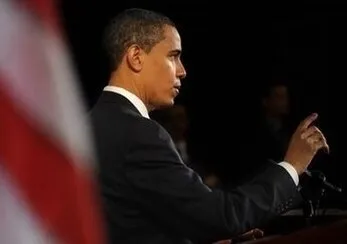
It takes money to build a political movement. But progressive Democrats are not always comfortable with this reality. During the 2008 presidential campaign, Barack Obama's campaign was able to raise massive amounts of cash -- funds that proved pivotal to fending off the Republican attacks in the final month of the race.
Democrats have been more willing to boast about their huge data base of small donors upon whom Obama relied. Using computer and telephone technology, as well as a motivated army of volunteers, Democrats did extremely well at raising small amounts of cash from donors who saw the possibility in his presidency.
In contrast, Democrats have not figured out how they feel about the wealthy individuals who have poured their money into the Obama campaign, as well as the efforts in recent years to create a vibrant infrastructure of progressive media and Internet outlets. The Campaign Finance Institute reported that Obama's base of small donors was roughly equivalent to George W. Bush's base in 2004. But large donors were extremely important. A recent analysis by the Washington Post found that there were approximately one hundred families and couples who donated $100,000 or more in 2007 and 2008 to Obama's campaigns. George Soros and Sheldon Adelson, the most talked about donors, have often been the focus of conservative attacks. Liberals have also come under fire from the right with questions about who provided the funds for the Center for American Progress, whose president John Podesta is in charge of Obama's transition and which is providing much of the intellectual firepower and personnel for the new administration.
Kim Phillips-Fein's new book, Invisible Hands provides a fascinating account of how important wealthy donors were to the rise and success of conservatism. She traces a network of wealthy business leaders who, starting in the 1940s and continuing through the 1980s, poured their funds and energy into making conservatism a viable and powerful political force. While many historians have focused on the role of ideas, activists, and politicians, this work takes us to the people who put their money where their mouths were.
"It is a book," she writes, "about businessmen like Lemuel Boulware [of General Electric] who supported and helped to build the conservative movement that brought Reagan to power in 1980 . . . This book is about those determined few, those ordinary businessmen . . . from companies of different sizes and from various industries, who worked for more than forty years to undo the system of labor unions, federal social welfare programs, and government regulation of the economy that came into existence during and after the Great Depression of the 1930s."
There is a big cast of characters in this book, including many figures who are not well known, but who were influential. For example, President of Sun Oil J. Howard Pew was determined to combat the influence of liberal ministers in the Protestant church. He helped to create an organization called the Spiritual Mobilization which paid to send conservative books to ministers and solicit money for this cause.
In another chapter of the book, Phillips-Fein recounts the history of The National Review, a journal famously founded by William Buckley Jr., that helped spread and popularize the ideas of conservatism since the 1950s. But what is less discussed are the people with the money that allowed this magazine to happen. Fellow Yale graduate Roger Milliken, a wealthy industrialist in the textile industry who had been tough with unions in his South Carolina plant, purchased subscriptions for over a thousand of his friends and bought advertising space. According to Phillips-Fein, he increased the number of ads significantly when the magazine faced a revenue shortfall that threatened the future of the magazine early in its history. Milliken also leaned on his friends to purchase advertisement. He was one among many other executives, like Lemuel Boulware from General Electric.
During the 1970s, businessmen funded the creation of numerous think tanks and advocacy organizations to fight against unions, government regulation, and for lower taxes, leaving behind a significant institutional infrastructure of organizations such as the Heritage Foundation, which continue to influence public debates.
Progressive Democrats now have their own wealthy donors, though the list is not nearly as extensive as the one compiled by conservatives. In the coming years, they will have to decide what role wealthy donors should play in this burgeoning movement. There will be two ways to read this book. One is as a guide of what not to do, a model of how private money became extremely influential in the political world. The other way is different, as a model of how money can be a useful and constructive force in coming years.
More soon from the academy....
Julian E. Zelizer is a professor of history and public affairs at Princeton University's Woodrow Wilson School. His new book, Arsenal of Democracy: The Politics of National Security -- From World War II to the War on Terrorism, will be published this fall by Basic Books. For more information about this author, see www.julianzelizer.com.