
Co-authored with Lee Glenn
Some ideas don't fade, they simply adapt to changing circumstances. So we found in the rolling hills outside of Sonoma, California, home of the Occidental Arts and Ecology Center on 80 acres of organic gardens, orchards and wild lands. We were drawn to the center after hearing Founder and Executive Director Dave Henson's compelling keynote address at the 32nd Ecological Conference. A committed educational program, a historical approach to agriculture, an "intentional community," the OAEC weaves together its resources into a comprehensive agenda of local and regional response to destructive global change.
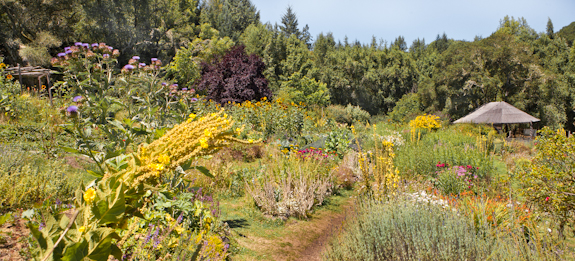
As we wander the secluded property with Dave, each turn brings a break in the forest revealing the gardens, the common kitchen, dining hall, outdoor stage, swimming lake, guest yurts, green houses, the classic wood barn/shop and classroom, over 30 on-site buildings in all.
The OAEC offers six-, nine- and 12-month agriculture internships, acquainting with growing strategies. Based on Allen Chadwick's teachings from the 1960s combining the French intensive growing program of the 1800s, with the pollination-intensive approach of English gardening, they practice and teach bio-intensive growing, another branch of progressive farming to which we are being exposed.
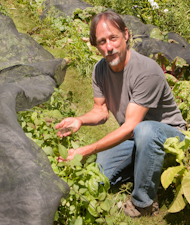 As if feeling the smell on our skin while walking the multiple gardens, pockets of scent moisten the warm air. Its texture intermittently thickens like walking through invisible clouds. Sweet and savory aromas envelop us, the rich soil and bounty from the garden seductive.
"We're growing soil... that's what we grow," explains Dave.
This thread has been expressed by others committed to a new awareness of old practices in farming, nutrition and personal involvement. For OEAC, good medicine starts in their compost, a hot topic featured in "Health Begins in the Soil," our recent blog on bio-nutrient dense farming.
Advocating that market pricing should reflect the actual cost of production, Dave contrasts large-scale agriculture with small-scale organic farming. The bottom line... if conventional food were priced without government subsidies, organics would be competitive. Surprising to us though, is the belief that even small-scale, private, organic farming is frequently subsidized by personal wealth since revenue from ecologically sustainable farming frequently does not pay for agricultural land purchase and ongoing farm overhead.
A non-profit, the OAEC self-funds 50 percent of its expenses through for-fee courses, nursery sales, organic crop sales, consulting services and facility rentals. The remainder comes from donations, private foundations and government grants.
A parallel OAEC goal is bringing together the disparate elements of work and daily life. We talk over a delectable daily meal from fresh produce, prepared for the students, interns and residents by Chef Coby Leibman.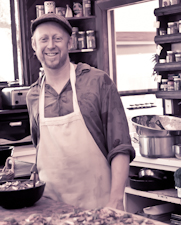 The menu is drawn from the garden: Spicy Amaranth Greens Pesto, Fresh Chickpea Falafel, Cucumber and Goat Yogurt Mint Salad. Interested in the recipes?
Culturally, OAEC is a "Sowing Circle Intentional Community," or what would have been called a "commune" during the culture wars of the'60's. It is the permanent home for ten owners, 28 people total, including six children. For them, the connection to place, growing, harvesting and preparing communally has physical, mental and spiritual benefits... a life choice. It is not for the dabbler, the vaguely committed or the faint of heart. Their sense of community embodies a collective energy responding to the dramatic changes they see overwhelming our planet.
The rapid pace of change is what Dave calls "The Great Acceleration," referring to the breakneck pace transforming our environment. He challenges the belief that technology can resolve our global issues: "There is not enough energy to power the full production of the systems that we think will solve our energy problems. Instead, we are focused on local or regional transition, on what we can impact. We cannot rely on market solutions to our ecological an social crisises."
This dynamic, alternative community is educating for "... the tsunami of peak everything: fossil fuels, water, food, population." A core teaching program, Permaculture Design, is a response to this predicted transition. It offers 28 students a two-week intensive, covering topics including sustainable agriculture, natural building, restorative land management practices and cultivating local economies.
"Permaculture, and Ecological Design, are systematic approaches to designing human settlement rooted in the ethics of caring for the earth and human communities, and guided by the uniqueness of each situation."
The Center strongly believes they can have a positive impact on a regional scale. They are helping communities restore watersheds in northern California, with a focus on supporting salmon recovery. "Regionally, salmon is a keystone species -- when salmon are healthy, it is indicative that the overall ecosystem is doing well."
OAEC is also working to restore the beaver population of the state. As per Dave, "Just like humans, beavers transform the landscape. High in the mountains, their dam systems slow down and sequester the snow melt reduced by global warming, preserving downstream water supply for ecosystems, agriculture and urban use in California."
Drawing upon the knowledge and experience of their former incarnation as the Farallones Institute, a pioneering center in appropriate technology and sustainable design, collectively, they have taught and inspired generations of practitioners. Combining demonstration, teaching, research and political activism, their audience is diverse, their mission:
"To develop collaborative, community-based strategies for positive social change and environmental stewardship."
Julie Brothers
Lee Glenn
