
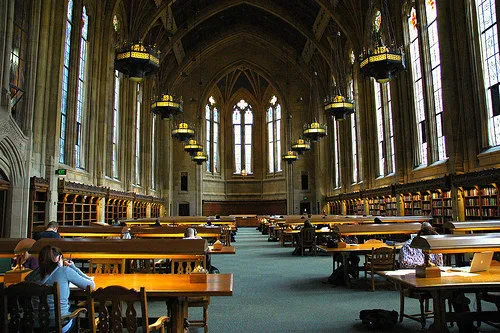
America's universities have long had a reputation for being the best in the world -- a truth so apparently self-evident that it's rarely been doubted or questioned. But what if the nation's 5,000 institutions of higher education, as a whole, have fallen behind their international peers?
Indeed, there's lots of evidence that American higher education could be doing significantly better. But how?
It's a question that we at The Hechinger Report set out to answer by visiting countries on three continents and examining their new higher-education agendas.
As President Barack Obama has noted time and again, the U.S. has slipped from first to 16th in the world when it comes to the percentage of our population aged 25-34 with postsecondary credentials. We're at 41 percent, or about two out of every five young adults, according to the latest data from the Organisation for Economic Co-operation and Development -- and this despite the huge cost of U.S. higher education to families and taxpayers.
World champion South Korea is at 63 percent. Canada -- with which the United States shares a border, yet which fares far better in this international ranking -- is tied with Japan for second. Fifty-six percent of Canadian and Japanese young people hold degrees. Russia follows, in fourth, at 55 percent. So what's going on?
Yes, the U.S. is home to Ivy League institutions such as Harvard and Yale, along with top-rated M.I.T. and Stanford. And yes, the U.S. boasts 17 of the top 20 universities in the world, according to the most recent Academic Ranking of World Universities by Shanghai Jiao Tong University.
Yet these institutions enroll a thin slice of America's 20 million college students. Far more attend two- and four-year colleges, both public and private, of often-questionable quality.
And for every U.S. student who graduates, two drop out. Nearly 80 percent of those who enroll in community colleges never finish what they start.
The United States is facing a projected shortfall of 16 million college-educated adults in the American workforce by 2025 if it doesn't change the rate at which it produces college graduates. Young Americans today will make history for being the first generation ever to be less educated, and to earn less and live less comfortably, than their parents.
With the country on the cusp of a double-dip recession, millions remain unemployed and leading thinkers are suggesting that the 21st century belongs to China and India, not America.
Why? We hear again and again that it's because America fell asleep at the wheel.
Our series, "Lessons From Abroad," tells the story of a once-dominant nation in danger of being left behind. We invite you to be a part of the discussion, as it unfolds over the coming months on this site, in The Washington Post and in other national outlets. The Hechinger Report will turn its attention to higher education in China, India, Japan and South Korea, as well as Canada, Great Britain and Ireland. Blaine Harden reports on Japan in Saturday's Washington Post. Our hope is to spark a national conversation about higher education that continues well beyond our coverage.
In their new book, That Used To Be Us: How America Fell Behind in the World It Invented and How We Can Come Back, Thomas Friedman and Michael Mandelbaum explain both the opportunities and the challenges facing the United States:
To prosper, America has to educate its young people up to and beyond the new levels of technology ... we need our education system not only to strengthen everyone's basic -- reading, writing, and arithmetic -- but to teach and inspire all Americans to start something new, to add something extra, or to adapt something old in whatever job they are doing. With the world getting more hyper-connected all the time, maintaining the American dream will require learning, working, producing, relearning, and innovating twice as hard, twice as fast, twice as often, and twice as much. (Emphasis in the original.)
Our series attempts to showcase the vital lessons to be learned about how other countries get more of their students to and through college than the United States does. What works in higher education elsewhere? How are other countries increasing access and success among historically underrepresented groups? How are they maintaining quality without increasing costs, while also focusing on what students actually learn and are able to do?
More specifically, how has China doubled its higher-education participation in just the last decade -- attracting students who once came to the United States for college -- and how does it educate a quarter of the world's students with just two percent of the global education budget? How has Canada increased attainment rates and integrated immigrants and native populations into its higher-education system? How has Ireland created strong linkages between its K-12 and higher-education systems?
And the most important question of all: For America to avert catastrophe and regain both its educational edge and economic dominance, how -- and how urgently -- must must U.S. higher education change?