More

Featuring fresh takes and real-time analysis from HuffPost's signature lineup of contributors
K. Sudhir

GET UPDATES FROM K. Sudhir
 

Firing Customers to Flatten the Whale

Posted: 02/ 6/2012 6:21 pm

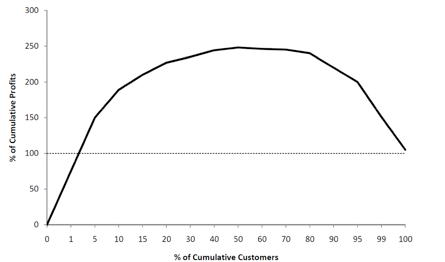
It's called the whale curve -- a schematic representation of profit, replicated below. It illustrates, among other things, how 200 percent of profit can come from only 10 percent of customers. Fifty percent of customers might account for 250 percent of profit. And the bottom half of customers can actually bleed the profits of the firm. Innovation in accounting, called activity based costing of individual customers, has led to this important insight.

What should a manager do with this insight? The more a firm can flatten this hump, the more it will profit from customers who do not bleed the firm. So the question stands: when should a firm fire a customer?
2012-02-06-Screenshot20120206at6.12.06PM.png
An undeniably strange question, but certain types of customers can prove costly enough that the relationship is worth terminating, as Sprint somewhat infamously demonstrated in 2007. For example,
  • A Netflix customer with a 7.99 plan who turns around as many as 10 DVDs per month;
  • A bank customer who insists on visiting the bank multiple times a month and never uses ATMs or online services;
  • A retail customer who buys numerous items with the intent to return most of them;
  • A business customer who exploits free delivery to order small quantities and minimize inventory costs.

There are a variety of solutions available in each case above. Netflix, for example, could slow down its shipment rate; or banks could spend time educating customers about online resources. Generally, firms might raise prices to account for the increased cost of specific customers. But the essential riddle remains whether or not these actions make sense for profitability.

To examine these tradeoffs, I worked with my colleagues at the Yale Center for Customer Insights, Jiwoong Shin and Dae-Hee Yoon, to develop an economic model based on game theory that clarified the relationships between a firm and its customers and aided understanding of how to improve profitability by flattening the whale curve.

We discovered first that most business-to-consumer markets, like direct marketing and online retail, are structured such that every customer tends to be profitable. There is no need to fire any customers because a firm does not spend differentially to serve them; there are essentially no unprofitably high-maintenance shoppers, except those that have a chronic habit of returning items after trying them out. Zappos is famous for the ease with which it facilitates returns, but can be successful only if most of its customers don't make a habit of it.

But in many business-to-business markets, as well as those business-to-consumer markets that demonstrate differential customer costs (as in the examples above), it makes sense to selectively raise prices for high-cost customers, offer lower prices for low-cost customers, and fire the customers who cost more than they expend.

Interestingly, firms can even benefit from selectively firing profitable customers if the cost to serve them is also high.

A common fear of winnowing the customer base is that the average cost will rise for the remaining customers because much of the cost of doing business (e.g., the staff, the office, etc.) remains fixed over the short-term. We find that this is an unfounded fear. Rather, as long as new and profitable customers come in to replace the old, firms will not only be able to cover the cost of doing business, but find it more profitable.

Our modeling approach shows the usefulness of looking at the whale curve from a dynamic perspective, though traditionally accountants look at this model in static terms. Common practice often strives to expand a consumer base, with the intuitive understanding that more customers equal more profit. Unfortunately, intuitive in this case is not also accurate, and selective customer management can flatten the whale curve over time and increase overall profitability.

Not bad when things are lean. It might just be time to hand out a few pink hued receipts.


  • Comments
  • 47
  • Pending Comments
  • 0
  • View FAQ
Comments are closed for this entry
View All
Favorites
Recency  | 
Popularity
Page: 1 2  Next ›  Last »  (2 total)
HUFFPOST SUPER USER
A level Head
06:16 PM on 02/10/2012
We own a quite successful business - Grow every year -- Been around near 40 years.

We "fire" customers regularly --- We provide what is paid for plus a little more in every transaction. I have learned that despite this it is simply not possible to satisfy everyone and it is a waste of time, money, and emotion to try.

I have never considered the customer to be always right or even just King. Business is a two way street -- Treat the customer fairly, offer good product and service, put a cherry on the top -- BUT -- Understand that not every consumer is a fit for the business and when they cost more money than they generate they are no longer a customer - They are an expense.
08:04 PM on 02/09/2012
i own a smal trucking company, and have fire several customers who we were not making money or very little money on.
photo
HUFFPOST SUPER USER
Ppenguinator
Life's too imprtant to be taken seriously.
04:54 PM on 02/08/2012
Good for them. It's not illegal to want to get your money's worth, is it?
05:40 PM on 02/07/2012
In general acquiring new customers is more expensive than keeping existing customers, therefore the notion that firing annoying / under-performing customers is good for the bottom-line is somewhat naive. Instead I would work harder to established more streamlined ways of serving those customers.

Also there is a general equilibrium in everything known as Pareto, in the case of business of a good scale 80% of sales or profit from 20% of customers. Cutting off the tails does not change that reality and overtime equilibrium returns. You will never be done cutting off the tails unless you want to run a completely niche company with few customers that have to be actively managed so they never become outliers.

I just don't see much value on this research.
08:08 AM on 02/14/2012
Perfect, greenerstep. Keep cutting off the tail till you have no customers :-) And keep spending more to get in replacement customers till you have no funds :-)
HUFFPOST SUPER USER
Dirk1
Same Sex Married
10:19 AM on 02/07/2012
As the owner of a small business, I understand the problem quite well.

Given how often the application of game theory has led to the death of a business, my faith in making decisions based on models which use this group of algorithms is not what it was in the 1990s.

The information the model provides is useful, the knee-jerk belief all customers are king should be shaken. When I recall the financial harm Netflix suffered and Verizon suffered and T-Mobile suffered and Deutsche Bank suffered, I shudder to think what harm this information will do to businesses when decisions are made by typical young MBAs who cold-heartedly apply theory while forgetting who actually makes the bottom line possible.
photo
HUFFPOST SUPER USER
bbarnezz
"Round up the usual suspects"
09:00 AM on 02/07/2012
I wish they would apply the same analysis from the customer side of things. For instance, does a business calculate the potential loss of customers from making us listen to an automated phone queue before speaking to someone who can actually help us? Do they consider the time lost on the customer side from these processes? Does a cable company calculate the ill will arising from forcing us to pay for 80 channels that we don't want in order to purchase the 5 that we do want? Or the cell phone company insisting on a 2 year contract? Or the fine print in an insurance contract that comes to light when we actually have to make a claim? I seriously doubt that these companies are concerned about the ill will that they create. Customers are generally on the losing side, not the other way around.
08:17 AM on 02/07/2012
Companies like NetFlix offers unlimited DVDs for 7.99 a month and then cries when customers actually use their service. This is one reason why Blockbuster and most other small video stores have gone out of business. So they use these predatory business practices to gain market share and then cry because customers use their services like advertised. Hurray for me and screw you
07:43 AM on 02/07/2012
Every business already does th
09:39 AM on 02/07/2012
You betcha. Every single small businessman knew exactly what they were talking about. You don't do it willy-nilly, but every once in a while you just need to cut a customer loose.
HUFFPOST COMMUNITY MODERATOR
JScott
John Galt's last name is McGuffin-Smithee
10:44 AM on 02/07/2012
It goes by another name 'how to nickel and dime your customers in any way possible but not so much that they decide to leave.
And I wonder if they account for the competition, aka if others do/don't do the same is that a factor in this.
photo
HUFFPOST SUPER USER
frank day
Republican = FAIL
07:32 AM on 02/07/2012
This kind of short term thinking is why business schools and their graduates

are ruining American businesses.

See: Netflix.
07:14 AM on 02/07/2012
Let every good depositor with Bank of America and Wells Fargo go forth to his bank as many time as possible each month and cash a check for $10.00 and chat amiably with the teller.
06:41 AM on 02/07/2012
Not a very incisive analysis. The negative pr from a heavy handed policy of firing customers could lead to the loss of more profits than writing them off as part of the overhead.
photo
HUFFPOST SUPER USER
frank day
Republican = FAIL
07:34 AM on 02/07/2012
Not only that, but today's unprofitable customer may be tomorrows profitable one and vice versa.

Also, an unprofitable customer may go on to refer multiple profitable ones.

This bean counter mentality is short sighted.
This user has chosen to opt out of the Badges program
photo
09:47 AM on 02/07/2012
The bean counter says you may assume additional profitable customers will sign on and replace the one you just fired. And that pesky overhead will just take care of itself. Yup.
photo
HUFFPOST SUPER USER
hoover52
Tickle me blue
09:49 AM on 02/07/2012
. . .or they can tell all of their friends not to use that company. One satisfied customer might tell 3 or 4 other people about how good a company is, but one very unhappy customer will tell everybody they can NOT to use a company. It's a very thin line between the two.
09:14 AM on 02/07/2012
One of the problems with acedemics is when they do modeling they forget to factor in human nature.
This user has chosen to opt out of the Badges program
06:26 AM on 02/07/2012
Good data is very important.

Years ago, I helped a bike shop convert to computer based inventory and sales. After we had every item that was sold bar coded so every sale was tracked, the owner discovered that some of the stuff he had in stock never sold and was wasting space, while some of the parts he sold from his own repair stock were being sold for much less than their market value. After getting rid of SKUs that never sold and re-pricing the parts he sold, his profit increase a lot.

This why Walmart tracks all inventory and sales so tightly so they know exactly what to stock an what to ignore.

As far as "firing" customers I have had to do that when I was the Customer Care manager for a PC company. Some customers just have very unreasonable expectations about technology (and other products). Once I determined our products could never make the customer happy, I purchased them back and sent them to Dell (whose products couldn't meet the customer's expectations either, but they were not shrinking my profits).
photo
HUFFPOST SUPER USER
OCerInTN
Hoplophobics worst nightmare.
06:10 PM on 02/09/2012
I had similar experiences when I was a hotel manager. Some customers will always have unreasonable expectations, those are the ones you need to send away.
photo
HUFFPOST SUPER USER
Torus34
A poor old country mouse.
06:25 AM on 02/07/2012
Now, if we apply this to insurance companies ...
photo
abbienormal
What hump?
10:39 PM on 02/06/2012
Insurance companies honed this skill long ago.
photo
MSROADKILL612
am not convinced geothermal energy is above ground
10:34 PM on 02/06/2012
well i for one think its a fantastic article. v real world & v true

i used to have a shopfront pc shop - never again - so many time wasters - they would even eat their lunch in front of me

i used to have a huge spreadsheet price list of 3k items - one column was a hassle factor

can quite see how one could apply similar logic to a customer

in a time business, the art is in u choosing the customer, not vice versa

there are tell tale signs he plans to stiff you - bail at the first signs - i doubt less than $10k is worth chasing in court