
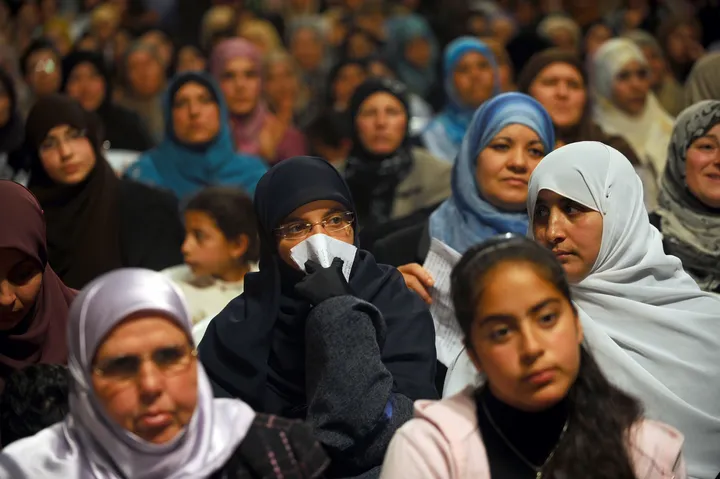
Many fans have asked where I have been for the past few months. I have been a regular blogger for the Huffington Post since 2009, often commenting on issues relating to Islam and the media, which as a Muslim in Hollywood is perhaps appropriate. But I have not written a post either here or on my own personal blog since late last year. Partly, I have been focused on balancing my career as a filmmaker and novelist with the needs of my family. But partly I have been just plain exhausted.
As someone who loves Islam, I have often felt drained spiritually and emotionally by the never-ending battle to overcome the false image of my faith. An ugly picture painted by anti-Muslim bigots and Muslim extremists who both embrace an empty and shallow vision of Islam. As a child, I loved reading Greek myths and was in particular fascinated by the tale of Sisyphus, the condemned man who was punished by Zeus by being given a never-ending task. Sisyphus was forced to push a boulder up the side of a mountain and was promised freedom from the underworld once he got the boulder up to the peak. But Zeus had a dark sense of humor. After centuries of toil, Sisyphus would finally manage to inch the boulder up to the mountaintop -- only to see it roll back down. And he was forced to start all over again.
I loved that myth -- and sometimes I feel I am living it today. Being a defender of Islam in the Western media often feels like a Sisyphean task. Every day there is another drama somewhere in the Muslim community, whether it be another vile act of terrorism committed by evil people in the name of my faith, or an attack by an Islamophobe on some aspect of Muslim religion and values. For years, I have been condemning the former and trying to educate the latter about the true nature of Islam as a vibrant, positive force in the world. And it often feels like my efforts are doomed to failure -- the stupidity continues and the discourse about Islam in the media remains controlled by imbeciles among both Muslims and non-Muslims. The story of Islam, like history itself, often feels like just "one damned thing after another."
So I took a break. I sat back and let the world flow by me in blissful silence. The Arab Spring. The death of the cursed Osama bin Laden. The anti-Muslim "hearings" held by Congress. The growing Islamophobia in America being fed by unscrupulous politicians. I had a lot to say about all of that. And I chose to say nothing.
Perhaps I would have stayed in this stupor of defeat forever. And then my mother came to live with me and reminded me that Islam is a verb. That faith without action is dead.
As my readers may remember, my father passed away last year. His death was peaceful, but very unexpected, and my mother was devastated. After living together for over 40 years, after weathering decades of struggle and pain as immigrants in America, after experiencing both remarkable joy and deep grief as a couple, my mother was suddenly alone. While her children were quick to remind her that she had a loving family to support her, my mother was also quick to respond that none of us children could truly know what it is like to lose a life partner who had been by her side for so many years. And to that we really had no answer, except to offer her our love and a shoulder to cry on.
My parents had a beautiful home in Phoenix, Arizona. But with my father gone, my mother chose to move to Dubai to live with my sisters, who both work there. But after a few months, it became clear that the UAE, despite all its wealth and Westernized luxury, would never truly be home. America was where her heart was. And so my mother came to stay with me in Los Angeles.
The cycle of life is fascinating, and poignant. When I was a child, I was powerless and had to rely on my mother for even the simplest decisions. And now the the roles are reversed. I find myself taking care of her and organizing my life around her needs, even as she once did for me. For a bachelor accustomed to living alone, I was afraid that the transition would be difficult for both of us. And perhaps it would have been if my mother were weak and defeated, as Muslim women are usually portrayed in the media.
But my mother is anything but weak. Like millions of Muslim women worldwide, she is a spitfire. Strong. Confident. Dignified. She is a woman who refuses to let life conquer her, or to be defined by the projections of others. Difficult as she has found her new circumstances, she has refused to be defeated by them, and is focused on rebuilding her life. And the strength she exhibits is founded on her faith.
My mother is the living essence of a Muslim woman. She surrenders to no one except God.
Having had such a strong woman as my role model, it is perhaps not surprising that I have dedicated much of my literary career to telling stories of powerful Muslim women who shatter the old stereotypes of the veil and the harem. My first novel, Mother of the Believers, focused on Aisha, the wife of Prophet Muhammad. Aisha has inspired Muslim women for centuries. She was a scholar, a poet, a jurist, a politician and a military commander who led armies. And she was the one woman whom the Prophet was closest to, the one he chose to spend his final hours with, the one who cradled the Prophet's head as he passed away. And it was under Aisha's house in Medina that he was buried.
But Aisha is not alone. There have been innumerable Muslim women who have changed the course of history. They include Khadija, the Prophet's first wife, who was 15 years senior to him, a wealthy businesswoman who employed young Muhammad as her caravan leader, and ultimately proposed marriage to him. Khadija, the first convert to Islam and its strongest supporter. She convinced an initially self-doubting Muhammad that his vision of Angel Gabriel was a real spiritual experience, and provided him the emotional and economic support to launch a spiritual movement that would create a global civilization.
Khadija and Aisha were just the beginning, the precursors of great Muslim women such as the Sufi mystic Rabia al-Basri who challenged the corruption of the Caliphs of Baghdad in the 8th century. The Turkish slave girl Shajarat al-Durr who became Sultana of Egypt and launched the Mamluk dynasty that halted the Mongol invasion of the West in the 13th century. The iron queen Nur Jahan, Empress of Mughal India, who rivaled Queen Elizabeth I as the most powerful woman on earth.
The stories of these remarkable women are told in my novels, as well as in wonderful books such as The Scimitar and the Veil: Extraordinary Women of Islam by Jennifer Heath. From queens and warriors, to poets and artists, to loving homemakers who serve as the foundation of its civilization, women have been the heart and the driving force of Islam from its beginning.
And they remain so today. Watching my mother take on the new challenges of life with such courage and dignity has reminded me of the inherent power that women bring to Islam and to the world. At a time when both Muslims and non-Muslims cling to foolish and backwards interpretations of the Quran, Muslim women have been at the forefront of the fight for justice and wisdom in the Islamic community.
The recent movement by Saudi women to confront the idiocy of those who would deny them the right to drive is a shining example of courage exhibited by those who know that Islam was revealed to help women, not to hurt or oppress them. Despite some Muslim men's efforts to interpret the Quran and Islamic law as a vehicle of oppression, Muslim women remember that Prophet Muhammad was by all accounts a feminist. He gave Muslim women the right to own property and inherit, rights denied to their Jewish and Christian sisters by men until the late 19th century. He ended the Arab practice of female infanticide and worked tirelessly to protect widows and orphans in a barbaric desert world.
The Prophet was centuries ahead of the men of his time in his attitudes toward women, and not surprisingly, right after he died, men started rolling back the reforms he began. The Prophet may have been too advanced for the mindset of 7th-century men, but his compassion for women is exactly the model that Muslims in the 21st century need to emulate today.
Many people have called for a "reform" of Islam, but the truth is that Islam needs to be rediscovered, not changed. The deeper one goes into Islamic scholarship, the more the harsh images of Islamic law as a vehicle for stonings and amputations fades away, and is replaced by a surprisingly sophisticated and progressive approach to faith that dates back to its earliest days. Muslims don't need to throw out their religion and create something new, they need to re-examine the original scriptures and find the original meanings as the Prophet, a man of progressive vision, would have seen them, even if his earliest followers did not always see as far as he did.
This work, of rediscovering the progressive jewel at the heart of Islam, is being led by courageous Muslim scholars today, many of them women. In fact, women have always been scholars of Islam -- Aisha herself being a jurist who advised the first Caliphs on matters of Islamic law and practice. And following in her footsteps today are remarkable women such as Prof. Leila Ahmed at Harvard Divinity School who is a leading feminist scholar of Islam; Prof. Amina Wadud and Prof. Asma Barlas, who have produced important scholarship on the Quran as a feminist-friendly scripture; and Prof. Aminah McCloud at DePaul University, a living encyclopedia of Islam who can take on any conservative mullah and win the debate.
Women such as Dr. Laleh Bakhtiar, a Sufi writer who was the first American woman to translate the Quran into English. Her translation, The Sublime Qur'an, is moving and captures the scripture's beauty and ability to inspire both men and women today. Dr. Bakhtiar has often been attacked by conservative Muslim men for her willingness to examine linguistic ambiguities in the Arabic text of the Quran that have been used by men to control or oppress women for centuries. Her scholarship has shown that the text has often been interpreted by later generations in ways the Prophet himself would never have supported. For example, one verse in the Quran (Surah 4, verse 34) has been used for centuries to justify the idea that Islam permits a man to strike a disobedient wife. And yet Ms. Bakhtiar has carefully shown that the original Arabic can correctly be read to indicate "separate from" an unhappy marriage, rather than "hit." Considering that Aisha herself said that Prophet Muhammad never struck his wives, children or servants, Ms. Bakhtiar's interpretation is likely the authentic one based purely on the Prophet's own example. As Aisha also said, the Prophet was the living embodiment of the Quran in practice.
Ms. Bakhtiar's discussion of how this mistranslated and misread verse compelled her on her spiritual journey to uncover true Islam is fascinating:
These Muslim women are engaging in what may appear as a truly Sisyphean task of promoting Islam as a feminist religion at a time when many Muslims and non-Muslims want it to be anything but. By watching their never-ending struggle for truth and justice, I realized that my own weariness in speaking out is unjustified and, frankly, un-Islamic.
As my mother reminds me now every day with her struggle to build a new life without my father, the purpose of existence is to face challenges, not to run away from them. That is why God created us. That is why we are here. Men and women, living in a broken world that needs constant mending. There is no end to this journey, no final moment in this world where all will be perfect and pure. Perfection is for Paradise. But it is our efforts to confront this often ugly and unjust world that make life worthwhile. That is the true meaning of "jihad" -- of struggle in the path of God.
I want to thank all the Muslim women out there who continue to follow in our Prophet's example of speaking truth to power. You are the heirs of our mothers -- Khadija, Aisha, and the Prophet's beloved daughter Fatima.
And I want to thank my own mother for showing me the truth of Prophet Muhammad's famous words: "Paradise is at the feet of the mothers."
Kamran Pasha is a Hollywood filmmaker and the author of Shadow of the Swords, a novel on Crusades (Simon & Schuster; June 2010). For more information please visit: http://www.kamranpasha.com