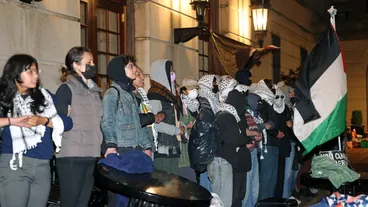
Acclaimed Indian actress Nandita Das recently turned to film directing, and screened her first film Firaaq at this year's Thessoloniki International Film Festival. Her film, championed by Salman Rushdie, highlights a problem that is not often enough (except for now) discussed outside the country: the acute tension between Hindus and Muslims. Using an exciting (albeit sometimes melodramatic) rhythm of cross-sectioning, the film follows different families in the northern state of Gujarat -- Hindus and Muslims -- during the tense period of curfew that followed the 2002 massacre of Muslims. Having recently traveled to Gujarat myself (where even this summer, there was violence), I was most curious to see how this actress-turned-director would explain to me what I noted was the constant undercurrent of visceral hatred in my conversations with locals: once one scratches a bit, the conversation was bound to produce a statement like: "There would be no problem in Kashmir if those Muslims had just all gone to live in Pakistan" or "Of course I have Muslim friends, but they are a different breed, not like us Hindus."
Her film is particularly important now -- showing the nuances of the mutual distrust (and where it can all lead) -- in light of the recent siege in Mumbai.
Below, the interview:
This film begins with the 2002 massacre of Muslims in Ahmedabad. What happened then?
There was a train passing through Godhra. Some Hindu pilgrims refused to pay a Muslim tea seller, and there was a girl on the platform and the Muslims started misbehaving with her. A group of Muslim boys started throwing stones. People say this Muslims then set the train on fire. 25 Hindu women and ll children were burned to death. This is what started the riots, where l044 people were killed, the majority being Muslims. Muslim women were gang-raped, many were murdered, all in the course of 3 days. In the city of Ahmedabad, all the Muslims were pushed to the other side of the river. It's almost impossible to find one Muslim house in their original neighborhood. After the riots, they had to move across the river, into a ghetto. It is now a segregated city.
The version I believe: the Hindu carry cylinders for cooking. One burst and caught on fire, and everyone was trapped in the train and got trapped. So now, as I mention in the film, the government keeps a data base about Muslim businesses and keeps watch on them. The Hindu-Muslim tension is quite serious throughout India. Although it is difficult to get a film like mine distributed, because I am told that people are only interested in happy subjects, and are tired of problems in the rest of the world.
You are an actress in India. How did you get interested in political issues?
I live in Delhi, and was born in Bombay. I did my masters in social work and was involved with NGOs which worked in the field of women, and with children. I worked for three years in the slums empowering women, organizing them to understand their own rights. I got emotionally drained. There are lots of contradictions in what it means to be a "woman." I worked with low-caste women who thought so little of themselves. They take so much rubbish from their men and the system. One day I came to work and one woman in the group was black and blue. She said her husband had beat her up: he was drunk and she hadn't wanted to sleep with him. She said: "don't worry I'll get him back!" I was very idealistic, but I didn't know what to do. I can't tell her what to do: where would she go with three kids? Today in India, there are more and more divorces as women are questioning and becoming more independent. Because of my human rights work, I am especially interested in women and children.
I did notice that this film on Hindu-Muslim tensions has a strong side-theme about how men treat their women badly.
You can't talk about the religious divide without talking about the gender divide or the class divide. The class divide is also important in my film, which is why I have several intersecting stories reflecting different social strata. The auto rickshaw guy says, "Why does Samir have to fear anything, he lives in a big house?"
Friends did ask why didn't you do a women oriented film? As a woman, everything does not have to be women oriented. But it is instinctive to me to not just deal with the wife's guilt [about not helping a Muslim child during the riots]. You must deal with the husband issue as well.
Is wife beating as prevalent in India as your film suggests?
Beating is a huge issue, although now there is a law against it. Domestic violence used to be seen as a private matter. It did not get much public attention. Today there are public service ads about it. If a man beats a woman, it is as public as it gets. Yes, beating is frequent. Women grow up learning to ignore a lot of things, especially in the countryside because there is stigma about talking about it. The woman does a hundred things in the home, to be a super woman. Women are trying to do everything well. Although some male-female relationships today do show equality. When Samir decides to leave the city for Mumbai, his wife agrees. There is true equality in a relationship, when there is a dialogue.
How did you invent these various stories in the film?
I was very connected to the issues, so I brought a lot of my personal ideas to it, and then invented the scenes with co-writer Shuchi Kothari. I had stronger stories, which would translate into cinema, but these stories in the film are more relatable, because you can relate to the characters, unlike great heroes.
What about religion? You have surprisingly little emphasis on religious practice, despite the fact that your characters are staunchly Hindu or Muslim.
I am born Hindu but my parents are not ritualistic, and so Hindu ritual was not part of the family. This film is not about religion. When I started working to stop violence, I gave talks in schools, in social forums, and I would see immediately there would be a division, when talking about violence. People started justifying violence. They spoke about us versus them. Indian Muslims have so little to do with Pakistan, but they are told nonetheless to go back to Pakistan. They become resentful. It is such a vicious circle: where do you stop? It's all over, and it is at various levels. There is no reason for a majority community to feel so threatened by a minority group. The total of Muslims in India is twelve percent. What is more worrisome is that people are getting divided themselves. They are getting prejudiced. Daily conversations show that people just accept prejudice and violence. The religious divide is used in politics. We now have Raj Thackrey's rightwing party the MNS, which condones and organizes brutality. I made this film to raise consciousness in India. We have to reflect on our own prejudices and reactions to violence. I saw there how the religious divide is used in politics. Even personally I am affected. This film is supposed to take place in Ahmedabad [city of the recent bombings this summer], but I did not film there. I was worried the politicians would stop the film production there, because I am known to speak out. I have spoken up against right-wing platforms

Firaaq means "quest or search" in Urdu, in keeping with Nandita Das' mission of hope for resolution of the conflict.
Want to reply to a comment? Hint: Click "Reply" at the bottom of the comment; after being approved your comment will appear directly underneath the comment you replied to
First, no problem emanates simply with Hindus loathing Muslims presence in the country. There are many Indian Muslims who believe they belong to Pakistan, but there are many more that believe they belong to India. Muslims and Hindus have coexisted for centuries, and have had no problems with each other for the most part. Politicians and lawmakers try to create a divide to enable them to gather votes and rule. The attitude that any Muslim atrocities on Hindus is justified, but criminal when Hindus wreak havoc, creates tension and riots. It is not hatred, but mutual distrust, but violence has never solved anything, and is never the answer. The religious conflict is not simply one-sided as Nandita Das seems to think. Hindus did not simply overnight decide to hate Muslims, this has its roots during India-Pakistan partition, and if anyone is to blame for the rift, it is the British who fostered and established the divide, and Indian politicians from all ruling parties perpetuate this through creating anxiety and panic.
I think it's not a fair enough depth of analysis to say that such conflict "has it's roots" in partition. Not to take a side, but it's important to remember that Muslims essentially invaded and conquered India in two different periods in history. And aside from the periods of rule by the likes of Ashok and Akhbar, there have not been entirely peaceful relations between these two groups within the subcontinent. In other words, there were specific historical-cultural reasons that people like Md Ali Jinnah fought for a separate Muslim state.
I think the contemporary conflict -- within the borders of India -- is one where Hindus see themselves as the sole cultural and de facto historical endemic peoples of the subcontinent, while Muslims may view themselves as an unfairly subjugated minority. Taking one side, as anyone saw throughout the 20th century, is extremely naive and often dangerous.
I don't think majority of Hindus view it that way. As a Hindu myself, exposed to both religious and violent conflict, I can understand the ethos and passion both communities bring forth. My own grandparents fled Pakistan post-partition. We have seen the worst and the best.
In modern India, reservation-based education and work environments leave distaste for minorities and hence spreads grief and animosity towards sections.
Economic strife leaves hapless individuals vulnerable to persuasion by extremists, both Hindus and Muslims who easily incite one against the other. Historically, yes, there were problems, but the cultural sharing has also been profound. I blame British colonialism for bringing dormant concerns into full active mode that induced Jinnah to defect. Jinnah was not always for a Pakistan state.
The northern part of India is very similar culturally to Pakistan. Bollywood is ruled by Khans, where can that be possible? We have had a Muslim President, a wonderful man and scientist. We have popular Muslim cricketers. Yes, there are problems but there are far more benefits
We have co-existed and will co-exist for centuries ..but it takes only a dozen or 100 extremists to destroy bliss and prevent any sort of reconciliation with Pakistan, which is sad. Post-Mumbai attacks --- the fact that public anger has been directed towards political parties instead of Muslims, shows some maturity among the Indian populace and is gratifying. This does give a flicker of hope that we can think beyond religion.
It is other way round. Muslims view themselves as de facto historical rulers of the country and Hindus view of themselves as an unfairly subjugated majority.
I agree that there have never been peaceful relations between these two groups. There cannot be peaceful relations between two groups when one group insists that their way is the only way, and force other group to convert into their religion.
Muslim rulers plundered Hindus, destroyed temples, but they settled in India; the wealth changed hands but stayed in India. British conquered India using divide and rule strategy. Unlike the Muslims, the British plundered India and transferred the wealth to Briton. When there was nothing left to plunder further, they left. Muslims were under the impression that British will handover the country to them. That never happened. Two groups of people, both poor, and one fanatic, thus left to fight with each other.
She is a great actress, particularly her involvement in Deepa Mehta's feminist trilogy (Das was in Fire and Earth, but not Water.) Earth is especially worth a look, as it involves the Muslim-Hin du-Sikh-(P arsi!) conflict in the Punjab around Partition.
Hope this one gets released here (the District) sometime soon. Looking forward to it!
You must be logged in to comment. Log in or connect with