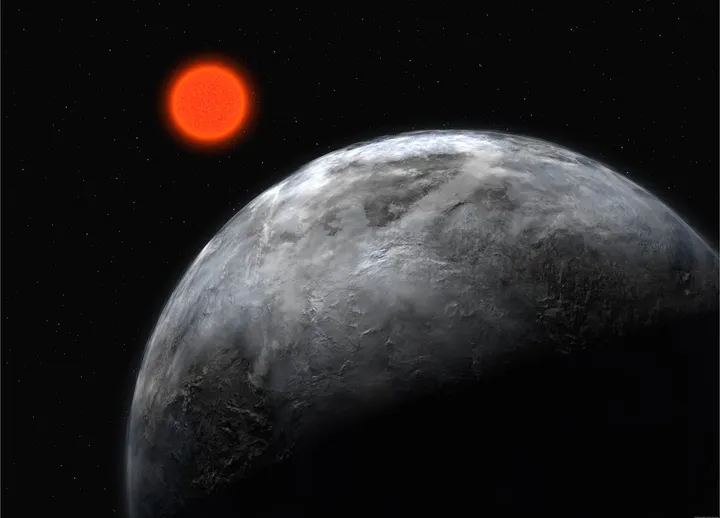
The discovery of an Earth-like planet outside our solar system has rejuvenated the conversation about life elsewhere in the universe. Dubbed Gliese 581g, the planet is thought to be Earth-like because it is orbiting about its sun in the so-called "Goldilocks Zone," where the temperature would permit liquid water on its surface. Most planets are either too cold or too hot to have liquid water on their surfaces. Gliese is 20 light years from Earth and located in the constellation Libra.
Finding intelligent life elsewhere in the universe would be the most provocative discovery of all time. Carl Sagan was a tireless enthusiast for searching, believing that it would transform our view of ourselves. More recently, SETI astronomer Jill Tarter echoed Sagan's wistful comment about how such efforts, even if they turn up a null result, might enable us to "calibrate our place in the universe."
Discovering life on other planets, especially intelligent life even remotely like us, would be marvelously stimulating, a cosmic version of Robinson Crusoe discovering Friday's footprint and realizing that he was not marooned in isolation from fellow humans. All of a sudden, the universe in its vast emptiness would not seem quite so purposeless, as we could envision countless other life forms sprinkled throughout the cosmos. I can imagine looking up at the night sky with a license to wonder how many of those stars were the suns of alien civilizations.
Communicating with aliens would ratchet up the interest, especially if we were able to travel and visit. No doubt many would eagerly reach out in peace; others would call for a global defense. Glenn Beck would call for a pre-emptive strike, unless he thought he could sell some books there.
The most peculiar of all reactions to aliens -- and one we don't have to wonder about -- would have to be that of Ken Ham, the biblical literalist who runs the Creation Museum and heads up Answers in Genesis. Ham is a tireless promoter of the belief that the ancient writers of Genesis made scientifically accurate statements about the universe. Never mind that those writers lived in cultures that thought the Earth was flat and the heavens were a solid dome overhead. Somehow, when Genesis was penned -- or, technically, transcribed after centuries of oral tradition -- those writers spoke with scientific accuracy about a universe of planets, stars and galaxies that their readers knew nothing about.
In the Young Earth Creationist worldview promoted by Answers in Genesis and like-minded organizations, the sin of Adam and Eve in the Garden of Eden affected more than just the Earth. "The Bible makes it clear that Adam's sin affected the whole universe," says Ham. "This means that any aliens would also be affected by Adam's sin."
In the Creationist worldview on display in the Creation Museum, sin inaugurated sickness, disease, and the decay associated with the Second Law of Thermodynamics. Prior to Adam's sin, the laws of physics were different, since there could be no decay. So, according to the Answers in Genesis website, "another compensating restorative process may have prevented any net decay of the universe." This restorative process ended with Adam's sin, and now the Second Law of Thermodynamics was unbalanced, and the entire universe began to run down.
The creative interpretative scheme used by the Young Earth Creationists leads them to find biblical support for claims about laws that science discovered centuries later. Other Young Earth Creationists suggest that the Second Law of Thermodynamics actually appeared for the first time as the scientific consequence of sin.
In this view, the sin of the first human affected everything, even stars trillions of miles away. To see how odd this claim is, imagine that there were life forms on Gliese at the time of Adam's sin. What would this sudden cosmic change look like to the Gliesans, as the entire universe, including their planet, was suddenly cursed? In the Creationist worldview, Gliese would have been a paradise, like the Earth before Adam sinned. Presumably the citizens would have been very happy, immortal (since there was no death before Adam sinned), and getting along fine with docile herbivores, and the laws of physics would not be causing everything to decay -- no need for Gliesan dryers to have lint filters. All of a sudden, because of an act on a planet trillions of miles away, Gliese would have been stricken with inexplicable suffering, death, and different laws of physics.
This worldview undergirds the displays in the Creation Museum. Highly creative interpretations of cosmic events are forced into the Bible, doing great violence to the text. Bronze Age scribes are transformed into uncomprehending secretaries, writing things about an undiscovered universe that nobody could have possibly understood for centuries.
And, adding insult to injury, even though human sin on a distant Earth wrecked their planet, the poor Gliesans "can't have salvation," says Ham. "Only descendants of Adam can be saved." To even "suggest that aliens could respond to the gospel is just totally wrong," he says.
This bizarre and unsympathetic cosmic picture results when we force the Bible to be something it is not. By ripping the Bible from its time and place of origin, Biblical literalists destroy its credibility, rendering it incapable of speaking to a contemporary reader. By insisting that this is what the Bible teaches, and raising children to believe it, Young Earth Creationists are driving thoughtful Christians out of the church.