My sainted mother, who passed away this year, raised me to value the truth. My family members were fundamentalist Baptists, attending a church in rural New Brunswick, Canada, pastored by my father. The reason I am no longer a fundamentalist is precisely because I was taught to value the truth and there are some fundamentalist beliefs that I just don't think are true any more. The earth, for example, is not 10,000 years old.
I have naively assumed, until recently, that respect for the truth is deep in the DNA of Baptists. I have assumed that when a Baptist speaks or writes, they do their best to be truthful. I am thus quite alarmed that America's leading Baptist, Al Mohler -- widely read author, president of Southern Baptist Theological Seminary and, according to Time, the "reigning intellectual of the evangelical movement in the U.S." -- does not seem to care about the truth and seems quite content to simply make stuff up when it serves his purpose.
About two months ago Mohler spoke to a group of leading fundamentalists at a prestigious venue. His topic was why Christians must believe that the earth is just a few thousand years old. A transcription of his talk is available here.
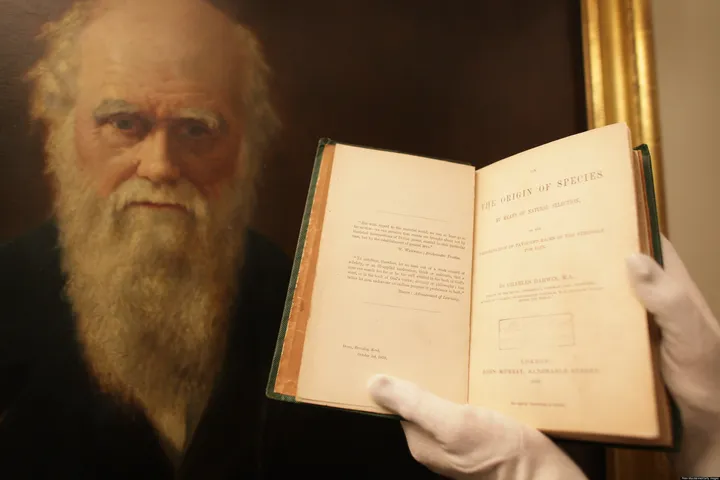
In this talk Mohler made false statements about Darwin. He apparently wanted to undermine evolution by suggesting that it was "invented" to prop up Darwin's worldview, rather than developed to explain observations in the natural world. He said, "Darwin did not embark upon the Beagle having no preconceptions of what exactly he was looking for or having no theory of how life emerged in all of its diversity, fecundity, and specialization. Darwin left on his expedition to prove the theory of evolution."
Because Darwin was constantly journaling, keeping careful notebooks, and writing letters, historians have established beyond all doubt that Mohler's summary is simply false. To be fair, an alarming number of fundamentalists have made similar claims. John Ankerberg and John Weldon make essentially the same false claims in Darwin's Leap of Faith: Exposing the False Religion of Evolution.
Of course, Mohler may simply have made a mistake. He is, after all, a theologian and not a historian. He could have gotten this wrong idea from any number of his fellow anti-Darwinians. However, I don't think so. In his address he read from my book Saving Darwin, in which I took some pains to correct the all-too-common misrepresentation of Darwin he presented. So, unless he was just cherry-picking ideas from my book that he wanted to assault, he should have known better. But let us bend over backwards here and give him the benefit of the doubt. Perhaps his only real encounter with Saving Darwin was an instruction to an assistant to "find something in Giberson's book that I can ridicule in my speech."
I gave Mohler the benefit of the doubt in an open letter that I posted on the BioLogos website. (He had also criticized BioLogos in his address.) In this letter I invited him to correct the record, naively thinking that he had been raised with the same respect for the truth that I had. "Dr. Mohler," I wrote, "I must express my dismay at your mispresentation of Darwin. I can only hope it is because you used some questionable sources and perhaps you might be willing to do some checking and try to set the record straight. I encourage you to do so, since I know you value speaking the truth highly."
Two months have passed and Mohler has made no effort to correct his misrepresentation of Darwin; he has not even acknowledged it, at least publicly. I can only conclude that because this particular "truth" is a political liability, Mohler chooses to ignore it. Mohler perhaps, is being a "faith fibber," something I have been guilty of, although not on this scale.
What disturbs me about this is the revelation -- which has taken me a long time to accept -- that some of my fellow Christians have no more respect for the truth than some of my non-Christian critics. In fact, the most honest dialog I have had on this topic was with Michael Shermer. Shermer, the editor of Skeptic Magazine, is an enthusiastic agnostic, but he seems far more engaged in searching for truth than winning converts to his position. I am disappointed to realize that Shermer, who repudiated his faith, has more respect for the truth than Al Mohler, who views himself as a caretaker of a faith that I share.
Religious belief is complex and full of mystery, paradox, and contradiction. Those without faith often seem unable to even understand it, much less enter into meaningful conversation with believers. And often they express this with caricature and ridicule. But our conversation, as shaky and precarious as it may be, should always be anchored to whatever bits of truth we can find and agree on.
Darwin's religious journey has been the subject of intense scrutiny and even entire books. He struggled throughout his life with issues of faith. He did eventually lose his childhood Anglican faith, but he lost it reluctantly and not until middle age, long after his famous voyage on the Beagle. Toward the end of his life he wrote to an old friend about the painful experience of losing his faith: "I was very unwilling to give up my belief." He recalled daydreaming as a younger man about something that could arrest his slide into disbelief, perhaps the discovery of "old letters between distinguished Romans, and manuscripts being discovered at Pompeii or elsewhere, which confirmed in the most striking manner all that was written in the Gospels." Gradually, though, he found it harder to imagine being rescued in this way and "disbelief crept over me at a very slow rate, but was at last complete."
This is the Darwin of history -- not the fictional character preferred by his anti-evolutionary critics. It is the story of an honest seeker, with a profound respect for the truth, even when it did not serve his purposes.