
This interview is part of a series of conversations with faith-inspired activists, based on interviews led by Katherine Marshall for the Berkley Center for Religion, Peace, and World Affairs at Georgetown University and the World Faiths Development Dialogue. The full interview can be found here.
Since founding Buddhism for Development 20 years ago, Heng Monychenda has trained hundreds of Cambodian monks, nuns and community members in conflict resolution and social change. Katherine Marshall talks to him about using Buddhist teaching to contribute to Cambodia's reconciliation and development.
What are some of the key Buddhist teachings that you draw on as a motivation for social engagement?
The Buddha's first order, given five months after his enlightenment was to go out and reach the people, to proclaim the Dhamma, the way of life for the people. The Buddha taught that people could not find peace if they did not listen to the Dhamma. We encourage the monks to search out this original intention of the Buddha: That means getting the monks out of the pagodas, teaching and reaching out to people. We need to reflect carefully on the principles and laws of the Buddha that truly allow monks to do far more for the society within their daily lives.
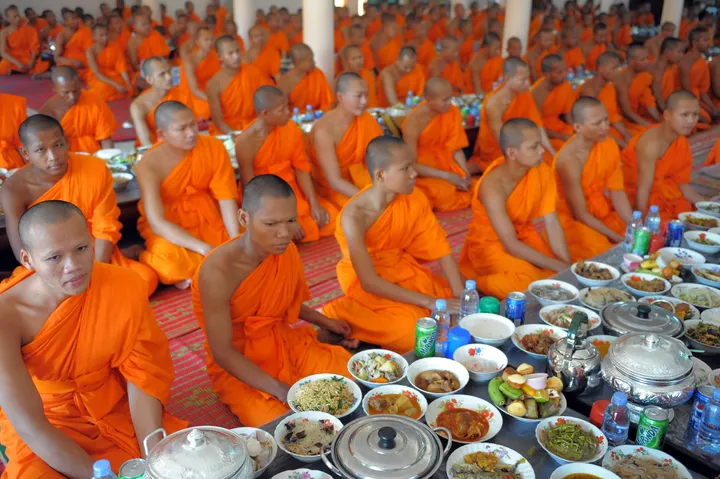
Some people believe that Buddhist monks should live only in the pagoda and pray eight to 10 hours a day, rather than involve themselves in daily life. But monks have in fact been engaged for a long time, just in an unsystematic way. Monks have built schools and hospitals, but nobody realized that it was social engagement because the term wasn't there. The way forward is to let them do it in a more systematic way or to look for extensions of the activities that they can do. With some 50,000 monks in Cambodia, if we had the means to help them we would have 50,000 free-of-charge social workers.
In 1995 I was the first Monk to start to talk about HIV/AIDS. I spoke through TV on issues of awareness. A lot of people complained and scolded me, saying that I cannot be a monk and talk about HIV/AIDS. It is taboo to talk about this topic, especially as a monk. Nonetheless, I still kept trying to teach about HIV/AIDS though my sermons and teachings. After one or two years I was no longer the only one taking up these issues, and people adopted the idea of Buddhist monks incorporating HIV/AIDS issues into the religious ministry.
How did Buddhism for Development get started? And what is it today?
We created Buddhism for Development (BFD) in 1990. Its first location and purpose was in the camps along the Cambodia-Thai border during the troubled times of that era, helping the displaced people living there. A group of monks, including myself, began to work in the camps, and in 1992, even before the repatriation program, we moved to Cambodia itself. In that new phase, we kept the same concept: Buddhism for development.
I believe strongly that each country has its own merit and values -- some kind of indigenous spirit, indigenous culture and indigenous strategy -- and that is what is needed in rebuilding the nation. Let the nation heal itself. Cambodia must heal itself through its own values and beliefs, not those of others. And Buddhism is one essential part of Cambodia. About 95 percent of the population is Buddhist and Cambodia has been Buddhist for a long time. There must be teachings in Buddhism, I thought, that could be used in healing the nation and its people.
Thus a central idea behind BFD is that Buddhism can contribute both to healing and to development. We looked for Buddhist teachings that related to the different areas: development, healing and the maintenance of peace. We looked to how Buddhist institutions, including pagodas, monks, etc. were useful in the society. We explored how the participation of Buddhists could contribute to the healing, reconstruction and peacebuilding process that was going on at the time. We began training in socially engaged Buddhism, based on the idea that Buddhism -- both Buddhist ideas and Buddhist monks -- could help people, especially the refugees and displaced people.
BFD now works in seven provinces in the north and west of Cambodia, working from the headquarters in Battambang. Our main focus has been and remains in communities. Starting in 1999, we have been able to establish small units at the community level, known as peace and development volunteers, or PDV. These volunteers are elected by secret ballot in their own communities. We train them to be the agents of change, to promote peace and development in their own village, based on the self-help concept. They watch for human rights violations. They also reach out to promote peace and reconciliation. At the start, many people were still living in zones controlled by the Khmer Rouge. The idea was that the PDV in the Khmer Rouge zone and the PDV in other areas would talk. Through this dialogue, feelings of animosity began to disappear and people become friendlier and friendlier. Today, the divides are far less clear and the former Khmer Rouge can hardly be seen as a distinct group.
Most work involving communal or group activity in Buddhism starts with the central Buddhist concept of saddhā, which is confidence or trust. If you don't trust each other, how can you work together? That is why we built the PDV on trust -- trust in each other, trust in what they can do and trust in what they can achieve together.
But the results at the grassroots are truly sustainable results. Part of the strategy is that our task is just to educate. The Buddha called it proclamation. We advise, but you do it by yourself. The Buddhist concept is self-help: first you help yourself.
Buddhists ask us why we don't help them to gain more knowledge about Buddhism or help them to build a temple. But if I build a temple, in the future nobody will build them. But if I help you to help yourself, and you continue to believe in Buddhism, then you will build the temple yourself.
What are the main lessons you have learned since starting the organization?
Spiritual and economic development should not be separated into two separate realms. In Buddhism, one is not more important than the other. We have a saying, "Nāma-rupa" which means that mind and matter have to go together. Mind affects matter and matter affects the mind. It is the teaching of the Buddha that economic development and spiritual development need to be done alongside each other.