An Interview with Dr. Michael Greger, Part 2
Read Part 1
After reading "Bird Flu: A Virus of Our Own Hatching", by Michael Greger, M.D., I was stunned to realize the extent to which we have endangered our health by allowing factory farms to flourish and produce 99% of the meat, dairy, and eggs we eat. Not only are dangerous flu viruses mutating because of these concentrated animal feeding operations (CAFO's), but we are also being exposed to some other very serious bacteria and pathogens. It seems that things have gotten out of hand in our food production, especially in the livestock sector. In my last blog, Dr. Greger explained the growing potential of deadly flu viruses; in Part 2 of the interview, we discuss E. coli, Salmonella and other worrisome pathogens.
Kathy Freston: Where does E. coli come from and how does it get into food? Why is it often found on vegetables?
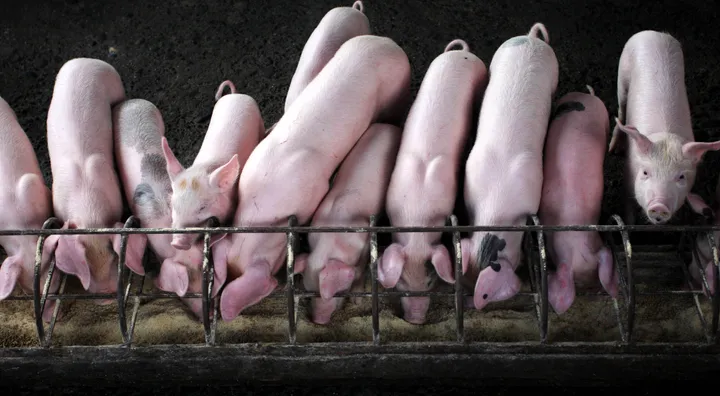
Michael Greger: E. coli is an intestinal pathogen. It only gets in the food if fecal matter gets in the food. Since plants don't have intestines, all E. coli infections--in fact all food poisoning--comes from animals. When's the last time you heard of anyone getting Dutch elm disease or a really bad case of aphids? People don't get plant diseases; they get animal diseases. The problem is that because of the number of animals raised today, a billion tons of manure are produced every year in the United States--the weight of 10,000 Nimitz-class aircraft carriers. Dairy cow and pig factories often dump millions of gallons of putrefying waste into massive open-air cesspits, which can leak and contaminate water used to irrigate our crops. That's how a deadly fecal pathogen like E. coli O157:H7 can end up contaminating our spinach. So regardless of what we eat, we all need to fight against the expansion of factory farming in our communities, our nation, and around the world.
KF: What percentage of the population gets hit by the bacteria? How many of them die? Could that likely increase?
MG: While E. coli O157:H7 remains the leading cause of acute kidney failure in U.S. children, fewer than 100,000 Americans get infected every year, and fewer than 100 die. But millions get infected with other types of E. coli that can cause urinary tract infections (UTIs) that can invade the bloodstream and cause an estimated 36,000 deaths annually in the United States.
KF: It seems we only occasionally hear of the very few terrible cases where E. coli kills; is it really a widespread problem?
MG: When medical researchers at the University of Minnesota took more than 1,000 food samples from multiple retail markets, they found evidence of fecal contamination in 69% of the pork and beef and 92% of the poultry samples. Nine out of ten chicken carcasses in the store may be contaminated with fecal matter. And half of the poultry samples were contaminated with the UTI-causing E. coli bacteria.
Scientists now suspect that by eating chicken, women infect their lower intestinal tract with these meat-borne bacteria, which can then creep up into their bladder. Hygiene measures to prevent UTIs have traditionally included wiping from front to back after bowel movements and urinating after intercourse to flush out any invaders, but now women can add poultry avoidance as a way to help prevent urinary tract infections.
KF: Are there any long term problems for people who ingest E. coli and have a bad day or two with diarrhea, or is the problem over once out of the system?
MG: Last month the Center for Foodborne Illness Research & Prevention released a report on the long-term consequences of common causes of food poisoning. Life-long complications of E. coli O157:H7 infection include end-stage kidney disease, permanent brain damage, and insulin-dependent diabetes.
KF: Is E. coli a problem if the meat is cooked?
MG: With the exception of prions, the infectious agents responsible for mad cow disease and the human equivalent--which can survive even incineration at temperatures hot enough to melt lead--all viral, fungal, and bacterial pathogens in our food supply can be killed by proper cooking. Why then do tens of millions of Americans come down with food poisoning every year? Cross-contamination is thought to account for the bulk of infections. For example, chicken carcasses are so covered in bacteria that researchers at the University of Arizona found more fecal bacteria in the kitchen--on sponges and dish towels, and in the sink drain--than they found swabbing the toilet. In a meat-eater's house it may be safer to lick the rim of the toilet seat than the kitchen countertop, because people aren't preparing chickens in their toilets. Chicken "juice" is essentially raw fecal soup.
KF: What goes on inside the body when a human ingests E. coli?
MG: Depending on the strain, the number of bacteria ingested, and the immune status of the victim it can fail to cause any disease at all or, in the worst cases, cause multi-system organ failure. Here's how one mother described what E. coli O157:H7 did to her three-year-old daughter Brianna: "The pain during the first 80 hours was horrific, with intense abdominal cramping every 10 to 12 minutes. Her intestines swelled to three times their normal size and she was placed on a ventilator. Emergency surgery became essential and her colon was removed. After further surgery, doctors decided to leave the incision open, from sternum to pubis, to allow Brianna's swollen organs room to expand and prevent them from ripping her skin. Her heart was so swollen it was like a sponge and bled from every pore. Her liver and pancreas shut down and she was gripped by thousands of convulsions, which caused blood clots in her eyes. We were told she was brain dead."
KF: What a horror. Why is it deadly for some and not others?
MG: We think it has to do with the virulence of the bacteria--some strains are deadlier than others--and the vulnerability of the host. We're not sure why children under 5 years of age are at the highest risk for dangerous complications, but that is certainly a finding that has been consistent.
KF: Is factory farmed meat more likely to get E. coli out into the market, or is all meat (even free range) carrying that potential?
MG: In chickens, these bacteria cause a disease called colibacillosis, now one of the most significant and widespread infectious diseases in the poultry industry due to the way we now raise these animals. Studies have shown infection risk to be directly linked to overcrowding on factory chicken farms. In caged egg-laying hens, the most significant risk factor for flock infection is hen density per cage. Researchers have calculated that affording just a single quart of additional living space to each hen would be associated with a corresponding 33% drop in the risk of colibacillosis outbreak. This is one of the reasons many efforts to improve the lives of farmed animals is critical not only for animal welfare, but for the health of humans and animals alike.
In terms of other infections like Campylobacter, the most common cause of bacterial food poisoning in the United States, Consumer Reports is publishing an analysis of retail chicken in their January 2010 issue. The majority of store-brought chickens were contaminated with Campylobacter, which can trigger arthritis, heart and blood infections, and a condition called Guillain-Barré syndrome that can leave people permanently disabled and paralyzed. Comparing store brands, 59% of the conventional factory farmed chickens were contaminated, compared to 57% of chickens raised organically. So there might be a marginal difference, but the best strategy may be to avoid meat completely. With the virtual elimination of polio, the most common cause of neuromuscular paralysis in the United States now comes from eating chicken.
KF: What about Salmonella? Is it really a big deal, or is it just a matter of an upset stomach?
MG: Salmonella kills more Americans than any other food borne illness. There is an epidemic of egg-borne food poisoning every year in the United States. To this day, more than 100,000 Americans are sickened annually by Salmonella-infected eggs.
KF: Do we have more Salmonella now than we did 25 or 50 years ago? If so, why?
MG: There was a time when our grandparents could drink eggnog and children could eat raw cookie dough without fear of joining the thousands of Americans hospitalized with Salmonella infections every year. Before the industrialization of egg production, Salmonella only sickened a few hundred Americans every year and Salmonella Enteritidis was not found in eggs at all. By the beginning of the 21st century, however, Salmonella Enteritidis-contaminated eggs were sickening an estimated 182,000 Americans annually.
There are many industrial practices that contribute to the alarming rates of this disease. Most eggs come from hens confined in battery cages, small barren wire enclosures affording these animals less living space than a single sheet of letter-sized paper for virtually their entire 1-2 year lifespan. Salmonella-contaminated battery cage operations in the United States confine an average of more than 100,000 hens in a single shed. The massive volume of contaminated airborne fecal dust in such a facility rapidly accelerates the spread of infection.
Factory farming practices also led to the spread of Salmonella around the world. Just as the feeding of dead animals to live ones triggered the mad cow crisis, this same practice has also been implicated in the global spread of Salmonella. Once egg production wanes, hens may be ground up and rendered into what is called "spent hen meal," and then fed to other hens. More than half of the feed samples for farmed birds containing slaughterplant waste tested by the FDA were found contaminated with Salmonella. CDC researchers have estimated that more than 1,000,000 cases of Salmonella poisoning in Americans can be directly tied to feed containing animal byproducts.
KF: What happens to the body when Salmonella gets into the system?
MG: Within 12 to 72 hours of infection the fever, diarrhea, and abdominal cramps start. If the victim is lucky it's over within a week. If not, the bacteria can burrow through the intestinal wall and infect the bloodstream, seeding its way to other organs, including the heart, bones, and brain.
KF: Are there any long term consequences from exposure?
MG: Thanks to Salmonella infection one breakfast omelet can now trigger persistent irritable bowel syndrome and what's called reactive arthritis, which can become a debilitating lifelong condition of swollen painful joints. Because Salmonella can infect the ovaries of hens, eggs from infected birds can be laid prepackaged with the bacteria inside. According to research funded by the American Egg Board, Salmonella can survive sunny-side-up, over-easy, and scrambled egg cooking methods.
KF: Would free range meat or eggs make a difference insofar as preventing it?
MG: There is evidence that eggs from cage-free hens pose less of a threat. In the largest study of its kind (analyzing more than 30,000 samples taken from more than 5,000 operations across two dozen countries in Europe) cage-free barns had about 40% lower odds of harboring the egg-related strain of Salmonella.
KF: Can we get salmonella just from touching something tainted?
MG: Absolutely, in fact the infective dose for Salmonella is as few 15-20 bacteria, and a single egg can be infected with hundreds. It's important to understand where the egg comes out. Eggs emerge from the hen's vent, which is kind of a joint opening for both her vagina and anus, which explains the level of fecal contamination one can find on eggs.
KF: Is it contagious?
MG: Person-to-person transmission of Salmonella can occur when an infected person's feces, unwashed from his or her hands, contaminates food during preparation or comes into direct contact with another person.
KF: Who is most at risk for serious illness or even death?
MG: More than half of all reported Salmonella infections occur in children, who are especially susceptible to serious complications. Elderly and immunocompromised adults are also particularly vulnerable. In the United States, though, some strains of Salmonella are growing dangerously resistant to up to six major classes of antibiotics, due in large part to the irresponsible factory farming practice of feeding millions of pounds of antibiotics to animals every year as a crutch to combat the stressful and overcrowded conditions of intensive animal agriculture systems. This puts everyone at risk.
KF: What is the overall solution to prevent these dangerous pathogens and bacteria?
MG: Over the last few decades new animal-to-human infectious diseases have emerged at an unprecedented rate. According to the World Health Organization, the increasing global demand for animal protein is a key underlying factor.
Swine flu is not the only deadly human disease traced to factory farming practices. The meat industry took natural herbivores like cows and sheep, and turned them into carnivores and cannibals by feeding them slaughterhouse waste, blood, and manure. Then they fed people "downer" animals--too sick to even walk. Now the world has mad cow disease.
In 2005 the world's largest and deadliest outbreak of a pathogen called Strep. suis emerged, causing meningitis and deafness in people handling infected pork products. Experts blamed the emergence on factory farming practices. Pig factories in Malaysia birthed the Nipah virus, one of the deadliest of human pathogens, a contagious respiratory disease causing relapsing brain infections and killing 40% of people infected. Its emergence was likewise blamed squarely on factory farming.
The pork industry in the U.S. feeds pigs millions of pounds of human antibiotics every year just to promote growth in such a stressful, unhygienic environment, and now there are these multi-drug resistant bacteria and we as physicians are running out of good antibiotic options. As the UK's chief medical officer put it in his 2009 annual report: "every inappropriate use of antibiotics in agriculture is a potential death warrant for a future patient."
In the short term we need to put an end to the riskiest practices, such as extreme confinement--gestation crates and battery cages--and the nontherapeutic feeding of antibiotics. We have to follow the advice of the American Public Health Association to declare a moratorium on factory farms and eventually phase them out completely. How we treat animals can have global public health implications.
KF: Sounds like part of the solution is to lean toward a vegetarian diet. Check out One Bite at a Time for information on how to do it.
Michael Greger, M.D is a graduate of the Cornell University School of Agriculture and the Tufts University School of Medicine, and serves as Director of Public Health and Animal Agriculture at The Humane Society of the United States. An internationally recognized lecturer, he has presented at the Conference on World Affairs, the National Institutes of Health, and the International Bird Flu Summit, testified before Congress, and was an expert witness in defense of Oprah Winfrey at the infamous "meat defamation" trial. His recent scientific publications in American Journal of Preventive Medicine, Biosecurity and Bioterrorism, Critical Reviews in Microbiology, and the International Journal of Food Safety, Nutrition, and Public Health explore the public health implications of industrialized animal agriculture.