Most of the commentary on the May 21st 'Rapture Fail' consisted of gleeful mockery, with a dose of sympathy for the poor misguided, fools who quit their jobs and spent their life savings in anticipation of Judgment Day.
But for some reason, I just I couldn't bring myself to participate in the feeding frenzy.
I couldn't quite put my finger on why until I read this comment by @SteveSilberman of Wired magazine:
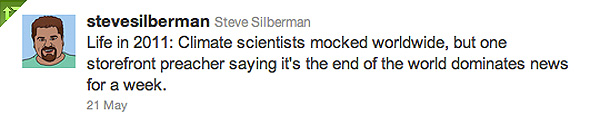
I suddenly realized it all sounded a bit too familiar, like a B movie caricature of what could, in fact, be a real Armageddon in the making -- climate change. The parallels were obvious.
The worst case climate scenarios could certainly spell the end of human civilization as we know it. Granted, the climate version will be gradual in comparison with the sudden-doom biblical version, and climate impacts will be equally devastating for believers and nonbelievers alike. But you've got to hand it to the rapture crowd -- they do a great job of articulating a happy ending for those who see the light and change their ways.
At the TckTckTck website, we try to paint a future vision for a "climate rapture" of sorts by demonstrating how a renewable energy future will create jobs, improve health, stave off the worst impacts of climate change and pave the way for sustainable development around the world. Though our version of the rapture is slightly less cinematic, it's a whole lot more democratic. The climate rapture has a win-win ending. Everyone benefits, not just the chosen ones.
The climate community also engages in apocalyptic prophecy, though in our case it's foretold by scientists who carefully follow the scientific method and are bound to its exacting standards through a large community of peer reviewers. In this form of prophecy, hyperbole is all but abolished. Still, many worry that toe-curling predictions (like those found in a new forecast by NOAA on the 2011 Atlantic hurricane season) will come back to bite us should they not pan out precisely as anticipated. While it would not make a whit of difference to the validity of the scientific consensus on climate change, it would play right into the hands of the denial machine's campaign to sow doubt in the public mind.
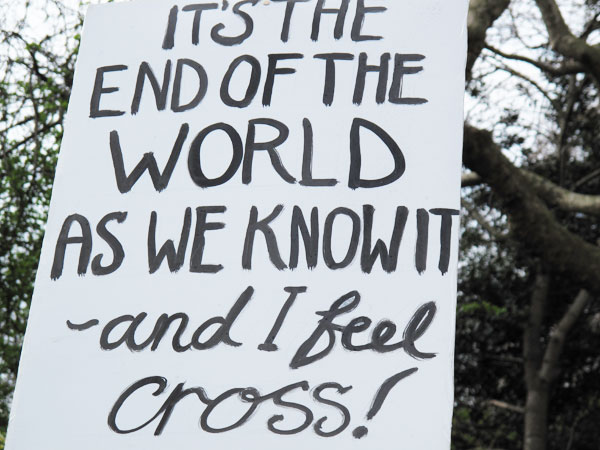
Photo by Kelly Rigg
I do have some sympathy for the much-ridiculed rapturists because I (and every climate activist worth his or her salt) have born the brunt of skeptic attacks. It's not fun being called an "alarmist nutball," and often we are accused of pursuing something akin to religious zealotry. It's easy to laugh it off, but we should remember that just because the climate case is based on overwhelming scientific evidence doesn't mean our beliefs are any more powerful than the beliefs born of religious (or other) conviction.
Belief -- not only in the frightening parts, but also in our ability to turn things around -- is key to the future of the climate change movement. There's a big difference between knowing that a bunch of facts and figures are true, and having a true inner conviction that motivates you to take radical action. I experienced this in my own personal life, battling a life-threatening illness through unorthodox means. I won that battle, much to the amazement of my fact-bound doctors, who had doubted such a thing was possible. Belief is a powerful motivator. In my case, it literally saved my life. And my belief that there is still time to save the climate is what drives my passion to fight for it.
Fortunately, there's no reason anyone needs to choose between science and faith when it comes to climate change. Many religious communities have embraced the scientific consensus on climate and are working for climate justice. No less an authority than the Vatican is on board.
We seem to be at a turning point. Climate change is happening, despite remaining uncertainties about the exact timing and nature of those impacts. Now is the time to take that leap of faith, to believe not only in our heads, but in our hearts, that catastrophe can be avoided if we act now.
So the next time you find yourself talking to a "nutball," remember that he probably thinks the same about you. You'll be far more likely to convince him to think again if you listen to what he's saying, consider the beliefs and values which underlie his convictions and look for areas of commonality. Try speaking to him on his own terms.
In the meantime, does anyone have suggestions for a word as seductive as "rapture" to describe the vision of a sustainable, heavenly future here on earth?
Follow Kelly Rigg on Twitter: www.twitter.com/kellyrigg
How can people make ludicrous statements like this? Who is “we”? What do “we” have to do?
Worship mammon, and it will warp the very fabric of your life.
Love ... simply Love One Another And Our Beautiful Planet.
The two questions we should ask before we allow any corporation or governmental entity (backed by corporations) to produce mad science on us (mad science as in nuclear anything, coal, oil, gas ...) are:
Is there any fallout to sentient beings that inhabit this earth?
Is there any fallout to our planet?
If the answer is yes ... then we don't embark upon that trail. Period. No questions asked. We have the technology ... greed hasn't exploited all that it can extract yet. We have to come together in grassroots unity to push back.
Really? If climate change predictions (which are presumably based on some scientific model) turn out to be wrong time and time again, that doesn't "make a white of difference to the validity" of the theory? So when a climatologist at East Anglia's Climatic Research Unit predicted back in 2000 that within a few years winter snowfall will become "a very rare and exciting event," that made absolutely no difference to the validity of the climate change discussion?
Such blind obedience sounds less like science and more like... faith.
You are clearly characterizing short-term weather conditions as being "foretold by scientists who carefully follow the scientific method and are bound to its exacting standards." And unlike religious-based apocalyptic prophecies, you say that for these science-based prophecies, "hyperbole is all but abolished."
So if such short-term weather predictions are right, then this is firm scientific-method based support for climate change. But if such short-term weather predictions are wrong, then this doesn't impact the issue one whit.
Isn't the right answer that if short-term weather predictions are wrong, then it shows that scientists don't have as firm a grasp on the link between climate change and weather patterns - or, alternatively, that their long-term prophecies are not as scientifically solid as they are purported to be?
I'm not twisting your words, just wondering how you justify your trust in the long-term models if the short-term predictions are often so completely wrong.
Here we go again. Trying to dismiss hard science by equating it to a religion.
For example, when we speak of "religions" taking positions on climate change, we completely ignore (even in the above post) the fact that only 33% of the world is Christian.
Muslim organizations (representing one fifth of the world's population) are FULLY in support of the necessity and religious responsibility to combat climate change.
Hindu organizations (representing nearly another fifth) are as well.
As are Buddhists.
It is completely false and crucially misleading to suggest that people of faith have any problem with accepting or fighting climate change.
We need to start acknowledging that only a very small clique, of a fraction of the world's religions, still opposes taking responsibility for protecting the planet, and it's inhabitants.
To allow this tiny clique to obstruct the world from it's united dedication - scientifically and spiritually - to address the issue is not only wrong-headed, it is unholy.
Problems are answered by working on them, not by denying them.
The irony is that oil is depleting rapidly. We need to make the big decisions soon so that oil supply can continue for manufacturing and for getting space solar power off the ground. No oil man is hurt in the making of this future.
I dont know if the "End of the World Church" (or whatever they call themselves) really cared. That is, until they begrudgedly woke up on Sunday morning to that curious brown smog in the air again.
Whenever I see a hatred of people as the bottom-line reason for the latest end o' the world scenario, I take a long step back, bible in hand, and wonder who is behind the Man As Evil world view. Easy answer: the one who wishes to be worshiped but will never be.
No..
The discussion in the 70s related to the cooling effects of atmospheric aerosols, i.e., pollution. In essence, they said, "High levels of pollution could result in significant cooling." This is not something that climate scientists would argue with even today.
So why didn't the world cool? Because we did something about it. Most of the world's industrialized nations enacted strict pollution controls, with the result that levels of atmospheric aeosols leveled off and then begain to decline.
So, basically, the entire premise of your comment is wrong. The conclusions aren't different now; it's the conditions that are.
And nobody has been caught "cooking the books." That is a completely false and baseless accusation.
"cooking the books"? Here is a quote from the New York Times: "these researchers, some of the most prominent climate experts in Britain and America, seem so focused on winning the public-relations war that they exaggerate their certitude — and ultimately undermine their own cause."
So faith is just as credible as reproducible evidence? The comparison of science to a religion is one of the biggest issues we have in this debate. My 'belief' in AGW is based on the scientific evidence. If the evidence where to prove incorrect I would change my 'belief' quite happily. If you are religious your beliefs are based on faith. Faith is presumption without evidence. They are complete opposites.
Science is not about “believing” it is about constantly reevaluating hypothesis and coming up with new theories if needed. And the big problem with “climate science” is that it has been divorced from that process. From the scientific method. Conclusions were reached by the IPCC based on data that rested on cherry picked tree ring samples in the Yamal. Or rigged peer review that shut out decent. and numerous other nonsense like the original Hock Stick.
Now you would like us to “avert catastrophe” as if there was strong proof one was coming. Or that we could do anything meaningful about it.
We are up against a deeper faith: the belief that individual greed is a wonderful engine for social organization. The recent economic crisis should be sufficient proof that this is totally false, and that co-operation is superior to selfishness by every yardstick. But facts be d*mned: anyone who calls into question the notion that the market will solve any problem by itself, and that even if it doesn't we have no choice, is called naive and a fool.
The May 21st believers at least admit they were wrong. When the financial system collapsed, there was no such admission from Austrian school economists and deregulation jihadists. And it will be no different when the global warming sh*t really hits the fan - as I believe it already has. We will be spoonfed that any problem created by greed can only be resolved with more greed.
We're not just up against people who deny climate change. We're up against people who deny that working together is better than kissing upwards and kicking downwards, and who will continue to deny it no matter how often the system they created tumbles off yet another cliff.
In both peak oil and climate change I only ever hear one question being asked "how do we keep all the cars going?".... cars... that's our priority, not food, not employment, not health care, not global logistics... we're worried about how we can drive to an empty Wal-Mart shell while keeping the polar bear alive.... cars are a big part of what is not sustainable about our world.
Of the suggestions made by others I also like “Verdure”. The Swedish have a great word that I love and that I don’t think exists in other languages: Smultronstället, which literally means "the wild strawberry patch", but idiomatically means an underrated gem of a place (often with personal or sentimental value).
There is an Ingmar Bergman movie called “Wild Strawberries” (yes, original title in Swedish is “Smultronstället”) that’s worth mentioning, about a journey to another place, but not just in terms of space and time, but also in terms of state of mind etc. Maybe it’s that sort of journey that is ahead of us, and maybe the “Smultronstället” is where we are going. Or “Verdure”, nice one...