iPhone app iPad app Android phone app Android tablet app More

Featuring fresh takes and real-time analysis from HuffPost's signature lineup of contributors
Kelly Rigg

GET UPDATES FROM Kelly Rigg
 

The Importance of Impossible Ambitions

Posted: 06/10/2012 6:30 pm

Reading the latest edition of UNEP's Global Environmental Outlook (PDF) last week was enough to make me lose the will to live.

It was sad to read what we all intuitively know: "The world continues to speed down an unsustainable path despite over 500 internationally agreed goals and objectives to support the sustainable management of the environment and improve human wellbeing."

I was tempted to join the ranks of "Ladies against Women." Remember them? This 1980s satirical troupe of anti-feminists called for abolishing the environment: "It takes up too much space, and is almost impossible to keep clean."

After 30 years of being an activist, I had to wonder -- has it really been all for nothing?

In fact, no. Thinking back to a few of the most memorable environmental campaign victories from my own experience, it's fair to say that had they not been won, the world would be even closer to -- perhaps already beyond -- that catastrophic tipping point, the point of no return, which the UNEP report warns us about.

Here are some examples:

1. Starting with the one closest to my heart, Antarctica. From 1982-1988, a handful of countries -- self-appointed stewards of one of the most hostile and environmentally sensitive places on earth -- negotiated a convention to open up Antarctica to oil drilling and mining. As the first Director of the Australian Antarctic envisaged it in 1964 (PDF):

... mining deep inside the rock of the peripheral mountains of Antarctica will proceed throughout the long winter months... hollowed out of the rock, irradiated with simulated sunshine generated electrically from nuclear power, the mining townships will be independent of surface weather conditions and shift work will proceed around the clock...

By 1990, after eight years of intensive campaigning, defying the prevailing wisdom which considered our call for a "World Park" unrealistic, the Antarctic Treaty Parties did an about-face. In two short years, they went from unanimously supporting the mining convention to rejecting it and unanimously supporting a comprehensive protection agreement instead. As I was often quoted as saying at the time, "if we can't save Antarctica, what hope do we have of saving the rest of the planet?"

2. Global Ban on Ocean Dumping. It's hard to believe that as recently as 30 years ago, the world's open oceans were treated with little more regard than an open sewer. Companies and governments routinely chartered vessels to dump their garbage, including toxic chemical and radioactive waste, straight into the sea (PDF).

As the campaign against ocean dumping began to bite in the 1980s, and rules for dumping at sea were tightened, they came up with other creative solutions for disposing of the nastiest stuff -- like depositing it under the seabed, or incinerating it at sea. Out of sight, out of mind, and out of the public eye... or so they'd hoped. By 1993, one year after the first Rio Earth Summit, these practices were banned permanently worldwide, and there are no longer any country objections to the agreement. If you think fish stocks are in trouble now, just imagine where they'd be had it not been for this campaign.
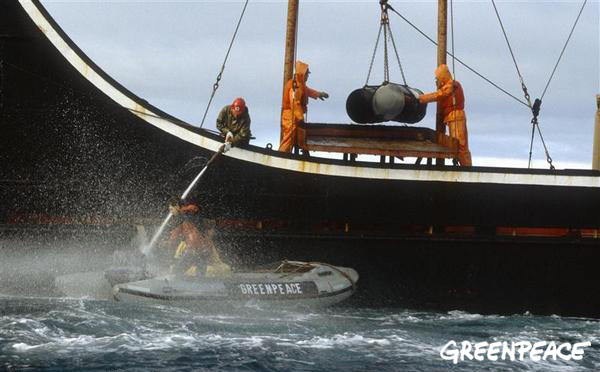
2012-06-10-greenpeacepierregleizesradiocativewastedumping.jpg
Activists blocking nuclear waste dumping. Photo courtesy of Greenpeace /Pierre Gleize, 1982


3. Offshore Oil Drilling. On July 21, 1982, two days after I started my first campaigning job (at Greenpeace in Boston), U.S. Interior Sec. James Watt offered up the entire U.S. outer continental shelf -- a total of a billion acres -- for oil and gas exploration and development.

His highest priority was to lease "frontier" areas, and he was prepared to sacrifice some of the U.S.'s most environmentally sensitive marine ecosystems -- off of Alaska, California and New England. (Come to think of it, the plan was not dissimilar to that of Stephen Harper's all-out offensive to develop Canadian tar sands).

As a result of the campaign against the Watt plan -- during which I once bid on 500 tracks on Georges Bank with no legal consequences I might add -- Congress passed a moratorium on leasing many of the most sensitive areas. The ban on new offshore oil development was reapproved annually up until 2008, and as a result of the Deepwater Horizon accident, offshore policy still remains in flux.

These were not just paper tigers, agreements made then left on the shelf to rot. Some might suggest that these were somehow easy victories, clear cut black-and-white cases compared to the complexity of the issues to be addressed at next week's Earth Summit in Rio. In some respects this is true, but all I can say is they didn't feel easy at the time.

If I've learned anything over the last 30 years, it's the importance of having impossible ambitions. As Nelson Mandela once said, "it always seems impossible until it's done."


Follow Kelly Rigg on Twitter: www.twitter.com/kellyrigg

FOLLOW GREEN
Reading the latest edition of UNEP's Global Environmental Outlook (PDF) last week was enough to make me lose the will to live. It was sad to read what we all intuitively know: "The world continues to...
 
 
  • Comments
  • 13
  • Pending Comments
  • 0
  • View FAQ
Comments are closed for this entry
View All
Favorites
Recency  | 
Popularity
06:45 PM on 06/12/2012
Kelly. Don't give up. Keep fighting for mother earth. She is the only one we have. Do all you can. Encourage your friends. Encourage your readers. Make recycling and conservation easy and fun. Eliminate the use of fossil fuels as soon as you can. We can save her!
greendig
Blogging and campaigning for climate action.
02:57 PM on 06/11/2012
Inspiring reminder that we can actually make a difference as activists. But to some of the points below.. an important characteristic of all these stories is CLEAR VISION. In all 3 cases what inspired them to take action was knowing the true extent of the problem, which at the time was not generally known to the public. The same holds true for climate change. Peak oil, if it ever happens, will not happen in time to prevent catastrophic climate change. We are flooded in abundant oil, and there are decades of plentiful oil to come. We need to take *action* to prevent climate change. It won't solve itself.
02:38 PM on 06/11/2012
"Catastrophic Tipping Point". Sounds really bad, doesn't it ... Kinda the liberal equivalent of the playground phrase "You're gonna be sorry someday"!

The true catastrophic tipping point is the time between your last heartbeat and your next one.

CO2 will not be what wipes us out, folks.
ThatsTheTheWayItIs
religion, ideology, partisanship are delusional
07:49 AM on 06/11/2012
People change habits perforce, not by choice, and that's good news.
We are running out of oil including offshore, so there will be less drilling 100 years from now.
And no fracking in the US - because the natural gas will all be gone by then.

The bad news is global warming. The good news is, we are running out of carbon fuels.
06:23 AM on 06/11/2012
You are fighting a losing battle, and are denying reality. I have examined the motivations of the major stakeholders related to climate change, and they all support the status quo, albeit for different reasons. The fossil fuel resource owners and producers want to squeeze every bit of profit they can from the remaining reserves. The fossil fuel energy workers want no disruption in their jobs; remember the near riots that almost occurreed during the short drilling moratorium after Deepwater Horizon.

The politicians are owned by their corporate donors, don't want to face the chaos and panic that would result if their constituents knew how dire the climate change situation was, and in addition, reflect the will of their constituents. And, therein lies the real problem. Despite their nice words, the American electorate like their large SUVs, their McMansions, their long commutes to the country, etc. They are not willing to sacrifice maximum comfort in the here-and-now for the survival of their progeny.

Each of the major phenomena contributing to climate change is associateed with its own positive feeedback loop (descending spiral), and in concert accelerate the downward descent. If we have not already passed the point of no return, we would need to institute the most drastic reductions in fossil fuel use. The chances of that are zero.
ThatsTheTheWayItIs
religion, ideology, partisanship are delusional
07:55 AM on 06/11/2012
The world is run by the people, not the special interests. We won't stop global warming because people want to drive SUVs. Capitalism just gives people what they want, it doesn't force anything on them. 90+% of people drive cars, about half big gas-guzzlers. That's why 60+% favor Keystone. We vote with our vehicles in the US, and we say "drill, baby, drill".

Yours is the true denial: the belief that big money and greedy capitalists force the good common folk to do wrong. Just the opposite. The average person in the US is a goober who doesn't care about anybody else. Look at what people drive, that will help you get past the denial. The US is the most right-wing developed nation.
08:47 AM on 06/11/2012
"Yours is the true denial: the belief that big money and greedy capitalists force the good common folk to do wrong."

I think we have a reading comprehension problem here. The last half of my middle paragraph says the same thing as your second paragraph. It's the insatiable energy demand of the electorate that's killing us, just as it is the insatiable demand of the drug addicts in this country that has fueled the drug wars for decades.
This user has chosen to opt out of the Badges program
photo
12:30 PM on 06/11/2012
And yet we simply cannot give up on this issue. The stakes are WAY too high, the consequences too negative. So we must fight for change regardless of how daunting it seems, and we need to start in our own yards.
08:28 PM on 06/11/2012
To solve a massive problem, one needs a vision, a strategic plan, and a realistic roadmap that proceeds from the present to the envisioned scenario. I have yet to see a realistic plan and especially a realistic roadmap. While technically possible, I don't believe either are politically or sociologically possible.

We've grown up thinking every problem is amenable to solution, given enough time and resources. But, if a massive asteroid were coming towards Earth, and were projected to land in the middle of the Pacific Ocean next week, much life on Earth would be doomed. That's what we're facing with climate change, but because of the lag times until severe consequences become evident, we think we've got plenty of time left. But, like pancreatic cancer, once the severe symptoms make themselves known, it's usually too late. We may be near that point with climate change, but there is zero interest in changing the status quo among all the major stakeholders.

I'm retired, and won't probably be around when the severe effects really hit. The younger generation will be heavily impacted, and I see zero effort on their part to attack the problem.
zinxeb
Empathy ends cruelty
02:14 AM on 06/11/2012
People can easily set goals to help the environment and conserve energy in their own lives...things like recycling and saving energy...if everyone did their little bit, the savings would be enormous in their totality. We, as a society, have gotten used to overconsumption, and by changing our habits, not only can we help the environment, we can also help ourselves by saving lots of money.
photo
HUFFPOST SUPER USER
waltifarian
Quis custodiet ipsos custodes?
12:48 AM on 06/11/2012
This is the spirit that we need. Goals can be met. We can have hope that efforts now will serve as inspiration to future generations.
photo
artleads
Let's have a national retreat.
09:19 AM on 06/11/2012
While future generations are key, we have an immediate crunch that must be faced. In my experience, a small, driven group of people--slaves to a vision--cannot help but make a difference. Effort is like water, but often quicker. Water seems almost immaterial compared to rock. But if it drips continuously onto rock it wears the rock away, or even breaks it to pieces. If we believe in the sanctity of effort, and ACT, we cannot fail. The point is to believe, even though there are no written guarantees of success. "(I)t always seems impossible until it's done." This is what "faith" means to me.

It could be that, at times like this, when the "leaders" are paralyzed, we have to work from the bottom up. Assuming that "strategy" is the purview of the ruling elite, we have to focus on tactics. Tactics sometimes seem to double as default strategies. Stopping Keystone XL is a default strategy. The right know it, which is why they are pushing the plan so hard. Stopping any large, determinative fossil exploration (as the article illustrates) doubles as strategy. If we can stop enough discreet things like this, regardless of how dire the big picture appears, it will eventually rob the current paradigm of its oxygen. All manner of other emergencies, systemically related to the latter will surely come to our assistance.
photo
artleads
Let's have a national retreat.
11:36 AM on 06/11/2012
"All manner of other emergencies, systemically related to the latter will surely come to our assistance.”

A clarification: These emergencies bring suffering and loss to many. I am not sanguine about that. I do not wish or take pleasure from this suffering. But when such misfortunes occur, due to the historical policies of the ruling elites, they will not be in vain. They will highlight the urgent need to change those harmful policies.