
Watching Irene from our small cabin in the New Hampshire woods was a sobering experience. Even though it was downgraded to a tropical storm by the time it hit us, trees were swaying dangerously, the water in the lake was rising and the proverbial babbling brook which normally carries the excess water away was transformed into something of a raging river (see my before and after photos below). We were fortunate, unlike so many others, not to have suffered any permanent damage.
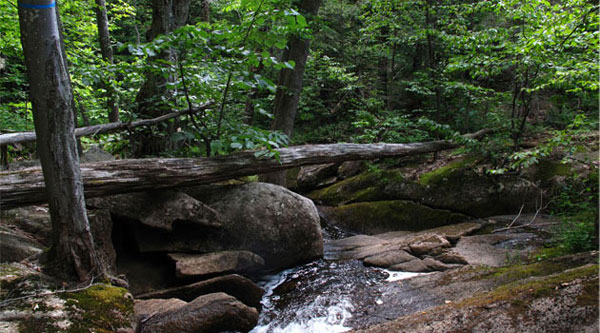
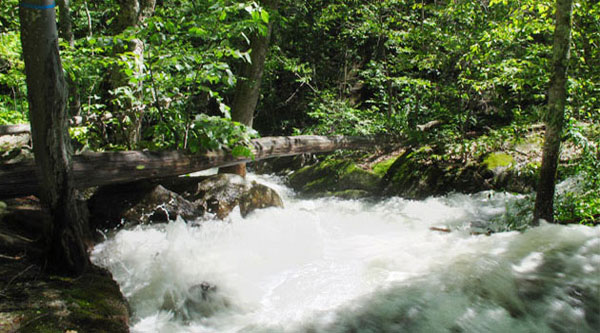
But watching the storm from the window, I knew we were in for another fruitless climate change "he said/she said," as has occurred after every other extreme weather event in the past few years -- wildfires, floods, tornadoes and, of course, tropical storms:
Last week it was Bill Nye "The Science Guy" who attempted to simplify climate change for a Fox News audience. It was a valiant effort, but once again the audience was undoubtedly left more confused and uncertain than ever.
The very nature of the question -- in this case whether Hurricane Irene was the product of a warming climate -- seems almost purposefully designed to elicit the same debate with the same outcome time and again.
It is not unreasonable that the media looks to climate scientists for the answers to such questions. Nor should it come as a surprise that scientists have trouble translating something as complicated as the global climate system into a simple yes or no answer. What's unreasonable is the question itself.
It's as if every smoker who didn't die of lung cancer were trotted out as evidence that the scientific consensus on this issue is up for debate.
Approximately 85 to 90 percent of lung cancer deaths can be attributed to smoking. Yet not everyone who smokes gets lung cancer. There are many factors that influence whether a smoker is likely to get cancer, but even a heavy, long-term smoker has less than a 20-percent chance of actually getting the disease.
Scientists don't know why some smokers get cancer and others don't. But just because your Uncle Joe smoked three packs a day for 50 years and died at the age of 90 does not in any way undermine the scientific consensus on the link between smoking and cancer. Nor would you expect the media to even ask that question, though once upon a time, corporate interests paid a few scientists to try to raise doubts in both the media's and the public's mind on this very question.*
There are parallels between the unfathomable intricacy of the human body and that of the global climate system. We know a great deal about the body -- enough to perform exquisitely complex brain surgery despite the fact that we understand only a fraction of what goes on in the human brain.
Similarly, we have extensive knowledge about the climate -- enough to know that it is warming, that humans are responsible, and that we are in for a wild ride when it comes to extreme weather events, despite the fact there is still much about the climate that we don't know. Just as we would never ask whether a single individual smoker's story constitutes proof or disproof of the theory that smoking causes cancer, we should not look at extreme weather events in isolation.
It's time to change the terms of this fruitless debate. When asked whether an extreme weather event is caused by climate change, scientists should reframe the debate by rephrasing the question: "Are more events like this what you would expect in a warming world?" The answer would be a resounding "yes."
*The Tobacco Control Act was finally signed into law in 2009 by President Obama, nearly 60 years after the first lawsuit was filed against a major tobacco company (Old Golds) for false advertising.
Follow Kelly Rigg on Twitter: www.twitter.com/kellyrigg
Paul Yeager: Widespread Mid-Atlantic and Northeast Flooding Threat This Week
Is our use of fossil fuels causing the earth to heat up? Yes.
Do we have reason to believe what we are doing is safe? No. It's very risky at best.
Are we going to do something about it? ... Please. Before we pass a tipping point.
For the basics, see http://climate.nasa.gov/keyIndicators
The question that will remain is whether our news media will utilize this data to educate the public on this complex but very real issue, or keep asking the dumb questions about earthquakes and hurricanes and tsunamis? After all, sexy sells.
It is more viable to work with our government to set regulations on Oil and Coal companies to R & D alternative energy sources" IMMEDIATELY ". We can not wait for the next disaster to happen. How many people have to DIE before the Oil & Coal companies get the message??? LIVES ARE NOT NUMBERS... Either way if the oil companies start R & D for alternative energy sources and rebuild our infrastructure they stand to make more money anyway.
It is a SAD state of affairs when major oil & coal companies and our Government PUT PROFIT OVER HUMAN LIVES....
Pay close attention to the signal on the left, and ignore all the noise about the hockey stick in the right.
http://maps.grida.no/library/files/storage/0_timeline_001.png
Do not even look at the right side of the chart.
It's not that any sentient being doubts that CO2 can trap heat, it may actually be how dreadfully important it is that it does...... If it was really all about needing to raise the alarm at the +0.59 IPCC AR4 worst case estimate, should we be at all concerned that sea level has overshot this by a wide to very wide margin time and time again? Hindcast, not forecast.
We really need to start thinking about adaptation, and on more than one level. Thirteen of our 16 largest cities squat on estuaries, the only known incubators in the presently perceived universe. And they have been drowned, hard, at the very ends of the most recent extreme interglacials.
The question might just be how are we going to get TO the next interglacial, and the one beyond that? Because, this time, at an eccentricity minimum boys and girls, we are going to have to do it ourselves, twice, just to get to the next eccentricity maxima, our next climatically programmed potential hardware upgrade.
Because I must eventually retire, I will leave you with this thought. Every penny not spent on fusion research may very well turn out to be a penny wasted. A "put that in your climate change pipe and smoke it" CO2 independent species of thoughts.
Good evening all!
It harmonizes with the natural cycles and lets you wake up fresh as a daisy.
I've read through your posts and they are, I am afraid, incomprehensible to a non-specialist. I am a scientist myself, and I have frequently been called upon to teach and write for non-specialists -- it can be done, without substantially sacrificing accuracy, but without using jargon and referring to an assumed common framework of highly specializd knowledge. You might want to cultivate this skill.
From what I do know, it looks as if you are proposing a wildly unorthodox theory suggesting that we are about to plunge into another ice age unless we have plenty of anthropogenic CO2 in the atmosphere, and backing this up with another unorthodox reading of the paleoclimatological data. Now, unorthodox theories in a well-studied field are occasionally right. But this happens very seldom.
I must say that this is a strange series of posts. I feel much as I might if I were asked to referee a paper somewhat outside my field, and, reading the paper, got the strong impression that it was wrong, but didn't quite have the expertise to show it without a huge amount of digging. You might want to write up your findings carefully and submit them to a true expert. It would be very interesting to see how far you got in that forum, because a true expert can smell animal products from a great distance.
The four points were simply this: (1) the vast research which has actually been performed, and which continues, points up the fact that left on its own thermal maxima in the other extreme interglacials either exceed this one or equal it, ditto sea levels. And it isn't just me that says this, every last shred of proxy evidence either has been or is being accessed to suss both out. (2) You can come to the exact opposite conclusion to AGW simply by looking at the facts. Which, for the uninitiated, is precisely how science sometimes works.
The third point is essentially a bit of personal research related to the recent publication of:
PHYSICAL REVIEW E 84, 011130 (2011)
Social consensus through the influence of committed minorities
J. Xie, S. Sreenivasan, G. Korniss, W. Zhang, C. Lim, and B. K. Szymanski1
It's paywalled so you will have to put your money where your mouth is, like I do almost weekly.
If I am not mistaken the leading estimate for doubling of CO2 forcing is 3.5 W/m2. That would get us to just 11.5 W/m2 less, repeat less than the minimum in MIS-11. Wow!
It's not that fascinating in this context. You've looked up some work on past climate change, on pre-industrial climate change. That's it.
We evolved in the current ice age. This climate, with all its variations, is the climate we are adapted to by mutation and selection. It's a climate that gives us a good chance of survival. We've changed and are continuing to change that climate, and doing that with such reckless disregard for the consequences violates the basic principles of conservatism. Since conservatism is a survival trait, violating conservative principles is anti-survival behavior.
Because, on the other hand it occurs to me that what we really need at this juncture in hominin evolution is another ice age. Credible evidence has been presented that H. sapiens may have been down to just about 10k in population during (pop quiz question here) ice age. And we made it!
As it turns out, as a species, climate change has been very very good to us in this way:
“An examination of the fossil record indicates that the key junctures in hominin evolution reported nowadays at 2.6, 1.8 and 1 Ma coincide with 400 kyr eccentricity maxima, which suggests that periods with enhanced speciation and extinction events coincided with periods of maximum climate variability on high moisture levels.”
state Trauth, et al (2009) in Quaternary Science Reviews. There is just nothing quite like having such a natural fly land in your climate change soup.
It is, as Rigg points out, a fairly pointless question. We've already changed the climate equation, and we're continuing to change it. Every piece of weather that happens now is a part of the new climate, which is the biggest unintended consequence we ever caused.
Some of that weather is going to fall within the limits of what we've come to expect as normal, but some of it's going to keep breaking records, especially as the increased warming releases even more greenhouse gases. The longer we wait to fix the problem, the harder and more expensive it's going to be.
And CO2 DID play a role! "We have observed some correlation between B and C cycles and CO2 concentration, but of the opposite sign to the one expected: maxima in atmospheric CO2 concentration tend to correspond to the middle part or the end the cooling period. The role of CO2 in the oscillation phenomena seems to be more related to extend the duration of the cooling phase than to trigger warming" state Sole Turiel and Llebot in Physics Letters A (366 [2007] 184–189).
Just imagine the possibilities here! You are at an end interglacial, you now know all of this. If it was all up to you would you really advocate stripping perhaps the only means of ameliorating the drop to the cold glacial state right at the end of an interglacial? Really?
I keep forgetting the Flintstones used their feet to get their cars rolling.
Thanks for the reminder.
What we are hoping to avoid is a switch to a roast setting. This time we know it is CO2.
What is your source of information?
What debate, Freehat? Science has been doing it's work since the year 1800 when Herschel discovered infrared arriving directly from the sun. Science has carefully and painstakingly worked out the mechanism of climate change over the past 211 years. The denier industry has sprung in to existence in just the most recent couple of decades. They seem to be saying 'hey guys, we need to debate this.' Question for you deniers. Where have you been the past 211 years? Scientists have been on the job. The fundamental science issues are quite settled. That fact is highly inconvenient for the fossil fuel industry which would like to extract just a few more trillion worth of profits and so they maintain extensive denier campaign efforts.
The possibility consequently exists that at perhaps precisely the right moment near the end-Holocene, the latest iteration of the genus Homo unwittingly stumbled on the correct atmospheric GHG recipe to perhaps ease or delay the transition into the next glacial. Under the antithesis “Skeptics” and “Warmists” thus find themselves on the mutual, chaotic climate ground where the efficacy of CO2 as a GHG had better be right.
1) remove the post-industrial climate security blanket CO2 right now, at the end of the interglacial, to better facilitate nature in ending this already half a precessional old interglacial. We will take our chances with the next glacial epoch.
2) Think a little bit further back and realize that having incredible, stupid blind luck releasing a climate security blanket right at the waning days of said half-precessional old interglacial might be rather serendipitous, if you actually know what I mean.....
As with most things, extracting maximum entertainment value should not be ignored. Going with what is behind door number 1 leaves us wide open to the application of what may be some sorely needed chlorine to the gene pool. Going with door number 2 might lead to maintenance of the status quo. Which, from keeping up with the news, has disastrous written all over it.
In their work, at least 13 of the 24 D-O oscillations (indeed other workers suggest the same for them all), CO2 was not the agent provocateur of the warmings but served to ameliorate the relaxation back to the cold glacial state, something which might have import whenever we finally do reach the end Holocene. Instead of triggering the abrupt warmings it appears to function as somewhat of a climate “security blanket”, if you will.
Continued....