Twice in recent months, I've heard speakers refer to a decisive moment in American history, a moment which shows our capacity to mobilize quickly in the face of an existential threat. One of them was Lester Brown, who wrote in his book Plan B 2.0: Rescuing a Planet Under Stress and a Civilization in Trouble:
"In his State of the Union address on January 6, 1942, one month after the bombing of Pearl Harbor, President Roosevelt announced the country's arms production goals. The United States, he said, was planning to produce 45,000 tanks, 60,000 planes, 20,000 anti-aircraft guns, and 6 million tons of merchant shipping. He added, "Let no man say it cannot be done."
"No one had ever seen such huge arms production numbers. But Roosevelt and his colleagues realized that the largest concentration of industrial power in the world at that time was in the U.S. automobile industry. Even during the Depression, the United States was producing 3 million or more cars a year. After his State of the Union address, Roosevelt met with automobile industry leaders and told them that the country would rely heavily on them to reach these arms production goals. Initially they wanted to continue making cars and simply add on the production of armaments. What they did not yet know was that the sale of private automobiles would soon be banned. From the beginning of April 1942 through the end of 1944, nearly three years, there were essentially no cars produced in the United States."
With the exception of nuclear war, I can't think of any greater existential threat to human civilization than climate change and its related impacts. If ever we needed an "FDR moment," now would be it.
Looking back through a week's worth of posts on the Daily Kos climate change SOS blogathon, no topic was left behind: there are pieces on how climate change is taking its toll on virtually every ecosystem on the planet; how political will is undermined by those who are invested in the status quo; and how the solutions are there for the taking.
The solutions proposed -- and being implemented -- are inspiring to be sure: campaigns against coal, fracking, Arctic oil drilling, and fossil fuel subsidies, to name a few, are aimed at busting the fossil fuel monopoly on our energy future. Likewise, campaigns on deforestation, sustainable agriculture and ocean protection are moving us in the right direction.
Equally inspiring: Investments in clean energy are soaring as the costs of renewables drop rapidly around the world. According to Michael Liebreich, CEO of Bloomberg New Energy Finance, more than $1 trillion has been invested in clean energy over the last seven years.
But are we doing enough?
According to the International Energy Agency, "without further action, by 2017 all CO2 emissions permitted in the 450 Scenario will be "locked-in" by existing power plants, factories, buildings, etc." Bear in mind that the "450 scenario" -- whereby the CO2 concentration in the atmosphere stabilizes at 450 ppm -- only gives us a 50-50 chance of keeping temperature rise below 2°C. Also note that a 2°C target in itself is not exactly safe -- it's now being described as the threshold between 'dangerous' and 'extremely dangerous' climate change.
Maybe this is the sort of thing Woody Allen had in mind when he quipped, "More than any time in history mankind faces a crossroads. One path leads to despair and utter hopelessness, the other to total extinction. Let us pray that we have the wisdom to choose correctly."
Stabilizing the climate requires global CO2 emissions to stop increasing, and then to steeply decline. Fast. The longer it takes for emissions to peak, the steeper the decline will have to be in the years that follow. The graph below, although several years old now, shows how much smoother the transition would have been had we taken aggressive action back in 1990, and how much harder it gets every single year we delay.
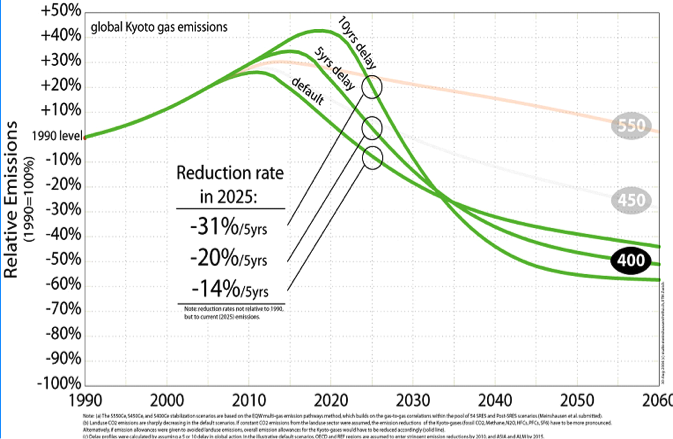
And delaying we are. Following a brief drop in emissions in 2009 as a result of the global economic recession, they began growing again in 2010 and emissions in 2011 reached a new record high -- a 3.2 percent increase over 2010.
There are different views about how much we need to reduce emissions, by when and by whom. In its last assessment report, the IPCC said that for the 450 scenario, developed countries needed to reduce their emissions collectively between 25 and 40 percent below 1990 levels by 2020, and that developing countries needed to substantially reduce their emissions below the amount they were projected to grow. Lester Brown, on the other hand, speaking at the AREDAY conference last week, made the case that food scarcity will ultimately be our civilization's weakest link and argued that we should be aiming to cut carbon emissions 80 percent by 2020.
In Copenhagen in 2009 many countries put down their pledges in writing for the first time. But even if all countries fully implement their commitments -- a rather optimistic assumption -- we're looking at a temperature rise of 2.5 to 5°C before the end of the century. This is a terrifying prospect as the scientists at Climate Action Tracker show in this graphic:
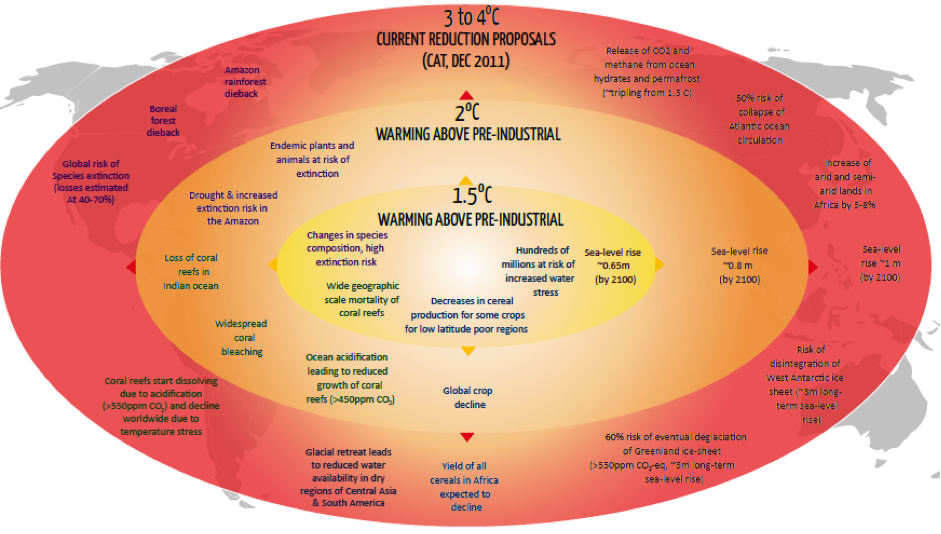
So we have five years or less to transform our global energy systems, not to mention the changes we need to make in forestry and agriculture practices. No wonder Very Serious People like Bob Watson have begun openly questioning whether 2° is "out the window."
Which brings me back to the "FDR moment." Business as usual, even a positive variant in which we accelerate action, won't keep us below 2° let alone the 1.5° limit that more than 100 countries are calling for. We need to start moving at warp speed. Sadly, neither of the U.S. presidential candidates is even talking about climate change, let alone proposing the kind of action that will protect our children from dangerous climate change. I don't know which is more depressing -- candidates who don't consider this a top priority, or an electorate which doesn't demand it of them.
We have confronted the threats of drugs and terrorism by declaring war on them. With my sincerest apologies to those who abhor the language and metaphors of war, I believe it's time we declare one on climate change, and empower our leaders to get the job done. We can all play a part, through lifestyle choices, participation in activist campaigns, spreading the word through our communities, and ultimately letting our elected representatives know that we will vote like we mean it. It's time to insist that our leaders lead.
This post originally appeared on Daily Kos. It is part of the Climate SOS blogathon.
Follow Kelly Rigg on Twitter: www.twitter.com/kellyrigg
Just look at the efforts of their online astroturf trolls, aimed at disrupting honest dialogue and spreading the pro-industry talking points their PR firms have created. Just look at the hijacking of the political process in the U.S. and Canada. Look at their nefarious activities in South America, Russia, Africa and all over the globe. It is past time we stopped getting "worried" or "depressed" or "concerned," and started getting angry.
We must break the back of the fossil fuel lobby politically in order to win this war.
http://www.guardian.co.uk/news/datablog/2011/jan/31/world-carbon-dioxide-emissions-country-data-co2#zoomed-picture
Let's be honest. President Obama when he was elected could have been the next FDR. All the components were there. His first opportunity was the banking crisis. He already had Senator Cantwell and his previous opponent Senator McCain introducing legislation to re-instate the Glass Steagall Act. The Glass Steagall Act is less than 30 pages on how to run the banking system. What did President Obama and congress give us? The Dodd Frank Act 849 pages of loop holes.
If we are looking for the next FDR we can only hope Candidate Romney is elected and has a change of mind!
With President Obama there is only disappointment!
And BTW, below us, we have:
Net-dr, our resident troll
who's funded by Big Oil and Coal
to lie, distort, and pretend
that truth is whatever they wend,
to protect the profits they stole.
60 aliases he says that he's used,
100 more stockpiled to abuse
the Earth, its people and future
just to feed an amoral moocher
who claims climate change is a ruse.
What is an astroturfing shill?
http://www.monbiot.com/2011/02/23/robot-wars/
BRAGS of 60+ BANNED aliases just this year alone.
http://www.huffingtonpost.com/social/climate-eagle/climate-change-adaptations_n_1759835_177421335.html
100 MORE ALIASES STOCKPILED
http://www.huffingtonpost.com/social/maxwells/bernie-sanders-climate-change_n_1723334_173476555.html
Banned aliases THIS year alone:
netdr NGC2623 Hoosier-Daddy25 leesburg-larry neptune2 Ptolemy101 Texas-Titan Texas-Husker ceasar200 Larry Schneiderwind falconia zillaii ptolemyii Saturn1 platoii mars222 jupiter5 mercury999 soctates earth999 saturn999 Plano-Husker Pluto- Neptune- Bills- skepticalone- Netdr- Plato- LarrySchmidt Texas--husker net-dr Texas--Titan Titan- Ceaser- Copernicus Copernicus- Copernicus-- Hoosier-daddy Arrhenius Arrhenius- Plano-husker JamesHansen Dr.Hansen Plato-- tesla- climate- climate-eagle Phil--Jones
Gallon cites more dormant aliases (clearly violating HuffPo policy)
http://www.huffingtonpost.com/social/gallon/antarctic-peninsula-warming_n_1822425_179955624.html
He had it! Did you ever hear him come out and vigorously support Senator's McCain & Cantwell?
No because he is a Rockefeller Republican aka Clinton Democrat - Social Progressive doing Wall Street's bidding! And far more effectively than the Neo/Con Republicans!
Say, are you really Grover Norquist? Some people think he's a genius, you know.
Since the long term warming is 1/2 degree per century with no warming this century global warming is a non problem.
That is why the alarmists have switched to climate disruption as if CO2 were a magic gas that could cause disruption without warming !
In the US, if there is to be any hope of reversing the trend, it will probably have to be done by individuals acting together to conserve energy, to install distributed electrical systems, and to demand energy efficient transportation.
The problem is not the lack of an FDR running the govt. What we require is a single mobilized organization that makes real changes now. The govt will follow.
The acuteness and urgency of the problem requires a spontaneous combustion of the many, and that combustion is hastened, literally, by rising temperatures. So we here continue to blow on the embers until they ignite.
The unprecedented success of the London 2012 Olympic Games has once again shown the global role that cities now hold.The opening ceremony focused on work and health as it celebrated the community spirit at the heart of the Olympic ideal. Over the two weeks that followed, London emphasized the importance of cooperating around a joint purpose built on professional engagement, leadership and selfless voluntary contributions.
In doing so, the overarching goals of the Games ticked every box with regard to the challenges posed by climate, energy, water and waste. I believe that London 2012 can inspire a leap forward for sustainable development that will give Rio de Janeiro something powerful to emulate in the preparations for 2016.
Within the arena of sustainable development, the boundaries of responsibility are undergoing a monumental shift. This allows new actors to take pole position in the creation of new opportunities. Old infrastructures are being replaced by new ones that are better designed to cope with the challenges facing cities and regions.
We should stop directing our attentions and frustrations towards impotent governments. Instead we must focus on more localized models that simmer from below but come to influence and inspire national actors to greater action.
Following on from my research, allow me to present six ingredients for local solutions to global problems:
1) All governments should appoint a minister for municipalities who is involved in international negotiations
Read the report and the article at http://bit.ly/Rh9Buk
Can't even hide that with per capita.
We are rapidly skinning the Earth and destroying ecosystems natural, life creating and supporting services. They are listed as:
Oxygen releasing; the maintenance of the atmosphere; the regulation and moderation of the climate; the natural sequestration of those climate warming greenhouse gases that will be released when the soil of an ecosystem is disturbed and the system's plants and trees sliced away; the climate cooling water cycle [deforestation feedsback to a hotter and drier climate]; the nitrogen cycle and the entirety of Earth's biogeochemistry; purification of the air and water; the creation and renewal of a life rendering soil [if soil is destroyed, it's over];
provisions of pollination; decomposition; seed dispersal; new medicines; 99% of pest control and the control and regulation of human disease pathogens that cause epidemics. These are the known "life-support services".
Man's unnatural changes to the surface of the Earth cannot perform any of the preceding services, and scientists do disagree about how much ecosystem death is fueling cc.
"Climate change and its ecological and societal impacts are receiving widespread attention. I would like to focus on a related and arguably more "urgent" issue: land use and land use changes." Senior scientist
http://www.guardian.co.uk/environment/2012/aug/27/arctic-sea-ice-shrinks-lowest-extent
I'm not sure we've got 5 years to power down and prevent feedback loops from occurring. An 80% reduction by 2020 is pie in the sky as the spoiled, capitalist brats will never allow that to happen. They're busy mapping out their new shipping lanes and drilling spots.
NAWAPA XXI
Dave Chrisite: Get Obama Out Now to Rebuild the Nation
6 min 33 sec ago
Dave Christie, member of the national slate of LPAC endorsed candidates, reiterates the necessity of removing Obama now in order to prevent thermonuclear war and rebuild the nation.