iPhone app iPad app Android phone app Android tablet app More

Featuring fresh takes and real-time analysis from HuffPost's signature lineup of contributors
Kelly Rigg

Kelly Rigg

GET UPDATES FROM Kelly Rigg

IPCC Report: Renewable Energy Key to Solving Climate Change

Posted: 05/ 9/11 06:25 PM ET

A new IPCC report is hot off the press this time focused on the potential of renewable energy sources to solve the climate crisis. Given the UN climate science panel's proclivity for producing scenarios guaranteed to make any thinking person lose sleep at night, the good news take-home message was a welcome cause for celebration.

From a technological standpoint, renewables can more than meet our global energy demands. By 2050, nearly 80 percent of our energy needs can be met by renewables with existing technologies. So it's clear that whatever challenges and difficulties lay ahead, they are entirely within our power to overcome, simply by adopting the right policy incentives.

A myriad of facts about the amazing rise of renewable energy can be found in the press releases of Greenpeace, WWF and the IPCC itself.

This labor of love (IPCC authors contribute on a voluntary, no-pay basis) will undoubtedly become a major source of discussion in the coming days and weeks. Or months -- after all, the report is 900 pages long. Climate deniers will look for conspiracies, and the nuclear and fossil fuel industries will seize on short-term costs and other obstacles to downplay the revolutionary message that shines through the study's conclusions.

But as I've said before there is no getting around one central conclusion -- like it or not we are in the midst of an energy paradigm shift.

This prevailing sense of change was clearly evident at the Creating Climate Wealth Summit last week in Washington DC, which brought together investors and entrepreneurs in the new clean energy economy. It was held at a rather unusual conference venue: the Washington Nationals baseball stadium.

Amidst the hotdog vendors at the top of the stands, there's a VIP area where some of the sessions took place and by some bizarre ironic twist, I accidentally found myself in the Exxon Mobil skybox. It was an honest mistake, cross my heart. I entered the room through a door marked with a 'W' mistaking the Washington Nationals logo for the Women's Room.

Imagine my surprise to suddenly find myself in a posh entertainment suite, replete with a massive Exxon Mobil logo on the wall and an antique Esso oil pump in the corner (the price showing a nostalgic 42 cents per gallon, with room for only a single digit to the left of the decimal point in the total purchase)! It was the epitome of all things anti-climate, anti-renewables, and anti-progress.

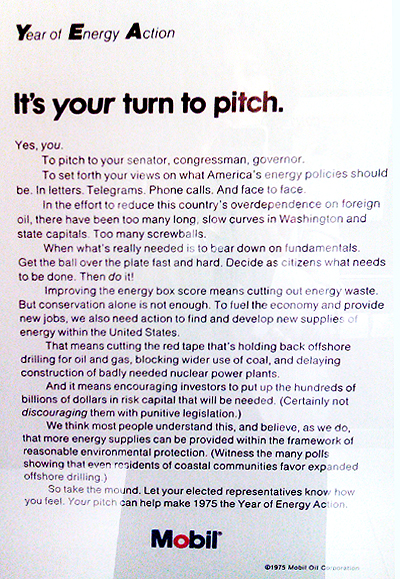
Suppressing my instinctive tendencies toward direct action, I contented myself with taking photos, including this framed company editorial hanging on the wall of the restroom:
2011-05-09-mobilpitchkellyrigg.jpg

I presume it was selected because of all the good ol' American baseball metaphors, but its message appeared to be aimed directly at the 112th Congress:

Improving the energy box score means cutting out energy waste. But conservation alone is not enough. To fuel the economy and provide new jobs we also need action to find and develop new supplies of energy within the United States. That means cutting the red tape that's holding back offshore drilling for oil and gas, blocking wider use of coal, and delaying construction of badly needed nuclear power plants.

It all seemed a bit ho-hum until I got to the last line: "Let your elected representatives know how you feel. Your pitch can help make 1975 the Year of Energy Action."

1975! Back then, Mobil ran weekly paid op-eds on the editorial pages of major U.S. newspapers. This one serves as a fascinating reminder of how just how stuck the major oil companies are in an energy paradigm that is so last century. Written more than 35 years ago, it could just as easily have appeared last week. All these years later, and they're still whining about pesky environmentalists holding them back.

What's even more interesting is that oil industry leaders know they are a dying breed. A recent survey of business leaders in major oil and gas companies found that 90 percent of those who responded believed that "by 2025, renewables will be the most substantial energy source."

Let's face it, the end of the fossil fuel era is in sight. Hats off to the IPCC for showing the way forward not just for the climate crisis but for a wide range of other societal ills -- energy poverty, energy insecurity, and respiratory diseases to name just a few. May government policymakers have the wisdom to take the hand being offered to them, allowing us to pull ourselves out of the dirty, dangerous energy hole we've dug for ourselves as fast as we possibly can.


Follow Kelly Rigg on Twitter: www.twitter.com/kellyrigg

A new IPCC report is hot off the press this time focused on the potential of renewable energy sources to solve the climate crisis. Given the UN climate science panel's proclivity for producing scenari...
 
 
  • Comments
  • 38
  • Pending Comments
  • 0
  • View FAQ
Comments are closed for this entry
View All
Favorites
Recency  | 
Popularity
01:48 PM on 06/16/2011
I'm sure a correction to this is upcoming now that it's been shown that this claim that 80% of our energy can come from renewables by 2050 is nothing more than a Greenpeace fantasy with no scientific backing. I'm also sure you'll call out the conflict of interest in appointing a Greenpeace employee as the lead author of an IPCC chapter.
10:14 AM on 05/11/2011
I am a great fan of solar energy and also of other renewable energy forms. But I also see their limitations. It makes me worried when their potential is "oversold". I do think it is realistic that they could contribute 80% of energy in 2050, but only provided that there is substantial savings on total energy use, a net reduction of energy use; that energy prices are at least doubled and that governments abolish perverse subsidies for fossil fuel and redirect investments in renewable. See more at: http://gardenearth.blogspot.com/2011/05/renewables-dangerously-positive-news.html
10:35 AM on 05/10/2011
It sometimes amazes me what great differences there can be in how people respond to things. Foir me, the IPCC is seedy, disreputable organisation with a penchant for outrageous reports that on occasion bear little relationship to the thousands of mostly well-intentioned inputs they have received ahead of them. Their sloppy reliance on non-peer reviewed literature makes them little more than a mouthpiece for such narrow-minded corporations as the WWF and Greenpeace, and as such are not worthy of our trust. As for renewables, if they are any good the marketplace will ensure they spread fast and wide. But I suspect they are not any good, and will only spread amongst the wealthy (to give them energy independence) for their yachts and homes, and elsewhere only at the taxpayers' expense. Higher energy bills are not attractive, and not progressive.
photo
HUFFPOST BLOGGER
Kelly Rigg
01:47 PM on 05/10/2011
Every investigation conducted into the IPCC has concluded that the science is fundamentally sound. Your conclusion that it is seedy and disreputable suggests you've been drinking the denialist Kool-Aid. Not to mention the fact that WWF and Greenpeace are non-governmental organizations not commercial corporations, and have a public interest mandate. As for the market, I presume you are in favor of eliminating all subsidies and tax breaks for fossil fuels and nuclear? Let's see how well they fare in a true free-market.
photo
HUFFPOST SUPER USER
fiddler3
physicist, musician, parent
12:44 AM on 05/11/2011
Interesting response. You don't need to read the skeptics' literature to have concerns about the IPCC.

I do like the idea of dropping the subsidies for energy companies. Maybe you should suggest that in one of your editorials. Take away all the pressure from the government and let the free market determine the best energy solution.
03:00 PM on 05/11/2011
Thank you for your reply. I think the investigations into the IPCC were all deliberately superficial and underpowered, avoiding key questions and, most importantly, key witnesses. In particular, the 'science' was never reviewed by them. WWF and Greenpeace are wealthy corporations, and have a strong self-interest mandate in their high salaries (for their leaders) and pension funds. They are anti-democratic, selfish, arrogant, and narrow-minded - in my humble opinion. I do not have a high opinion of them. I am indeed in favor of eliminating all such subsidies, except perhaps for any paid to help industries cope with unduly-burdensome legislation - in that case, the subsidies should go only after the legislation does.
10:34 AM on 05/10/2011
You are so right, the oil industry propaganda in the Exxon box, from 1975, is timeless--that's probably why they keep it on the wall, it doesn't go out of style! I rejoice at the clear goal issued by the IPCC but it also causes some panic. 2050!? Forty years from now!? Just think, if the IPCC report had been issued back in 1975 in the nascency of this debate, we would already be at 80%. Unfortunately we have 40 more years to go...
This user has chosen to opt out of the Badges program
04:54 AM on 05/10/2011
We also need to get a handle on the population explosion, no?
HUFFPOST SUPER USER
NoMoFearNoMoHate
08:32 AM on 05/10/2011
It would seem like it

http://1000memories.com/blog/75-number-of-people-who-have-ever-lived
photo
Jigar Shah
Visionary on accelerating Climate Change Solutions
02:55 AM on 05/10/2011
Great post! This is by far the most important points, "By 2050, nearly 80 percent of our energy needs can be met by renewables with existing technologies. So it's clear that whatever challenges and difficulties lay ahead, they are entirely within our power to overcome, simply by adopting the right policy incentives." I am so sick and tired of our own advocates saying the opposite:
1) "We can't survive without subsidies" -- we can and we must. We can win with a level playing field by getting rid of all $100B+ of production side subsidies for natural gas, coal, and oil
2) "Wind and solar are intermittent, we need baseload" -- this is patently false and if another environmentalist says it I swear I will throw a fastball right at their teeth. German, Japan, and others have proven that with dynamic virtual power plants you can control demand and supply to accommodate these energy sources with very little storage. Still not convinced, then read: http://www.asrc.cestm.albany.edu/perez/directory/LoadMatch.html

Onward!
01:04 AM on 05/10/2011
The nature of mother earth is that it changes. Some changes have been gradual and others abrupt. To think that man has the power to influence climate one way or the other, shows the ignorance of the scientists. A computer model that shows global warming is nothing but a program with "bugs". Man cannot predict the weather a month from now, and we are to believe that a program correctly tells us that the globe is warming because of coal powered electric generation plants. Get real you "warmer" idiots!
HUFFPOST SUPER USER
alvdh1
05:55 PM on 05/11/2011
dkinton49,

I have a suggestion. Lets assume that the earth has a finite atmosphere. Lets further assume that you own a garage. Pull your car into your garage and close the door with a full tank of gas, remain seated in it while the engine runs. Report back to us when you think you have sufficiently altered the finite atmosphere in your garage. I think you will be suprised how little time it takes to fill up the air with CO and what the consequences are of fouling a finite air space.

It is beyond scientific fact that CO2 and water vapor are heat trapping gases. You can deny this all you want, but it isn't going to change the science. Does water evaporate faster when the temperature is below freezing or when it is 90 degrees outside. Does water absorb more heat when it is in liquid form or in solid form.? Does asphalt reflect more light into space than concrete. Does bare land reflect more light into space than the ice covered south pole? Does methane ice release more heat trapping gases into the atmosphere than coal burned in a power plant? Do forests absorb more CO2 than deforested land? Have you ever been in a greenhouse in the dead of summer? Do you know why a greenhouse gets hot when the sun shines on it? Do you know the difference between long wave and short wave solar radiation? Please provide detailed answers to these questions.
photo
HUFFPOST SUPER USER
marco01
01:04 PM on 05/17/2011
Cat got my tongue? Are you referring to how I'm not engaging these deniers in technical back and forth? Because I have found it to be completely pointless, facts have little impact on these types. So I come at it from a different angle, emotional punches to the gut and the highlighting how absurd their conspiracy theories are.
 
 
photo
HUFFPOST SUPER USER
marco01
12:03 PM on 05/17/2011
"To think that man has the power to influence climate one way or the other,.."
 
Hey, dkinton, you look like you've served, you should understand this. You don't believe anything man could do could influence the climate? What effect on the climate do you think all-out Nuclear War would have?
 
I just love how you deniers spout off about something so technical and complicated with such arrogance without having the slightest clue what you are talking about.
HUFFPOST SUPER USER
alvdh1
12:32 PM on 05/17/2011
Hey Marco01,

Has the cat got your tongue fella?
photo
HUFFPOST SUPER USER
jabailo
(Participant) Texeme.Construct()
09:29 PM on 05/09/2011
The UN report is nonsense because it does not once mention hydrogen.

Hydrogen is the only viable clean storage method for renewables like solar and wind.

With hydrogen for home and cars we can become 100 percent renewable in 20 years.
photo
HUFFPOST BLOGGER
Kelly Rigg
02:25 AM on 05/10/2011
You've read the 900+ page report?
HUFFPOST SUPER USER
NoMoFearNoMoHate
08:33 AM on 05/10/2011
Takes more energy to capture, produce, store hydrogen than it yields - back to school for you.
HUFFPOST SUPER USER
alvdh1
05:04 PM on 05/11/2011
Technically that is not true. If the power from wind, solar, wave and tidal is not being placed into the grid because of a lack of demand, why not use it to produce hydrogen. Existing power plants can be used to produce it to level demand throughout the day. Building up for peak demand is inherently inefficient because utilities have to generate more power building up for peak demand than they can sell. There are ample oil fields with dry wells in America that can be used to to store the hydrogen gas.
This user has chosen to opt out of the Badges program
photo
fumes
Midnight Toker
08:17 PM on 05/09/2011
i've installed revolving doors..

throughout my house..

attached to generators!
07:57 PM on 05/09/2011
"Given the UN climate science panel's proclivity for producing scenarios guaranteed to make any thinking person lose sleep at night"

It is logical economics. The UN makes hundreds of millions of dollars on carbon offset "authentification" schemes, they need the "science" to support the "scam", especially since the UN Oil for Food scheme went defunct.
07:05 PM on 05/09/2011
A WINDMILL IN EVERY YARD,AND EVERY HOUSETOP.
greendig
Blogging and campaigning for climate action.
06:56 PM on 05/09/2011
It's interesting that the IPCC found we could get to 80% by 2050 given current technologies. The fact is these technologies are advancing at a breathtaking rate -- like new optical films that make the solar panels 2x as effective and new research in thermoelectric panels. With these innovations set to hit the market in the next couple of years the time frame could be much much sooner! Let's start investing in these technologies rather than sticking to the oil industry's "pitch."
07:54 PM on 05/09/2011
I'm right behind you. No seriously, go ahead and invest in these technologies. Oh, that's not what you mean? I thought so. Just some more empty rhetoric that is proxy for "I want government to pour money into things I like!"
photo
HUFFPOST BLOGGER
Kelly Rigg
02:18 AM on 05/10/2011
I said that government should create policy incentives. But now that you mention it, government funding for fossil fuels and nuclear -- through subsidies and tax breaks -- far exceeds support for renewables. So let's hear it for ending perverse subsidies.

And by the way, yes, I do put my money where my mouth is.
09:23 AM on 05/10/2011
Exactly. Wind, solar, biomass and energy management and storage technologies are improving all the time, and I'm pretty sure we'll be getting 100% of our energy from renewables well before 2050, but the fact that 190+ governments have said that it could be up to 80% by 2050 is significant...This includes the US, Saudi Arabia, Venezuela, Qatar and Oman, Canada and Australia...as governments go, it's not bad. Especially when they acknowledge than any serious effort to combat climate change will involve an energy system dominated by renewables.