iPhone app iPad app Android phone app Android tablet app More

Featuring fresh takes and real-time analysis from HuffPost's signature lineup of contributors
Kelpie Wilson

Kelpie Wilson

Posted: April 29, 2010 04:15 PM

WorldStove founder Nathaniel Mulcahy has just completed two months of work in Haiti, setting up a pilot project that will provide biochar-producing stoves and jobs for the Haitian people. The project was featured in an Earth Day press release from the UN Special Envoy to Haiti (former President Clinton) as an example of "building back better" by incorporating environmental sustainability in the recovery effort.

Before WorldStove, Mulcahy was an award-winning industrial designer creating consumer products for large corporations like Emerson Appliances. Eight years ago, while lying in bed recovering from a life-threatening accident, he realized that he needed to focus his energies on innovative designs to improve the quality of life for people who were less fortunate. The result was his invention of the fuel efficient, low emissions LuciaStove, named after the canine companion who saved his life.

The breakthrough that set the LuciaStove apart from similar gasifer stoves was Mulcahy's patented design which uses venturi holes to create negative pressure while a flame cap based on Fibonacci spiral geometry prevents oxygen from entering the pyrolysis chamber. The combination delivers better air control for cleaner combustion of the gases produced from the biomass it uses as fuel. It also produces biochar.

Mulcahy says that people are often surprised that such a sophisticated design would be used for such a simple product, a cook stove for developing countries. Mulcahy answers, "Why should we provide developing nations with stoves that look like cast off scrap? Style or elegance of design usually only involves added thought, not added cost."

Mulcahy considers it a matter of respect not only to offer a clean, efficient stove to the world's poor, but to make sure that the stove is adapted to people's needs and not the other way around. WorldStove pilot projects in several African countries, Indonesia, and the Philippines have encountered all manner of local conditions that have required changes in the stove setup or manufacturing techniques.

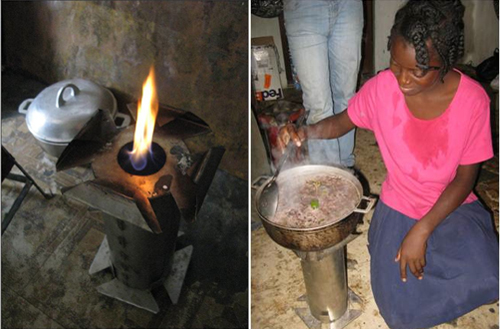
The adaptability of the Lucia stove faced its greatest test in Haiti this winter where Mulcahy carried out a WorldStove Pilot Program in the short space of two months. He not only redesigned the stove to be produced with available tools and materials, but he completed a camp survey. The fact that since the quake more children have been forced to take responsibility for cooking made safety a top priority, so Mulcahy developed a Haitian specific pot stand with heat-shield and windscreen to accommodate the wide variety of pots used in Haiti and protect children from burns.
2010-04-29-images-cookingcomposite.jpg
Left: The blue flame indicates that the Haiti Lucia stove is burning cleanly and efficiently. Right: Children have taken on more cooking responsibilities since the earthquake. Photo Credit: World Stove

Local versions of the Lucia stove must be tuned to work with available fuels. Peanut shells need different conditions than rice hulls, for instance. Mulcahy found that Haiti has many waste products that can be made into fuel pellets or used directly, including sugar cane waste, rice hulls, coffee hulls, bamboo, sawdust, coconut shells, mango pits, palm fronds and waste paper.

One of the best moments of Mulcahy's two months in Haiti was the day he first tuned a locally-built stove to run on the available pellets. That night he was able to cook a plateful of rice, beans and meat sauce for 21 people with only three handfuls of pellets.

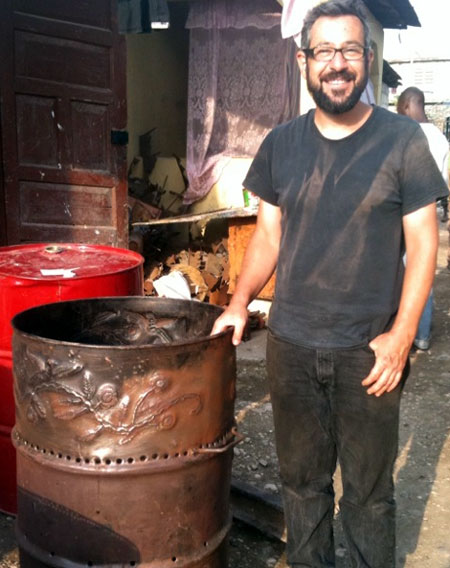
Another prize moment occurred when Mulcahy showed up late to a village artisan's shop only to find the artisan already engaging a crowd of people demonstrating the stove and explaining how the biochar would help restore their soils. The metal workers began to add decorations of trees and birds to the stoves, telling Mulcahy that the pictures represent what will happen if people use the stoves to make biochar - the trees and birds will come back to Haiti.
2010-04-29-images-nathanielmulcahy.jpg
Nathaniel Mulcahy showing designs that metal workers added to the stove wind screens. The metal workers say that trees and birds will return to Haiti when the soil is rebuilt with biochar. Photo Credit: World Stove

Almost a third of Haiti's land has lost so much topsoil that it is not possible to grow food crops. As a result, Haiti can no longer feed itself and people have fled to the cities where they were more vulnerable during the earthquake. Biochar can be a critical factor not only in restoring topsoil to Haiti but in revitalizing the rural economy and repopulating the countryside.

In the next phase of the Haiti project, WorldStove will work with United Nations Environmental Programme (UNEP), the World Food Programme (WFP) and the Haitian Government to build stove-manufacturing hubs and create thousands of jobs making pellets and distributing biochar in the rural areas. Preliminary agreements are in place with 48 agricultural cooperatives that will provide crop waste for pellet production. The farmers will receive a proportionate amount of biochar in return to build their soils and increase production.

Mulcahy invites anyone who is interested in learning more about next steps in Haiti to visit the WorldStove website, www.worldstove.com. For updates, you can sign up for the World Stove Twitter feed @WorldStove.

Kelpie Wilson is the communications editor for the International Biochar Initiative, working to promote sustainable biochar as a powerfully simple tool to fight global warming and boost food security.


Follow Kelpie Wilson on Twitter: www.twitter.com/@kelpiew

WorldStove founder Nathaniel Mulcahy has just completed two months of work in Haiti, setting up a pilot project that will provide biochar-producing stoves and jobs for the Haitian people. The project ...
 
 
  • Comments
  • 11
  • Pending Comments
  • 0
  • View FAQ
Comments are closed for this entry
View All
Recency  | 
Popularity
11:01 AM on 05/03/2010
Worldstove claims their stoves are highly efficient – producing more energy per unit biomass than other cook stoves. But this is counter-intuitive, given that something like 45% of the carbon is retained as char. Proof? Of course they are likely more efficient than open fires.

In order to burn biomass in stoves, one must HAVE - grow/harvest/collect the biomass to burn. This is clearly a very serious issue in Haiti. If in reality wastes and residues are used and replace charcoal production etc., that is probably an improvement. But it is troubling when these projects are then used as rationale for promoting large scale biochar production, as through the Clean Development Mechanism and other carbon markets.

Biochar sometimes increases yields temporarily because of the nutrients in ash but compost is better.

Even assuming benefits of char, the stoves produce rather small quantities – WorldStove claims 100 grams “per meal”. So if a family cooks three meals a day - 300 grams/day of char. It is generally thought that at least 10-20 tonnes per hectare must be applied for significant yield increases - that means a family will need to cook for over a century to have a chance of improving one hectare of land.

see: http://www.biofuelwatch.org.uk/docs/biocharbriefing.pdf
11:49 PM on 05/03/2010
This beats the heck out of cutting down trees or using charcoal which denuded the forests and caused erosion of the topsoil on the Haitian hillsides. This in turn has washed down the rivers and choked out the coral reefs around the island. This is off the grid cooking and for Haiti to become sustainable, de-centralizing is a key issue. The Biochar aspect is a rather small return, but if an entire village is cooking with these, it can add up and it is definitely a step in the right direction. You say that it is troubling, but what is your proposed solution?
01:33 PM on 05/04/2010
Rachel,

I'm really surprised you don't know more about biochar from all the research you've done!

For instance, your claim that "biochar sometimes increases yields temporarily because of the nutrients in ash" is very likely demonstrated to be false by Terra Preta soils in the Amazon. The char in those soils is several thousand years old, and locals prize it for its unique, highly fertile qualities in the region, and have done so for many generations.

Pyrolytic stoves are highly efficient because they produce a gas flame. It is next to impossible to get an efficient flame from burning biomass, because combusting a gas and a solid at the same time makes it very difficult to provide the proper mix of oxygen within the flame. That's why a wood fire produces so much smoke, and the WorldStove produces no smoke. This is probably the most important aspect of the efficiency of a pyrolytic stove, because wood fire smoke causes respiratory illness in women and children of the developing world to such an extent that it is the leading cause of death.
05:31 PM on 05/02/2010
This is great stuff. A simple and affordable way for billions of people to cook using less fuel, and avoid most of the soot and smoke from traditional woodstoves. This is the kind of work that really, really makes a difference.
09:13 PM on 04/30/2010
Love you! great work! fanned!
02:58 AM on 04/30/2010
World Stove's fabulous relief work in Haiti is but the tip of a global health and economic iceberg of benefits, if such low cost Biomass cook stoves that produce char were implemented at scale. The health benefits in Africa with the removal of BC aerosols and respiratory disease emissions replacing "Three Stone" stoves would equal eradication of Malaria.

The Congo Basin Forest Fund (CBFF).recently funded The Biochar Fund $300K for these systems citing these priorities;
(1) Hunger amongst the world's poorest people, the subsistence farmers of Sub-Saharan Africa,
(2) Deforestation resulting from a reliance on slash-and-burn farming,
(3) Energy poverty and a lack of access to clean, renewable energy, and
(4) Climate change.

The Biochar Fund :
Exceptional results from biochar experiment in Cameroon
The broad smiles of 1500 subsistence farmers say it all ( that , and the size of the Biochar corn root balls )
http://biocharfund.org/index.php?option=com_content&task=view&id=55&Itemid=75

Mark my words; Given the potential for Nat Mulcahy's and Laurens Rademaker's programs to grow exponentially, only a short time lies between their nominations for a Noble Prize.

This authoritative PNAS article below show the world climate implications for biochar systems in the developed economies for Soil carbon sequestration;

Reducing abrupt climate change risk using
the Montreal Protocol and other regulatory
actions to complement cuts in CO2 emissions
http://www.pnas.org/content/early/2009/10/09/0902568106.full.pdf+html
10:29 AM on 04/30/2010
I first read about terra preta in the book 1491 and am amazed at how fast the the information has spread and the technology has developed. This is all bottom up stuff. It is the only way that anything is going to happen. The people with the power could care less about the future of the planet. All they care about is money and status symbols.

I would love to have a world stove BBQ but my finances won't allow it. In the mean time I have started making my own bio char with what I have. which is dirt and a shovel and trimmings. Even finding a 55 gal steel drum seems to be an impossible dream around here.
05:02 PM on 05/01/2010
Waste Bio Char is one leg of the green energy economy.

rooftop PV solar, wind and Bio Char can supply all the worlds energy fuels and electricity needs, clean, safe, cheaper in the long run, and forever.
HUFFPOST SUPER USER
MaurizioMaranghi
Environmental Entrepeneur
02:51 AM on 04/30/2010
First of all, kudos to anyone helping in the Haiti efforts, and many similar efforts around the globe. We are so fortunate to have all that we do, that is good to see people get these types of designs and allow for them to help in their day-to-day lives. Keep up the great efforts!

- Maurizio Maranghi -

Reduce, Reuse, Recycle