
Several hikes in the woods this past long weekend led to many wonderful wildlife sightings, including a few invertebrates. Those in the know reference these as "inverts" while the rest of us just call them "bugs." I am most decidedly in that second group of folks.
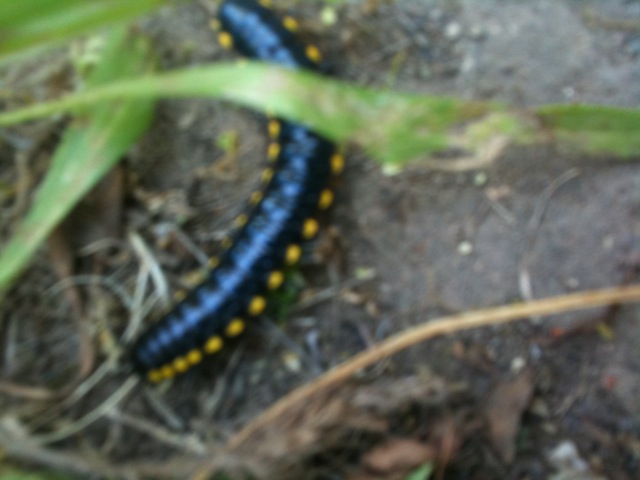
Spotting dozens, maybe hundreds, of these on a half mile or so of trail and sure that I had stumbled upon a soon-to-be spectacular mass emergence of butterflies, I snapped this smart-phone photo and sent it off to Chris Nagano, my favorite bug guy at the U.S. Fish and Wildlife Service, asking what would these turn out to be when they grow up. His answer: "You saw a millipede, a member of the genus Harpaphe most likely Harpaphe haydeniana. The photo looks like an adult so he/she isn't going to get any bigger or turn into anything else. In any event, it's one of the millipedes that secrete cyanide. I commonly saw big finger-sized, brightly colored members of this subfamily in the cloud forest in Costa Rica. They were quite nonchalant as they wandered about on the forest floor, as if they knew that no bird or other predator would touch them."
He then went on to say many other things to help me realize how little I know of our backboneless cousins. This is really a sad fact considering that between 95 percent and 99 percent of Mother Earth's animals are in fact invertebrates (that is, animals without a spine, an obviously natural and vitally important occurrence and as such not to be confused with the other form of spineless animals known as politicians). Millipedes are inverts but are not insects; insects have six legs (spiders have eight), and millipedes have a whole lot more. Invertebrates include insects (the majority of inverts) but also spiders, worms, leeches, jellyfish, squid, snails and a long, long list of others. It's easier by far to list those animals which are other than invertebrates (that is, vertebrates): that complete and comprehensive list is fish, amphibians, reptiles, birds, and mammals.
The millipedes I found are commonly called the Yellow-Spotted or Almond-Scented Millipede. The first name is an obvious one and the second obvious too once you remember that cyanide has a distinctly almond-like odor. These animals can reach two inches in length and can live for up to three years. I don't believe that there are any centipedes with 100 sets of legs or millipedes with a million, but watching them march along can certainly give that impression. Males of this species actually have at least 30 pairs of legs and the females 31. They feed on leaf litter and thereby play a vitally important role in the ecosystem, helping to break down what would otherwise be vast mounds of debris and at the same time freeing up nutrients for the soil.
As my invertebrate consultant indicated, the cyanide deters most potential predators, and that gives rise to one of the many fascinating aspects of evolution (which, by the way, is no more a theory than is the fact of the earth rotating around the sun). Since predators know that black and brightly spotted Harpaphe haydeniana are best left alone, then similarly patterned other similar sized creatures may and in fact do also get avoided by birds and other predators. That, in turn, leads to evolutionary mimicry, the evolution of similarly patterned but unrelated and non toxic species. Life is so amazing, if only we stop to look and learn. And when one does so, life also proves to be remarkably exotic even here close to home.
One last point: butterflies are beautiful, but so too are these millipedes. Next time you see some little thing crawling, hopping, flying, or scurrying by on what seems like a surplus of legs, elevate the language and impress your friends by saying "Gadzooks, it's an invert" instead of "Ewww, it's a bug." Then pause, please, without squishing. It's time to open our minds and our hearts to this 99 percent.