Cross-posted from The Green Fork.
Formerly squeamish suburbanites are learning what every little kid knows instinctively--dirt and worms are cool. If you're on the cutting edge, you've already stopped trimming your lawn and started clipping your nails, 'cause the era of manicured hands and manicured lawns is officially over. It's time to tear up your turf, grow 'clean' food, and get some dirt under your nails, because nothing says "sustainable" like particles of soil clinging to your fingers--or your fingerlings.
Mini farms are sprouting up in front yards, back yards, on rooftops, and sunny windowsills. Early adopters have taken chickens under their wings, and put bins of scrap-happy red wigglers under their kitchen sinks to compost the coffee grounds. Here in uber-urban NYC, my friends are planting illicit patches of herbs on their fire escapes, a practice hypothetically frowned on by the NY fire department. But who's gonna get busted for growing basil? Everybody knows that firefighters cook up a storm when they're not racing off to put out other folks' fires.
Illicit bee-keeping, on the other hand, can be a stickier endeavor, which is why there's a move to make it legal in NYC, where--to the astonishment of many--chicken keeping is actually permitted.
It shouldn't be such a surprise, really, because a half-century ago, "chickens were all the rage in the United States, and not just among farmers," as Nicolette Hahn Niman notes in her memoir Righteous Porkchop: Finding a Life and Good Food Beyond Factory Farms, adding that "these were times when people had limited entertainment options--no movies, no television, and no computers...contact with chickens was about as commonplace as interactions are today with dogs and cats."
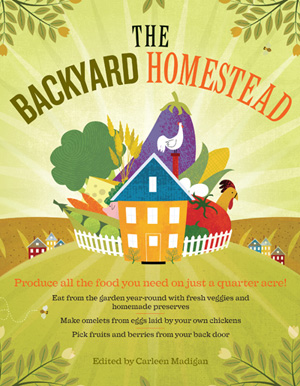
Speaking of cats, Catwoman Eartha Kitt kept chickens and grew greens in her Beverly Hills backyard. It's a shame she didn't live long enough to see farming become fashionable; I'm sure Kitt would have pounced on Carleen Madigan's The Backyard Homestead and added it to her Christmas wishlist for Santa, baby.
Madigan's book, aptly billed as "the Indispensible Guide To Food Self-Sufficiency" is an invaluable resource to help you tackle just about any homegrown, made-from-scratch project, from growing your own fruits, veggies and livestock to preserving it in the form of canning, curing, brewing, preserving, etc. Dominique Browning, the former editor of the late, lamented House & Garden (what other shelter magazine would have Bill McKibben contribute a column on composting?) gave it a rave in last Sunday's New York Times Book Review:
Madigan's got the goods, and she wants you to have them, too:
The Backyard Homestead is for anyone who's tantalized by the prospect of producing even a little bit of your own food, regardless of where you live. So if you've got those back-to-the-land fantasies but your town is more Wal-Mart than Walden Pond, don't despair: The Backyard Homestead will help you make your dreams come true.
Follow Kerry Trueman on Twitter: www.twitter.com/kerrytrueman
Kim O'Donnel: The United States of Canning
Canning celebrates the abundance of your local food shed. If you don't grow your own food, you might go to your neighborhood farm market, roadside stand or co-op to buy what you need to jam, preserve or pickle.
Dana Joy Altman: Real Food Rehab: The Recession Issue
I have never been so poor in my life. But despite how it appears on paper, there's been an upside to all this. It's easy to focus on what you don't have, harder to celebrate what you do. That, to me, is paramount to happiness.
Jenna Woginrich: Put a Lid On It: Learning to Can
It helps the organic farmers in the summer and helps you throw together a quick healthy meal on a cold night when fresh veggies are only being shipped from Chile.
Want to reply to a comment? Hint: Click "Reply" at the bottom of the comment; after being approved your comment will appear directly underneath the comment you replied to
Obviously, this writer really doesn't grow her own or she would be well-aware of all the soil-born parasites and pathogenic organisms which are the reasons experienced gardeners wear gloves and NEVER get the 'dirt under their fingernails'. One case of parasitic worms will teach anyone. (If you get pinworms, eat fresh pineapple--works every time.)
Still I'm glad to hear of a new book to help us figure out how to feed ourselves when the mega-agriculture culture falls apart when there is no longer water in California. One of my biggest concerns is how we know so much about so many things, from John Donne, to Shakespeare, to DNA, but we don't know how to grow our own food, or preserve for even one season. If there were a devastating disaster destroying our food systems, we would all starve in the winter since most of us don't know how to preserve foods except with electricity. What do people eat while waiting for the harvest? Without the wheat you can make no bread.
The way our grandparents did things has been almost lost. I have been actively gardening every year for the last ten years, and for about 15 years earlier in my life. It's a long learning curve, and I will need more than 1 book.
Thanks for the tip. I've been growing my own fruit and vegetables since I bought my first place a dozen years ago. At the time I did it because I could grow a wider variety of better tasting stuff than I could buy. The cash savings are nothing to sneeze at, though. I find I usually drop a few pounds through the excercise involved also.
Since I have been thinking about adding some chickens this book looks right up my alley!
The recent rise in urban, suburban, and rural small-scale homesteading couldn't be more timely. What better way to redirect local food sheds and ensure nutritious, quality foodstuffs than by growing, raising, and processing your own eats? My own books on the topic ("Homemade Living-Raising Chickens and Canning & Preserving", Lark Books, April 2010) profile individuals from Los Angeles to London taking back food pathways. From egg co-ops in Portland, to everyone from baristas to bankers making jam and putting up pickles, a food revolution is in the works. Carleen Madigan's book no doubt offers a little something for every plate.
WoW! Two- Thumbs UP! Homegrown food projects are a great opportunity to reclaim natural self-sufficency and sustainable living. For decades we have turned over the power of healthy choice to frozen foods, junk-food, fast-food, engineered grains, chemically processed beverages and the like.
It's a great idea to trim those fingernails and dig in the soil and joustle with a worm or two. Not only can we grow those veggies, fruits, herbs at home there's an intrinsic sense of pride and accomplishment. An added bonus for our efforts- Homegrown food and gardening is a stress-buster .
Grandma gathered the breakfest eggs. Hop to it - Chicken coops are a fun activity for kids and it puts them in touch with 'sustainable' living.
MerrieWay suggests 'Live Green Dream' TV to hop on the Homegrown Bandwagon...Yum Yum.
You must be logged in to comment. Log in or connect with