
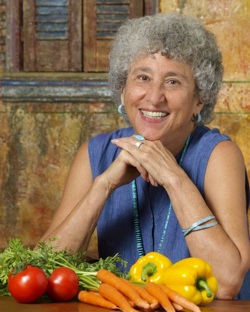
(With a click of her mouse, EatingLiberally's kat corners Dr. Marion Nestle, NYU professor of nutrition and author of Pet Food Politics, What to Eat and Food Politics:)
KT: The last two episodes of Jamie Oliver's Food Revolution have yet to air, but folks are already assessing whether Oliver's attempt to launch a culinary coup in the community of Huntington, West Virginia was a success or a failure. Jamie's 'people' consulted you at the start of this project. Did they heed your advice? If it had been your show, how would you have gone in and done it?
Dr. Nestle: I don't watch much TV (technophobe that I am, I have yet to figure out how to turn it on without resorting to instructions), but I would not miss the Jamie Oliver show. I first heard about it from students in my NYU Food Ethics class. They made it clear that the show was well worth watching by anyone who cares about how America eats.
I was dubious. When I met with Jamie Oliver's staff in London last summer--an information session, not a consult--I thought the project sounded kind of arrogant but knowing nothing about reality television, I was curious to see how it would go.
Splendidly, I would say. What I hadn't realized is how much fun this guy is, and how gutsy. OK, he has annoying Briticisms. OK, a lot of this is about him.
But he wants everyone to learn to cook healthy food and have fun doing it. He wants school lunches to be better. He wants people to be healthier. Along the way, he is exposing deep flaws in the federal school meal programs and in the kinds of foods that many people eat without giving what they eat much thought. Sounds good to me.
I'm kind of stunned by the hostility the programs have evoked among people I would have expected to support these goals. My teaching assistant, Maya Joseph, a doctoral student at the New School, categorized the criticisms for me:
• the wounded ego messages (how dare Jamie Oliver not mention MY work!!)
• the ugly foreigner message (how dare Jamie tell AMERICANS what to eat!)
• the outraged sensitivity messages (how dare Jamie Oliver not take account of X,Y, and Z when he so rudely ballooned into this town).
Maya adds: "I would have thought that it would be obvious...that this is (a) a TV show! and (b) great publicity for our food system tragedies."
Me too. Or, as food consultant Kate Adamick points out in her review on the Atlantic Food Channel, "the revolution will be televised."
This is reality TV aimed at an important public health problem. Is it theater, or is something bigger going on?
From the number of people I know who are watching it and talking about it, I'm voting for bigger. I think it's useful for people to know that kids at school think it's normal to eat pizza for breakfast, French fries for lunch, and nothing with a knife and fork. And they have no idea what a tomato or a potato looks like. People need to know that schools and USDA regulations allow these things to happen. They need to know that better food costs more.
From my observations of school food over the years, getting decent food into schools requires:
• A principal who cares about what kids eat
• Teachers who care about what kids eat
• Parents who care about what kids eat
• Food service personnel who not only care what the kids eat, but also know the kids' names.
Jamie Oliver is trying to reach all of these people, and more.
I think the programs have much to teach about the reality of school food and what it will take to fix it. The New York Times reviewer, also dubious at first, ended his review with this comment:
One thing noticeably absent from the first two episodes is a discussion of any role the American food industry and its lobbyists might play in the makeup of school lunches and in the formulation of the guidelines set for them by the Agriculture Department. If Mr. Oliver wants a real food revolution, it can't happen just in Huntington.
Yes! And these programs could help.
Finally, let me comment on the West Virginia University's evaluation. This survey found that the kids didn't like Oliver's meals (but did try them). The staff didn't like the increased work. Everything cost more.
Once again, this is TV, not a real school intervention. Real ones start at the beginning of a semester, not in the middle, and are about food, not entertainment. They also do not leave it up to the kids to decide what to eat.
As I said in one of my blog posts on these programs, I want to know what happens in schools and in the community after the TV crews are gone. If the programs are any indication, I think real changes will take place in the minds, hearts, and stomachs of at least some participants and viewers. Whether researchers can figure out how to capture those changes is another matter.
Watch them. And get your kids to watch with you.
 Follow HuffPost Food on Twitter and Facebook!