As the 2012 presidential election approaches, we are likely to hear more and more "gaffes" like that of Mike Huckabee, who last month claimed that President Obama is somehow un-American because he grew up near madrassas and not rotary clubs.
Huckabee went on to correct his factual error (Obama spent the vast majority of youth in Hawaii), but Huckabee let lie his suggestion that Obama is not a Christian and, ipso facto, not a good American. In his fertile "gaffe," only "true Christians" qualify as good Americans, outsiders beware.
Other Republican contenders followed suit. A few days ago, Howard Cain, the pizza magnate-turned-presidential contender said he wouldn't hire a Muslim in his cabinet or on the judiciary. Newt Gingrich said he feared the country was somehow turning into a hotbed of secular atheist values dictated by Muslim extremists.
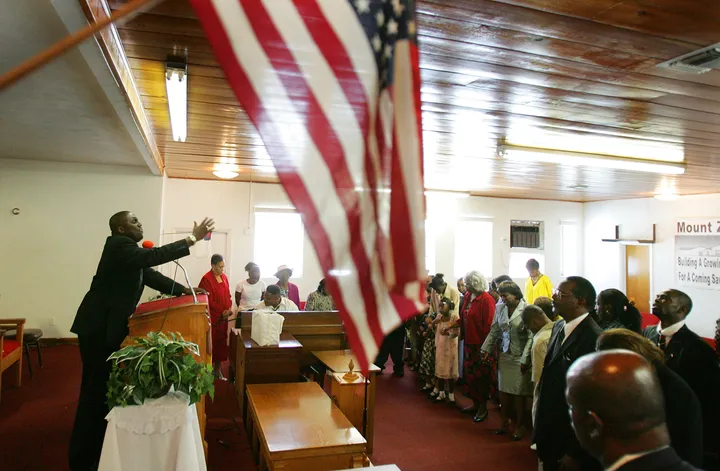
Underlying all these claims was the idea that the United States is a Christian nation, whatever that may mean.
There is a long history to the idea that the United States is a Christian nation. The idea has come and gone with the prevailing politics.
The idea certainly didn't first take hold during the revolutionary era. The first American patriots were not an especially unified bunch, and certainly not in the idea that the new nation should secede from Britain in order to create a Christian promised land. Indeed, there are 4,000 words in the Constitution and not one of them is god.
Instead, the idea that America is a Christian land was born in the early nineteenth century. Three ingredients helped create the idea.
First, there was a dramatic religious revival throughout the new nation, an event you'll remember from high school as the Second Great Awakening. Interestingly, the Second Great Awakening occurred in part because the few Founding Fathers who were evangelicals were denied from making the country a 'Christian nation' in law. This denial opened the door for minority faiths, and the Methodists, Baptists, and variety of African American churches did just that, thus democratizing Christianity in the new country.
The second ingredient was the arrival of large numbers of Irish Catholics, those poor souls fleeing the Irish Potato Famine in the 1840s and 1850s. They were mostly unwelcome guests. Fearful of this impoverished bunch, many Protestants with longer standing American credentials declared that American democracy was only safe in the hands of a people with an unmitigated relationship with God. Catholics could not think on their own, and could not, therefore, be good Americans.
The third nineteenth century ingredient was stunning creation of America's first truly national culture. Public schools, first developed in this era, began each day with Bible readings from the King James (Protestant) bible. Sunday laws were put into place. American literature and culture reflected Protestant values. America's civil religion became increasingly Protestant.
And so the idea of a Christian nation was born. To be a true American was to be a Christian and, more so, a Protestant.
This national image lasted quit a while. American imperialism began in the late nineteenth century under the banner of Christianizing the infidels (perhaps masking dollar diplomacy). It was the face of Jesus that magically appears hovering over the unified North and South in the most famous movie in American history, D.W. Griffith's 1915 classic, Birth of a Nation.
Challenges to this image first appeared in beginning of the twentieth century. Two reasons were particularly important.
First, the huge numbers of immigrants who came to the United States during the turn of the century were overwhelmingly Catholic and Jewish. Their numbers were so large (and politically important) they couldn't be ignored. Plus, they organized, developing large societies that could represent their voices at the highest levels.
Second, the rise of fascism in Europe made any intolerant claims unpopular. To suggest the U.S. was a Protestant nation, then, was to be openly discriminatory toward Catholics and Jews, and, of course, to sound suspiciously like Hitler.
World War II marked the death knell of the nineteenth-century version of America's Christian nationhood. Hitler was a key culprit.
What emerged in its place was a tri-faith version, centered on seeing Protestants, Catholics and Jews as equal parts American. A new national image emerged. This was when the phrase "Judeo-Christianity" came into vogue. A popular film of the era, Big City, told a tale of three men -- Protestant, Catholic, Jew -- who find a baby girl on the street and adopt and raise her together, the perfect child of postwar America's tri-faith image.
But of course what a nation proclaims to be has real repercussions. Shortly after the tri-faith conception emerged, Catholics and Jews demanded the nation change to accommodate them. Bible readings were removed from the classroom. Sunday laws were challenged everywhere. Catholics and Jews wanted access to mainstream college fraternities and suburbs. In 1960, one of them even won the presidency.
The result was a more tolerant nation, but also one that appeared to lack a moral rudder. Many Americans in the 1960s and 1970s began to fear a departure from any foundational values at all, tolerance not being enough.
Thus the rise of the Religious Right in the 1970s and 1980s. They've been engaged in a constant effort to "take back their country." And from whom? From the tolerant left, who have sacrificed their values at the altar of peace and harmony, and who have embraced things like diversity and pluralism as a founding national ideal.
The Religious Right has also brought back the notion that the United States is a Christian country (or, occasionally, Judeo-Christian, in order to keep Jewish neo-conservatives relatively placated).
We are likely to hear a lot more about this projected image as 2012 approaches. Best to know the history.
Kevin M. Schultz teaches history and Catholic Studies at the University of Illinois at Chicago. His book, Tri-Faith America: How Catholics and Jews Held Postwar America to its Protestant Promise, is just out from Oxford University Press.