Very few wild, relatively pristine lands remain in the lower 48 states -- about 8% of the total land area. Less than half of that 8% lie within protected areas like national parks and officially designated wilderness areas. The rest of these scarce wild lands are vulnerable to mining, oil and gas drilling, off-road vehicle abuse, etc. Since 8% is a small number, one would think that no one would be in favor of letting it dwindle down to, say, 4%. And yet a small but energetic minority are in favor of exactly that. The arguments these wilderness opponents offer fall into three broad categories.
- The first category: selfish but rational. A typical example is "I'm not satisfied that the large majority of public lands are open to my noisy off-road vehicle or drilling rig; I insist that a very large majority of public lands be open to my noisy off-road vehicle or drilling rig."
The second category: misinformed and/or irrational. "Drilling in these areas is essential to our energy independence." (In fact, public lands with the strongest oil and gas potential are already full of oil wells, and drilling in the remaining, low-potential areas would add at most a small fraction of a percent to our energy reserves.) The third category: bizarre technicalities. Strangely, it is this third category that has dominated the arguments of wilderness foes in recent years. The most prominent example is the sudden appearance of "ghost highways" across public lands in the western US in the 1990's.These ghost trails are the subject of this week's blog post.
Here's some very brief legal background for the amusing photos which follow. A one-sentence provision of the Mining Law of 1866 (not a typo -- 145 years ago) allows for the "right-of-way for the construction of highways across public lands." This statute was later renamed RS2477. In 1976 it was repealed, but the repeal was subject to valid existing rights. Just what constitutes a valid existing right in this context is open to debate, as is the extent of this right. When rural western counties realized this could be a tool for sabotaging wilderness, they took a very extreme view as to what "highways" existed as a result of RS2477.
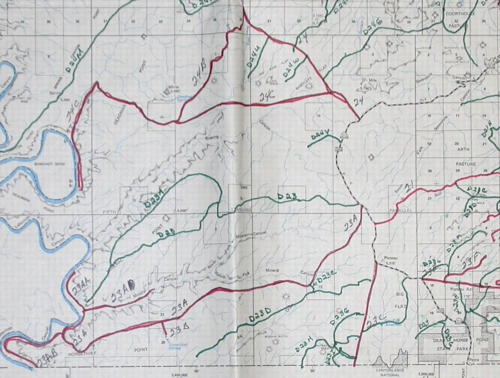
Consider Grand County, Utah, where I live. In 1985 Grand County's official RS2477 claims near the Green River looked like this.
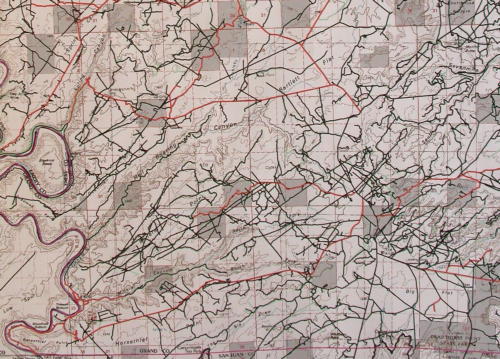
By 2002, Grand County had changed its mind and was claiming that a vastly larger network of county roads existed prior to 1976 (when RS2477 was repealed).
A similar surge in ghost highways occurred in most Utah counties and in many other western states as well.
The region depicted in the maps above has an area of approximately 200 square miles and a population of approximately zero. So why is Grand County so eager to claim so many rights-of-way?
A full explanation would fill this entire post, but here's a brief answer.
Despite the fact that these are public lands (like National Parks), owned equally by all Americans, the County would like to treat these areas as its own private fiefdom and promote extractive development at the expense of preservation.
They hope that if they legally establish rights to these routes then that will prevent the federal government from preserving the lands in their natural state.
Did these rural counties really overlook legitimate, significant roads in the 1980's, only to rediscover them in the 1990's? Or were they just making up nonsense claims in the 1990's in order to interfere with the public's right to preserve public lands for future generations? Let's see what some of these lines on the map actually look like on the ground. We'll concentrate on San Juan County, Grand County's neighbor to the south.
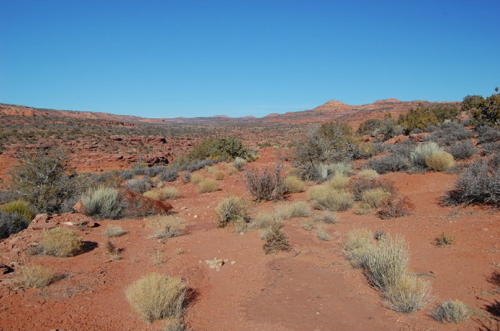
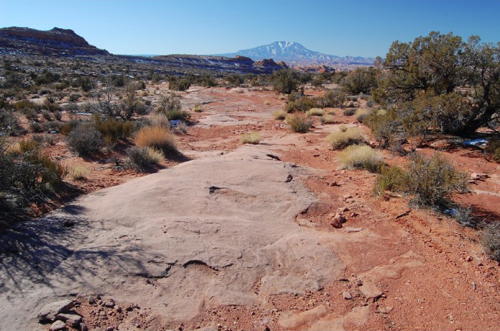
Here's County Road D2621 in San Juan County, Utah:
Note that there's slightly less vegetation down the center of the photo.
Years ago someone probably drove a Jeep through this area.
Now San Juan County is claiming it as a highway.
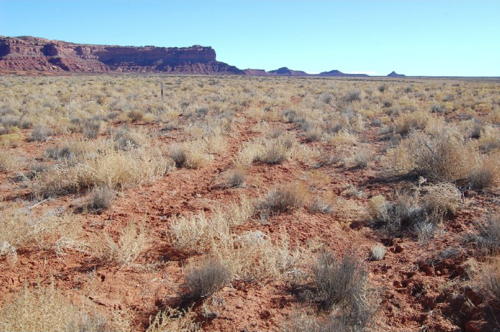
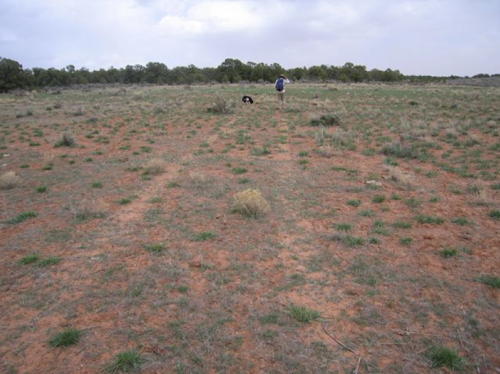
Here's San Juan County Road D4800:
You can make out a cow trail just left of center, and a parallel, somewhat less popular cow trail just right of center.
These cow trails were once tire tracks, and that's apparently good enough for San Juan County to claim it as a highway.
Here's San Juan County Road D4776:
Several decades ago this may have been a mineral exploration route.
Here's San Juan County Road D2294:
Those are fresh tire tracks.
Someone has actually driven a short distance on this "county road."
But you would need to be under the influence of some pretty powerful and distorted ideology to consider these faint tracks a legitimate argument against wilderness.
These lands remain pretty much the way they have been for thousands of years. We should protect the last remaining unspoiled acres of our original inheritance. Neither fake roads, unproductive drilling nor transient joy riding should take them away from us.
Our 2024 Coverage Needs You
It's Another Trump-Biden Showdown — And We Need Your Help
The Future Of Democracy Is At Stake
Our 2024 Coverage Needs You
Your Loyalty Means The World To Us
As Americans head to the polls in 2024, the very future of our country is at stake. At HuffPost, we believe that a free press is critical to creating well-informed voters. That's why our journalism is free for everyone, even though other newsrooms retreat behind expensive paywalls.
Our journalists will continue to cover the twists and turns during this historic presidential election. With your help, we'll bring you hard-hitting investigations, well-researched analysis and timely takes you can't find elsewhere. Reporting in this current political climate is a responsibility we do not take lightly, and we thank you for your support.
Contribute as little as $2 to keep our news free for all.
Can't afford to donate? Support HuffPost by creating a free account and log in while you read.
The 2024 election is heating up, and women's rights, health care, voting rights, and the very future of democracy are all at stake. Donald Trump will face Joe Biden in the most consequential vote of our time. And HuffPost will be there, covering every twist and turn. America's future hangs in the balance. Would you consider contributing to support our journalism and keep it free for all during this critical season?
HuffPost believes news should be accessible to everyone, regardless of their ability to pay for it. We rely on readers like you to help fund our work. Any contribution you can make — even as little as $2 — goes directly toward supporting the impactful journalism that we will continue to produce this year. Thank you for being part of our story.
Can't afford to donate? Support HuffPost by creating a free account and log in while you read.
It's official: Donald Trump will face Joe Biden this fall in the presidential election. As we face the most consequential presidential election of our time, HuffPost is committed to bringing you up-to-date, accurate news about the 2024 race. While other outlets have retreated behind paywalls, you can trust our news will stay free.
But we can't do it without your help. Reader funding is one of the key ways we support our newsroom. Would you consider making a donation to help fund our news during this critical time? Your contributions are vital to supporting a free press.
Contribute as little as $2 to keep our journalism free and accessible to all.
Can't afford to donate? Support HuffPost by creating a free account and log in while you read.
As Americans head to the polls in 2024, the very future of our country is at stake. At HuffPost, we believe that a free press is critical to creating well-informed voters. That's why our journalism is free for everyone, even though other newsrooms retreat behind expensive paywalls.
Our journalists will continue to cover the twists and turns during this historic presidential election. With your help, we'll bring you hard-hitting investigations, well-researched analysis and timely takes you can't find elsewhere. Reporting in this current political climate is a responsibility we do not take lightly, and we thank you for your support.
Contribute as little as $2 to keep our news free for all.
Can't afford to donate? Support HuffPost by creating a free account and log in while you read.
Dear HuffPost Reader
Thank you for your past contribution to HuffPost. We are sincerely grateful for readers like you who help us ensure that we can keep our journalism free for everyone.
The stakes are high this year, and our 2024 coverage could use continued support. Would you consider becoming a regular HuffPost contributor?
Dear HuffPost Reader
Thank you for your past contribution to HuffPost. We are sincerely grateful for readers like you who help us ensure that we can keep our journalism free for everyone.
The stakes are high this year, and our 2024 coverage could use continued support. If circumstances have changed since you last contributed, we hope you'll consider contributing to HuffPost once more.
Already contributed? Log in to hide these messages.