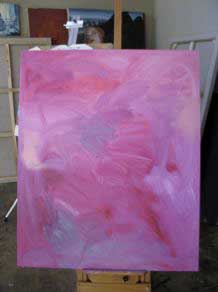
I made a great big canvas. For three weeks it sat in the center of the studio like Jack's massive desk in The Shining. No matter how many "painting miles" I've earned, there's really nothing more terrifying. Of course, I have some ideas, a subject, a palette in my mind. Several in fact. But I've encircled it, ignored it, worked on smaller paintings instead. Finally, today, I took six different shades of pink. Some cadmium red light, rose and violet, and I just attacked it. It's okay, I wasn't totally committed because I knew it was just the ground of probably ten layers that will live above it. But it was a start.
Like Kubler-Ross' five stages of death--Denial, Anger, Bargaining, Depression, Acceptance--I divide the creative process into eight stages. The first two are (1) Vision and (2) Hope. I don't care who you are or what the medium, whether writer, filmmaker, musician, or lithographer or lawyer, or postman, every person goes through these two phases when they get struck by an idea. Vision tends to come in a flash. Then Hope makes the heart swoon and the mind swell around it. Being a great daydreamer helps. Everyone is an artist.
But the difference between artists who create and artists who walk around pregnant with ideas is the third stage which I call (3) Diving In. That's the scary one. That's the one I had to deal with in the studio with the pink paint. My father is a surgeon and I used to watch him operate a lot when I was a kid. I'll never forget that singular moment, in the theatre of the operating room, when he had to press the scalpel into the flesh and make the cut. That's a surgeon's "Diving In". Mine just had less blood.
The next four stages are (4) Excitement (5) Suspicion (6) Clarity and (7) Obsession. Often I bounce between Excitement and Suspicion--suspicion that perhaps my instincts are wrong; that I'm heading in the wrong direction -- (Anxiety! Despair!) Finally I move on to Clarity. Clarity, like Vision, often happens in a moment-- when the sky opens and I can hear the angels sing. Then my favorite part is the tireless consuming fever of Obsession, the life force of every artist. The entire sequence can tend to form an infinite loop. Some artists just barely or never get out of this mobius strip, like the San Francisco Female Painter (whose name I can't remember) who added paint to the same canvas her entire career with a nervous pack of cigarettes until she died. Although Schubert's Unfinished Symphony was supposedly actually finished, James Joyce apparently couldn't help but to add pages every time he edited Ulysess and it almost never made it to the publisher. Then there's the perhaps sixty percent of you, dear readers, who have an unfinished draft of the next Great American Novel rotting in your desk drawer or hard drive.

A year ago, I attended the funeral of the well-known and beloved TV Writer Jerry Belson ("The Dick Van Dyke Show," "The Odd Couple", etc.) whose wife Jo Ann is also an artist. During the eulogy by one of his writer friends, he said that whenever he had massive writer's block he would call Jerry, exasperated. Jerry would say, "Just lay down shit, babe. Just lay down shit." What a liberating mantra! Don't worry if it sucks. Don't worry about ruining it. Just lay it down and get on with it. Making art is risky. Making art takes work. The mortar of all these stages is Discipline and Faith. Then listen, feel and see what's going on. All art works, are living organisms -- if you get out of the way they'll tell you the next move.
The last stage is (8) Resolution. Very elusive. The composer Aaron Copland said he didn't finish compositions so much as abandon them. When it's finally over, it feels like a whole relationship has ended. And then the anticipated rush of doing it all over begins again.
First Person Artist is a weekly column by painter Kimberly Brooks in which she provides commentary on art and process and showcases artists' work from around the world.
Want to reply to a comment? Hint: Click "Reply" at the bottom of the comment; after being approved your comment will appear directly underneath the comment you replied to
for me, the key thing to creativity is the space in which I work. There are places/spaces that remind me that I CAN work and often once I have that reminder I DO work.
Does anyone else have special spaces that encourage you to dare to create. T'aint easy.
Ah. The canvas undone calling for you! It's like all the forlorn books on my shelves staring down unread. Sartre threw out ALL of his books at one point. Instead, I boxed mine up. I now have no books around but the few I'm currently reading. It's a kind of monastic disciplining, one that clears the headspace even before the work begins. At film school, a screenwriting professor handed out index cards and asked us to write down on each what we do to 'prepare' to write. In minutes the wall was filled with excuses, tricks, avoidances, rituals, processeses of what's done even before the work begins -- from sharpening a jar of pencils that would sit unused to getting dressed and driving around the block (as if going to work) to cleaning out the refrigerator. Another writing professor insisted that we write 4 hours a day on a set schedule, inspired or not, clocking in like a factory worker. Moving the muscles, he called it.
Kimberly, you're astute discription of the process of creativity is simple, yet right on the money. I think it's absolutly true... and although I never articulated it in my mind, I can see that I go through each of these eight steps with every painting. It's nice to know that no matter how different our art may be, most of us have these steps in common. I especially appreciated #5...Suspi cian. Knowing that others sometimes have this feeling part way through the painting, makes me feel better.
There is a writer,and I can't remember who, had to have a bowl of ripe fruit on his table while he gazed on a tower out of his window. He couldn't write with out those two elements. It was someone like Schoppenhoer, or Voltaire. The smell of ripe fruit helped put him in the mood.
Thanks for this little gem of an essay. You trust the reader to hold the "stage" concept lightly, and you create a framework for thinking about the process that seems true to what I have learned in my psychoanalytic work with people who do creative work in arts and technology.
It's especially valuable for creative persons to realize that feelings of confusion, depression and despair are just a stage along the way and a sign to keep plugging. And "just lay down shit" is an incantation to banish premature judgment, which is the source of most creative blocks.
Nice work.
Great blog and very interesting breakdown of the creative process. For the surgeon, you cut here and take out the appendix there. The artist, here is a blank canvas, start anywhere and make art. Scary. You go girl!!!
For me, there's an extra stage to it not mentioned. In fact, it's never addressed in any exploration of creativity. The whole project is put into freeze frame mode. It's still there. Sometimes in my camera. Or on my desk. Or in my head. But it's forzen at least for a while and often forever. It's sitting there while some voracious hyena eats away not at it but at me -- inside my guts -- in the awareness that making this new thing will definitely turn into one more experience in tasting hopelessness. 1.) No one will see it because one is not allowed to represent one's self. 2.) What is the point. 3.) If I make this new thing, and by some strange twist it does get put into a public context, it will be spit on -- or worse -- not just misunderstood; it will elicit a violent reaction that will even bring violence to me, my family, my home. This has happened. It will not be perceived as art but as an invasion into territory staked out by other people who make it their business to attack anything that threatens them. 4.) How do I make this new thing when I know it will only be regarded with hatred. 5.) How do I find the strength to do it again and again and again. 6.) Usually I arrive at the conclusion that the thing can be done. The novel can be written. The canvas painted. The video put on le Tube. But if I do it, Make This Thing, it would be best for everyone concerned to simply put it away and store it in the shadows and make sure I am not causing any attention to be paid, or even better, store it under the bed or in a locked room, but not anywhere near the light of day because the hatred will definitely arrive like the hyena and surviving it will preclude ever doing anything like it ever again even if making these things is why you are here.
I think one of our self-imposed burdens is a combination of excessive situational awareness mixed with unnecessary expectations of future outcomes.
First, we see the successes of those we admire, and that becomes our benchmark. That's why we pursue our field. To be at that level, and have those rewards for ourselves.
We see this ultimate idea of success, creating landmark, iconic work, being recognized as a master in our field, etc. Which has nothing to do whatsoever with what is right in front of us. You cannot create when your mind is consumed with bogus expectations of the utopian consequences of creating, and an excessive self-consciousness about how huge the gap is between where you're at now and where you believe you should eventually be.
(This is also where stage fright comes from. Anxiety about the audience's future reaction to you, rather than a deep focus on the music you are manifesting at that moment.)
If what I write right now isn't part of a future best-seller that will make me famous and wealthy, why am I bothering? If I'm not as successful as U2, why play?
This mentality pulls you out of the state of centeredness where creativity thrives, and into a state of idea-squelching anxiety.
And that's why this blog entry was useful for me. "Just lay down shit, babe. Just lay down shit." and "... my favorite part is the tireless consuming fever of Obsession, the life force of every artist." are reminders to me that you're only actually creating when you're creating. When you're stressing about outcomes, you are thwarting your abilities.
So the trick becomes being skilled at and habitual about immersing yourself in phase (7) Obsession, and minimizing any of the bs that pulls you forward into the future, and out of the "timeless now", where creation occurs.
Thanks for the post. I'm glad I stumbled over here today.
But the difference between artists who create and artists who walk around pregnant with ideas (if you're alive, you're this kind of artist) is the third stage which I call (3) Diving In
The joke about the artist who sits on the corner of the bed talking about how beautiful its going to be....
A bullet-pointed list of stages of the creative process is so contrary to the way artists imagine themselves working. That said, I think this is a pretty legitimate breakdown. I know I can relate!
When all else fails lower your standards.
Absorb the world as much as you can and then convey it in any way that feels right. There is no definitive process in creating art - it is completely dependent upon the individual. If you acquire another person's methodology, or try reading "how-to"-type advice, you're moving in the wrong direction.
You want to create art? Get as much perspective as possible and then implement your own style. Placing technique into "stages" inhibits the creative process. And cheapens it.
For me the creative process is more fluid and the "steps' aren't there. Sometimes its just"ohh this is fun lets play with it for awhile, and sometimes I get an idea then I go about creating it. But its true the inspiration can come in a flash, seemingly out of the blue.
But thinking about the process can wreck the creativity.
----
Of course, I have some ideas, a subject, a palette in my mind. Several in fact. But I've encircled it, ignored it, worked on smaller paintings instead. Finally, today, I took six different shades of pink. Some cadmium red light, rose and violet, and I just attacked it.
----
I've found that setting some boundaries or limits around what you plan to create gives the creative mind something to latch onto, a structure or foundation on which to build.
One interesting area for discussion is how the amount of time you have affects the creative process. For me, if there's enough time, it focuses my attention and provides hope that I can come up with something acceptable. If there's not enough time available, this can either shut down the creative process entirely or you end up producing something that you know isn't going into the portfolio. When there's too much time, for me, this can make me unfocused or susceptible to distraction by other things, kills the creative tension and the project may never get done. Time: a necessary ingredient in the creative process.
- Tom
----
/depressio n cycle, where you may question if you even know what the hell you are doing. I suppose all of these phases are necessary and play important roles in the final result.
Jerry would say, "Just lay down shit, babe. Just lay down shit." What a liberating mantra!
----
It's a way to get the creative process going as it's next to impossible to be creative when you're frozen. It seems similar to brainstorming, where you just throw ideas out there, carefully keeping criticism away from your thoughts during this important phase.
Another tool I use for inspiration is looking at all kinds of reference imagery to get the creative juices flowing. I consider this a research phase. I can relate to the excitement
- Tom
You must be logged in to comment. Log in or connect with